

 登录
Have you ever been full of curiosity about the world and always liked to ask “why” when you were a child? Curiosity is the drive to explore and learn.
Curiosity helps the brain to take in new information. For students, curiosity is like a mind superpower. At the same time, it is also a process of actively looking for answers. When you’re truly curious about a topic, it becomes easier and more effective for your brain to take in and keep new information.
Curiosity also leads to more exciting ideas. Curiosity encourages students to go beyond “what is taught” and ask “what if”. Instead of simply accepting information, a curious student studies it and looks at it from different sides. This habit of thinking leads to more interesting ideas because it connects knowledge from different subjects.
Curiosity encourages active learning and helps you discover your career(职业) interests. When Qian Xuesen was young, he was curious about why paper planes could fly and how to make them fly farther. Driven by this curiosity, he worked hard and became a great scientist. The curiosity about one thing will keep you learning, and maybe that interest will shape your future career.
So how can you develop your curiosity? One effective method is to ask open-ended questions. For example, instead of asking “Did you enjoy the training?”, one might ask, “Which aspects of the training did you find most interesting?” Looking for new ideas is another important strategy(策略) for developing curiosity. Besides, jumping out of one’s comfort zone(舒适区) is also important.
As Richard Feynman said, “Nearly everything is really interesting if you go into it deeply enough.” Therefore, keep a curious mind. You never know where it may lead you!
根据材料内容选择最佳答案。
31. How does curiosity act on the brain according to the text?
A. It makes the brain more relaxed and active.
B. It allows the brain to focus on what you are learning.
C. It pushes the brain to remember knowledge more clearly.
D. It helps the brain take in and keep new information more easily.
32. What are curious students like?
A. It is easy for them to choose their own careers.
B. They often consider a thing from different sides.
C. They are used to accepting information directly.
D. They usually learn a thing more quickly than others.
33. What do the underlined words “open-ended questions” in Paragraph 5 mean?
A. Questions that have no clear answers.
B. Questions that will get short answers.
C. Questions that require you to think twice to answer.
D. Questions that need more than a “Yes” or “No” reply.
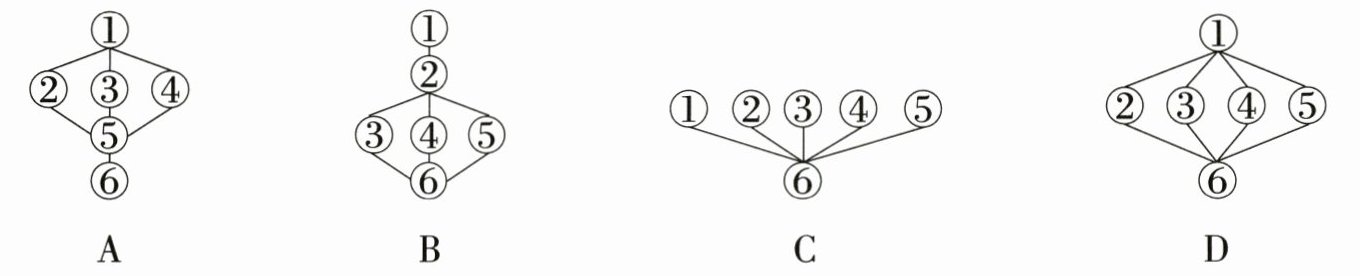
34. What is the structure of the text? (①=Paragraph 1, ②=Paragraph 2, ...)
35. What is the best title for the text?
A. The Power of a Curious Mind
B. A Study on How Curiosity Works
C. Ways to Come Up with New Ideas
D. The Influence of Curiosity on Future Jobs
Curiosity helps the brain to take in new information. For students, curiosity is like a mind superpower. At the same time, it is also a process of actively looking for answers. When you’re truly curious about a topic, it becomes easier and more effective for your brain to take in and keep new information.
Curiosity also leads to more exciting ideas. Curiosity encourages students to go beyond “what is taught” and ask “what if”. Instead of simply accepting information, a curious student studies it and looks at it from different sides. This habit of thinking leads to more interesting ideas because it connects knowledge from different subjects.
Curiosity encourages active learning and helps you discover your career(职业) interests. When Qian Xuesen was young, he was curious about why paper planes could fly and how to make them fly farther. Driven by this curiosity, he worked hard and became a great scientist. The curiosity about one thing will keep you learning, and maybe that interest will shape your future career.
So how can you develop your curiosity? One effective method is to ask open-ended questions. For example, instead of asking “Did you enjoy the training?”, one might ask, “Which aspects of the training did you find most interesting?” Looking for new ideas is another important strategy(策略) for developing curiosity. Besides, jumping out of one’s comfort zone(舒适区) is also important.
As Richard Feynman said, “Nearly everything is really interesting if you go into it deeply enough.” Therefore, keep a curious mind. You never know where it may lead you!
根据材料内容选择最佳答案。
31. How does curiosity act on the brain according to the text?
A. It makes the brain more relaxed and active.
B. It allows the brain to focus on what you are learning.
C. It pushes the brain to remember knowledge more clearly.
D. It helps the brain take in and keep new information more easily.
32. What are curious students like?
A. It is easy for them to choose their own careers.
B. They often consider a thing from different sides.
C. They are used to accepting information directly.
D. They usually learn a thing more quickly than others.
33. What do the underlined words “open-ended questions” in Paragraph 5 mean?
A. Questions that have no clear answers.
B. Questions that will get short answers.
C. Questions that require you to think twice to answer.
D. Questions that need more than a “Yes” or “No” reply.
34. What is the structure of the text? (①=Paragraph 1, ②=Paragraph 2, ...)
35. What is the best title for the text?
A. The Power of a Curious Mind
B. A Study on How Curiosity Works
C. Ways to Come Up with New Ideas
D. The Influence of Curiosity on Future Jobs
答案
31. D
32. B
33. D
34. A
35. A
32. B
33. D
34. A
35. A
解析
【分析】本题为英语阅读理解选择题,需结合原文内容逐一解答:31题定位原文第二段,查找好奇心对大脑的作用;32题定位第三段,明确好奇学生的特点;33题通过第五段的例子猜测短语含义;34题梳理文章各段落内容,判断结构;35题归纳全文主旨,选择最佳标题。
【解析】31题:根据第二段“When you’re truly curious about a topic, it becomes easier and more effective for your brain to take in and keep new information.”可知,好奇心帮助大脑更轻松地吸收和保留新信息,对应选项D;32题:根据第三段“Instead of simply accepting information, a curious student studies it and looks at it from different sides.”可知,好奇的学生从不同角度看待事物,对应选项B;33题:第五段举例中,“Did you enjoy the training?”是可回答Yes/No的问题,而“Which aspects of the training did you find most interesting?”是需详细回答的问题,由此推断“open-ended questions”指不能用简单的Yes或No回答的问题,对应选项D;34题:文章结构为:①引入好奇心的定义→②-④阐述好奇心的作用→⑤说明培养好奇心的方法→⑥总结呼吁,对应选项A的结构;35题:全文围绕好奇心的力量展开,包括其作用、好处及培养方法,最佳标题为“The Power of a Curious Mind”,对应选项A。
【答案】31.D 32.B 33.D 34.A 35.A
【知识点】英语阅读理解、细节理解、词义猜测、主旨大意
【点评】本题考查学生英语阅读理解的综合应用能力,涵盖细节查找、词义推断、文章结构分析和主旨归纳,需准确提取原文信息并结合语境分析,难度适中。
【难度系数】0.5
