

 登录
登录
1. 从Ⅱ栏中选择与Ⅰ栏相匹配的中文意思。(有多余选项)
Ⅰ
()(1) I’m coming!
()(2) Bobby, hurry up!
()(3) It’s time for breakfast.
()(4) What time is it now?
()(5) Wash your face first.
Ⅱ
A. 是吃早饭的时候了。
B. 现在几点了?
C. 我来了!
D. 是吃午饭的时候了。
E. 博比,快点!
F. 先洗你的脸。
Ⅰ
()(1) I’m coming!
()(2) Bobby, hurry up!
()(3) It’s time for breakfast.
()(4) What time is it now?
()(5) Wash your face first.
Ⅱ
A. 是吃早饭的时候了。
B. 现在几点了?
C. 我来了!
D. 是吃午饭的时候了。
E. 博比,快点!
F. 先洗你的脸。
答案
(1)C (2)E (3)A (4)B (5)F
解析
我们可以逐个匹配英文句子和对应的中文含义:
1. 句子"I’m coming!"的中文意思是“我来了!”,对应选项C。
2. 句子"Bobby, hurry up!"的中文意思是“博比,快点!”,对应选项E。
3. 句子"It’s time for breakfast."的中文意思是“是吃早饭的时候了。”,对应选项A。
4. 句子"What time is it now?"的中文意思是“现在几点了?”,对应选项B。
5. 句子"Wash your face first."的中文意思是“先洗你的脸。”,对应选项F。
剩余的选项D为多余选项,没有对应的匹配句子。
1. 句子"I’m coming!"的中文意思是“我来了!”,对应选项C。
2. 句子"Bobby, hurry up!"的中文意思是“博比,快点!”,对应选项E。
3. 句子"It’s time for breakfast."的中文意思是“是吃早饭的时候了。”,对应选项A。
4. 句子"What time is it now?"的中文意思是“现在几点了?”,对应选项B。
5. 句子"Wash your face first."的中文意思是“先洗你的脸。”,对应选项F。
剩余的选项D为多余选项,没有对应的匹配句子。
2. 给下列图片选择合适的句子或对话。
(1)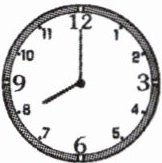 ()
()
(2)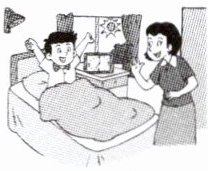 ()
()
(3)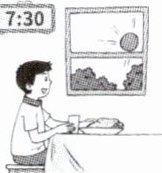 ()
()
(4)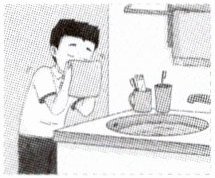 ()
()
A. It’s seven thirty. It’s time for breakfast.
B. I wash my face in the morning.
C. —Get up! It’s seven o’clock.
—OK, Mum.
D. —What time is it now?
—It’s eight!
(1)
()(2)
()(3)
()(4)
()A. It’s seven thirty. It’s time for breakfast.
B. I wash my face in the morning.
C. —Get up! It’s seven o’clock.
—OK, Mum.
D. —What time is it now?
—It’s eight!
答案
(1) D (2) C (3) A (4) B
解析
我们逐图匹配对应内容:
1. 第(1)张图的时钟显示时间为8点,和选项D的对话“—What time is it now? —It’s eight!”描述匹配。
2. 第(2)张图是妈妈在叫床上的男孩起床的场景,和选项C的对话“—Get up! It’s seven o’clock. —OK, Mum.”描述匹配。
3. 第(3)张图显示时间为7:30,男孩坐在餐桌前准备用餐,和选项A的句子“It’s seven thirty. It’s time for breakfast.”描述匹配。
4. 第(4)张图是男孩在洗手池边洗脸的场景,和选项B的句子“I wash my face in the morning.”描述匹配。
1. 第(1)张图的时钟显示时间为8点,和选项D的对话“—What time is it now? —It’s eight!”描述匹配。
2. 第(2)张图是妈妈在叫床上的男孩起床的场景,和选项C的对话“—Get up! It’s seven o’clock. —OK, Mum.”描述匹配。
3. 第(3)张图显示时间为7:30,男孩坐在餐桌前准备用餐,和选项A的句子“It’s seven thirty. It’s time for breakfast.”描述匹配。
4. 第(4)张图是男孩在洗手池边洗脸的场景,和选项B的句子“I wash my face in the morning.”描述匹配。
2. 连词成句,完成对话。
Mum: Get up, Sarah!
Sarah: (1) ? (is, What, it, time, now)
Mum: It’s seven thirty! (2) .
(time, It’s, breakfast, for)
Sarah: It’s early, Mum.
...
Mum: Hurry up! It’s eight o’clock. (3) .
(first, face, your, Wash)
Sarah: OK. (4) ! (coming, I’m)
Mum: Get up, Sarah!
Sarah: (1) ? (is, What, it, time, now)
Mum: It’s seven thirty! (2) .
(time, It’s, breakfast, for)
Sarah: It’s early, Mum.
...
Mum: Hurry up! It’s eight o’clock. (3) .
(first, face, your, Wash)
Sarah: OK. (4) ! (coming, I’m)
答案
(1) What time is it now
(2) It's time for breakfast
(3) Wash your face first
(4) I'm coming
(2) It's time for breakfast
(3) Wash your face first
(4) I'm coming
解析
这是连词成句的情景对话题,我们可以结合四年级学过的固定句型规则来完成:
1. 第(1)题是询问当前时间的固定特殊疑问句,疑问词组What time放在句首,后接be动词is,再接指代时间的it,最后加时间状语now。
2. 第(2)题是固定句型"It's time for + 名词",表示“到做某事的时间了”,这里名词是breakfast(早餐)。
3. 第(3)题是祈使句,要把动词原形Wash放在句首,后接搭配your face(你的脸),副词first(首先)放在句末。
4. 第(4)题是日常情景的常用表达,把I'm和coming组合,意思是“我来了”。
1. 第(1)题是询问当前时间的固定特殊疑问句,疑问词组What time放在句首,后接be动词is,再接指代时间的it,最后加时间状语now。
2. 第(2)题是固定句型"It's time for + 名词",表示“到做某事的时间了”,这里名词是breakfast(早餐)。
3. 第(3)题是祈使句,要把动词原形Wash放在句首,后接搭配your face(你的脸),副词first(首先)放在句末。
4. 第(4)题是日常情景的常用表达,把I'm和coming组合,意思是“我来了”。
