

 登录
登录
一、同学们参观长城后,有什么收获和感受呢? 根据句意,选择合适的单词填空。
1. The Great Wall is about 21,000
2. —How was your trip to the Great Wall, Allen?
—It
3. —What
—She walked on the wall and saw the beautiful mountains.
1. The Great Wall is about 21,000
kilometres
(kilometre/kilometres) long.2. —How was your trip to the Great Wall, Allen?
—It
was
(was/is) not bad. I took many photos there.3. —What
did
(does/did) Cathy do at the Great Wall?—She walked on the wall and saw the beautiful mountains.
答案
一、1. kilometres
2. was
3. did
解析
1. 分析:空前的数字21000大于1,此空应用可数名词复数形式,故填kilometres。
2. 分析:结合问句中的was和答句中的took可知,此对话时态为一般过去时,故填was。
3. 分析:结合答句中的walked和saw可知,此对话时态为一般过去时,故填did。
2. was
3. did
解析
1. 分析:空前的数字21000大于1,此空应用可数名词复数形式,故填kilometres。
2. 分析:结合问句中的was和答句中的took可知,此对话时态为一般过去时,故填was。
3. 分析:结合答句中的walked和saw可知,此对话时态为一般过去时,故填did。
二、外国朋友给你发来了消息。请正确回应她,将相关的内容连线。
 What did you do last weekend?
The Great Wall is amazing.
How was your weekend?
What do you often do at the weekend?
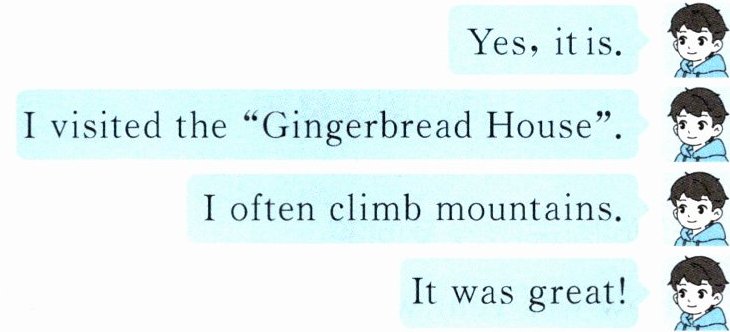 Yes, it is.
I visited the “Gingerbread House”.
I often climb mountains.
It was great!
What did you do last weekend?The Great Wall is amazing.
How was your weekend?
What do you often do at the weekend?
Yes, it is.I visited the “Gingerbread House”.
I often climb mountains.
It was great!
答案
二、

解析
左列从上往下:
句意:你上周末做什么了?
分析:句子询问上周末做的活动,答句应回答具体活动,且时态应为一般过去时,故将其与右列第二行连线。
句意:长城真是令人惊叹。
分析:句子是对长城的赞叹,答句应表示赞同,故将其与右列第一行连线。
句意:你周末过得怎么样?
分析:句子询问周末感受,答句应回答具体感受,故将其与右列第四行连线。
句意:你周末经常做什么?
分析:句子询问周末经常做的活动,答句应回答具体活动,且时态应为一般现在时,故将其与右列第三行连线。
三、打开时间胶囊,描述精彩瞬间。看图,判断句子正(T)误(F)。
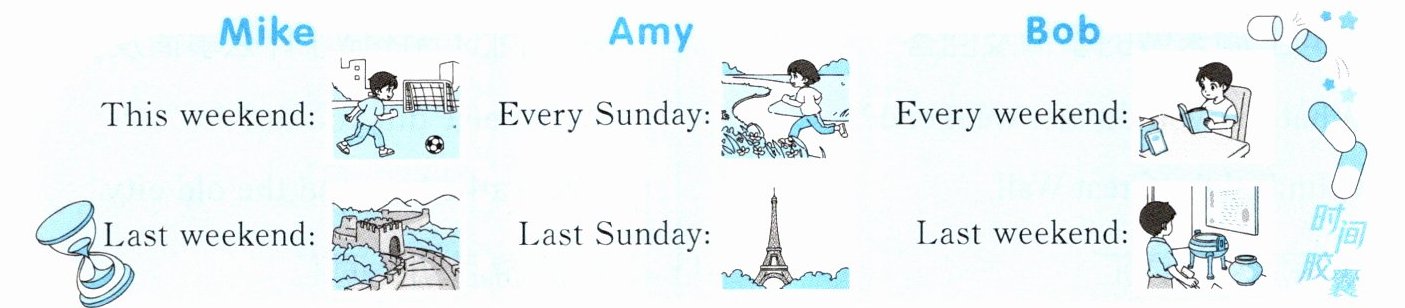
(
(
(
(
(
F
)1. Mike climbed the Great Wall and played football last weekend.(
T
)2. On Sundays, Amy always goes running in the park.(
F
)3. Amy visited a museum in Paris last weekend.(
F
)4. Bob sometimes reads books on weekends.答案
三、1. F 2. T 3. F 4. F
解析
1. 句意:Mike上周末爬了长城、踢了足球。
分析:Mike这周末踢了足球,而非上周末,故答案为F。
2. 句意:Amy总是周日在公园跑步。
分析:Amy每周日的活动都是跑步,故答案为T。
3. 句意:Amy上周末在巴黎参观了一座博物馆。
分析:Amy上周日在巴黎参观了埃菲尔铁塔,不是博物馆,故答案为F。
4. 句意:Bob周末有时读书。
分析:Bob每周末都在读书,而非“有时”读书,故答案为F。
解析
1. 句意:Mike上周末爬了长城、踢了足球。
分析:Mike这周末踢了足球,而非上周末,故答案为F。
2. 句意:Amy总是周日在公园跑步。
分析:Amy每周日的活动都是跑步,故答案为T。
3. 句意:Amy上周末在巴黎参观了一座博物馆。
分析:Amy上周日在巴黎参观了埃菲尔铁塔,不是博物馆,故答案为F。
4. 句意:Bob周末有时读书。
分析:Bob每周末都在读书,而非“有时”读书,故答案为F。
四、同学们秋假期间去了哪些地方呢?选择合适的句子补全对话,了解他们的见闻。
Bob: The autumn break was over.
Sally: Yes. 1.
Bob: It was wonderful. I went to Beijing. 2.
Sally: That must be fun. I went to South Korea.
Bob: 3.
Sally: I visited the “Candy House”.
Bob: Can you eat candies there?
Sally: No. It's a house with candy-shaped decorations(装饰品).
Bob: That sounds great. 4.
A. I climbed the Great Wall.
B. What did you do there?
C. I want to go there too.
D. How was your holiday?
Bob: The autumn break was over.
Sally: Yes. 1.
D
Bob: It was wonderful. I went to Beijing. 2.
A
Sally: That must be fun. I went to South Korea.
Bob: 3.
B
Sally: I visited the “Candy House”.
Bob: Can you eat candies there?
Sally: No. It's a house with candy-shaped decorations(装饰品).
Bob: That sounds great. 4.
C
A. I climbed the Great Wall.
B. What did you do there?
C. I want to go there too.
D. How was your holiday?
答案
四、1. D 2. A 3. B 4. C
解析
对话:Bob和Sally谈论各自的秋假经历。
选项:A. 我去爬长城了。
B. 你在那里做什么了?
C. 我也想去那里。
D. 你假期过得怎么样?
分析:1. 下文Bob对某物或某事作出了评价,推测此处Sally询问Bob假期过得怎么样,故选D。
2. 上文Bob说自己去了北京,此处应该补充他在北京做的活动,故选A。
3. 上文Sally谈到自己去了韩国,下文回复了自己在韩国做的活动,推测此处Bob问Sally在韩国做了什么,故选B。
4. 上文Bob赞赏糖果屋很棒,推测此处他应该进一步表达兴趣,故选C。
解析
对话:Bob和Sally谈论各自的秋假经历。
选项:A. 我去爬长城了。
B. 你在那里做什么了?
C. 我也想去那里。
D. 你假期过得怎么样?
分析:1. 下文Bob对某物或某事作出了评价,推测此处Sally询问Bob假期过得怎么样,故选D。
2. 上文Bob说自己去了北京,此处应该补充他在北京做的活动,故选A。
3. 上文Sally谈到自己去了韩国,下文回复了自己在韩国做的活动,推测此处Bob问Sally在韩国做了什么,故选B。
4. 上文Bob赞赏糖果屋很棒,推测此处他应该进一步表达兴趣,故选C。
