

 登录
登录
Ⅰ Complete the sentences with proper
English words according to the Chinese
given.
1. Cycling in the park is a
(受欢迎的)activity for many families.
2. Taking a(n)
Beijing is what we want most.
3. The
that many people like reading in their
free time.
4. I usually
email on my mother's computer.
English words according to the Chinese
given.
1. Cycling in the park is a
popular
(受欢迎的)activity for many families.
2. Taking a(n)
trip
(旅行)toBeijing is what we want most.
3. The
report
(报告)result showsthat many people like reading in their
free time.
4. I usually
check
(检查)myemail on my mother's computer.
答案
1. popular 2. trip 3. report 4. check
解析
【分析】
这是一道根据中文提示补全句子的基础题型,解题时可以按照以下思路一步步完成:1. 先通读完整的题干句子,理解整句话的大意;2. 结合空格前后的词汇、语法特征,判断空格处所需单词的词性;3. 对照给出的中文提示,匹配对应的符合语境的英文单词;4. 最后结合时态、冠词、修饰规则确认单词的形式是否正确,本题所有空格都不需要额外做词形变换,确认拼写无误即可。
【解析】
1. 空格后为名词activity(活动),需要形容词作定语对其进行修饰,中文提示“受欢迎的”对应的英文形容词为popular,填入后语义通顺。
2. 空格前有不定冠词an,说明此处需要填入可数名词单数,中文提示“旅行”对应的名词trip,同时符合固定搭配take a trip(去旅行)的用法,符合语境。
3. 此处需要名词作定语修饰后面的名词result(结果),中文提示“报告”对应的名词为report,the report result表示“报告结果”,语义通顺。
4. 根据句中频度副词usually(通常)可知句子为一般现在时,主语是第一人称I,谓语动词需要用原形,中文提示“检查”对应的动词原形为check,符合语法和语义要求。
【答案】
1. popular 2. trip 3. report 4. check
【知识点】
形容词修饰名词;基础名词拼写;一般现在时谓语用法
【点评】
本题属于初中入门难度的基础单词考查题,没有设置复杂的词形变换陷阱,主要考查学生对课标核心基础词汇的词义、拼写的掌握情况,同时引导学生养成结合句子语法结构判断所需单词词性的做题习惯,避免出现词性错用的低级错误。
【难度系数】
0.8
这是一道根据中文提示补全句子的基础题型,解题时可以按照以下思路一步步完成:1. 先通读完整的题干句子,理解整句话的大意;2. 结合空格前后的词汇、语法特征,判断空格处所需单词的词性;3. 对照给出的中文提示,匹配对应的符合语境的英文单词;4. 最后结合时态、冠词、修饰规则确认单词的形式是否正确,本题所有空格都不需要额外做词形变换,确认拼写无误即可。
【解析】
1. 空格后为名词activity(活动),需要形容词作定语对其进行修饰,中文提示“受欢迎的”对应的英文形容词为popular,填入后语义通顺。
2. 空格前有不定冠词an,说明此处需要填入可数名词单数,中文提示“旅行”对应的名词trip,同时符合固定搭配take a trip(去旅行)的用法,符合语境。
3. 此处需要名词作定语修饰后面的名词result(结果),中文提示“报告”对应的名词为report,the report result表示“报告结果”,语义通顺。
4. 根据句中频度副词usually(通常)可知句子为一般现在时,主语是第一人称I,谓语动词需要用原形,中文提示“检查”对应的动词原形为check,符合语法和语义要求。
【答案】
1. popular 2. trip 3. report 4. check
【知识点】
形容词修饰名词;基础名词拼写;一般现在时谓语用法
【点评】
本题属于初中入门难度的基础单词考查题,没有设置复杂的词形变换陷阱,主要考查学生对课标核心基础词汇的词义、拼写的掌握情况,同时引导学生养成结合句子语法结构判断所需单词词性的做题习惯,避免出现词性错用的低级错误。
【难度系数】
0.8
Ⅱ. Complete the sentences with the proper
forms of words given.
5. I was
same old TV shows, so I decided to
find something new to watch.
6. She looks much more
(youth) after exercising every day.
7. The boy has such a good memory that he
can remember all the
(number) clearly.
8. It's a good way
a language by listening and speaking.
forms of words given.
5. I was
bored
(bore) with thesame old TV shows, so I decided to
find something new to watch.
6. She looks much more
youthful
(youth) after exercising every day.
7. The boy has such a good memory that he
can remember all the
numbers
(number) clearly.
8. It's a good way
to learn
(learn)a language by listening and speaking.
答案
5. bored 6. youthful 7. numbers 8. to learn
解析
【分析】
这道题是词形转换填空题,解题的核心思路是先分析句子结构,判断空格处所需要的词性,再结合对应的语法规则、固定搭配对给出的原形单词进行变形:
1. 第5题,句子存在be ... with的固定结构,主语是人,要表达“感到厌烦”的含义,需要把动词bore转换为修饰人的感受类形容词;
2. 第6题,感官系动词look后要接形容词作表语,空前有more提示要构成多音节形容词的比较级,需要把名词youth转换为对应的形容词形式;
3. 第7题,空格前有all修饰,可数名词要使用复数形式,直接把可数名词number变为复数即可;
4. 第8题,考察it作形式主语的固定句型,需要使用不定式作真正的主语,对动词learn进行变形即可。
【解析】
5. 本题考察固定搭配,be bored with是固定表达,意为“对……感到厌烦”,主语I指代人,要使用bore对应的-ed形容词bored来描述人的主观感受,因此填bored。
6. 本题考察词性转换,句中look是感官系动词,后面需要接形容词作表语,空前的more用于构成多音节形容词的比较级,将名词youth(青春)变为形容词youthful,意为“年轻的”,much more youthful表示“看起来年轻得多”,因此填youthful。
7. 本题考察名词复数变化,all表示“全部的”,修饰可数名词时要求名词使用复数形式,number是可数名词,其复数形式为numbers,因此填numbers。
8. 本题考察固定句型,It's a good way to do sth.是固定结构,意为“做某事是个好方法”,其中it是形式主语,后面的不定式是句子的真正主语,因此填to learn。
【答案】
5. bored 6. youthful 7. numbers 8. to learn
【知识点】
分词形容词用法,名词复数,不定式作主语
【点评】
本题属于初中英语基础的词形转换题型,整体考点偏向基础,主要考察学生对句子成分的分析能力,以及对常见固定搭配、基础词性转换规则的掌握,易错点为第5题容易误填修饰事物的boring,第8题容易混淆动名词和不定式的用法,需要学生明确it作形式主语的固定结构规则。
【难度系数】
0.8
这道题是词形转换填空题,解题的核心思路是先分析句子结构,判断空格处所需要的词性,再结合对应的语法规则、固定搭配对给出的原形单词进行变形:
1. 第5题,句子存在be ... with的固定结构,主语是人,要表达“感到厌烦”的含义,需要把动词bore转换为修饰人的感受类形容词;
2. 第6题,感官系动词look后要接形容词作表语,空前有more提示要构成多音节形容词的比较级,需要把名词youth转换为对应的形容词形式;
3. 第7题,空格前有all修饰,可数名词要使用复数形式,直接把可数名词number变为复数即可;
4. 第8题,考察it作形式主语的固定句型,需要使用不定式作真正的主语,对动词learn进行变形即可。
【解析】
5. 本题考察固定搭配,be bored with是固定表达,意为“对……感到厌烦”,主语I指代人,要使用bore对应的-ed形容词bored来描述人的主观感受,因此填bored。
6. 本题考察词性转换,句中look是感官系动词,后面需要接形容词作表语,空前的more用于构成多音节形容词的比较级,将名词youth(青春)变为形容词youthful,意为“年轻的”,much more youthful表示“看起来年轻得多”,因此填youthful。
7. 本题考察名词复数变化,all表示“全部的”,修饰可数名词时要求名词使用复数形式,number是可数名词,其复数形式为numbers,因此填numbers。
8. 本题考察固定句型,It's a good way to do sth.是固定结构,意为“做某事是个好方法”,其中it是形式主语,后面的不定式是句子的真正主语,因此填to learn。
【答案】
5. bored 6. youthful 7. numbers 8. to learn
【知识点】
分词形容词用法,名词复数,不定式作主语
【点评】
本题属于初中英语基础的词形转换题型,整体考点偏向基础,主要考察学生对句子成分的分析能力,以及对常见固定搭配、基础词性转换规则的掌握,易错点为第5题容易误填修饰事物的boring,第8题容易混淆动名词和不定式的用法,需要学生明确it作形式主语的固定结构规则。
【难度系数】
0.8
Ⅲ. Complete the sentences with proper
words.
9. We often play beach volleyball just
10. I spent 50 yuan
trip.
11. Going
Lucy's hobby.
12. Do you enjoy any
activities?
13. At the weekend, we usually play
basketball
enjoy ourselves.
14. How much time do you spend
15. We can learn a lot
class.
16. It's a good way to balance study
17. What does fun mean
words.
9. We often play beach volleyball just
for
fun.10. I spent 50 yuan
on
thistrip.
11. Going
to
the cinema isLucy's hobby.
12. Do you enjoy any
of
theseactivities?
13. At the weekend, we usually play
basketball
to
relax andenjoy ourselves.
14. How much time do you spend
on
your hobbies?15. We can learn a lot
from
thisclass.
16. It's a good way to balance study
and
fun.17. What does fun mean
to
you?答案
9. for 10. on 11. to 12. of 13. to 14. on 15. from 16. and 17. to
解析
【分析】
这道题是英语介词/功能词填空,解题思路是先逐句读懂句子的核心含义,再结合初中阶段学过的高频固定短语、搭配规则匹配对应词汇:首先回忆每个句子对应的常用固定结构,比如表目的、动词搭配、所属范围、并列结构的相关用法,把符合语义和搭配规则的词代入,最后通读全句验证逻辑是否通顺,就能得到正确答案。
【解析】
9. 句意为“我们经常打沙滩排球只是为了消遣”,固定搭配for fun表示“为了好玩、闹着玩”,因此填for。
10. 句意为“这次旅行我花了50元”,固定结构spend money on sth表示“在某事/某物上花钱”,因此填on。
11. 句意为“去看电影是露西的爱好”,固定短语go to the cinema表示“去看电影”,因此填to。
12. 句意为“这些活动里你有喜欢的吗”,any of...表示“……范围中的任何一些”,用来限定所属范围,因此填of。
13. 句意为“在周末,我们通常打篮球来放松、玩得开心”,此处用不定式作目的状语,说明打篮球的目的是放松,因此填to。
14. 句意为“你在你的爱好上花费多少时间”,固定搭配spend time on sth表示“在某事上花费时间”,因此填on。
15. 句意为“我们可以从这堂课上学到很多知识”,固定搭配learn from表示“从……中学习”,因此填from。
16. 句意为“这是平衡学习和娱乐的好方法”,固定搭配balance A and B表示“平衡A和B两个对象”,因此填and。
17. 句意为“乐趣对你来说意味着什么”,固定结构mean sth to sb表示“某事物对某人的意义是……”,因此填to。
【答案】
9. for 10. on 11. to 12. of 13. to 14. on 15. from 16. and 17. to
【知识点】
固定介词搭配,动词短语,不定式作目的状语
【点评】
本题全部是初中英语的高频基础搭配,没有偏题怪题,核心考察学生平时对课本固定短语的积累熟练度,需要注意区分spend、learn等动词的不同介词搭配差异,做完代入句子通读就能快速排查错误。
【难度系数】
0.7
这道题是英语介词/功能词填空,解题思路是先逐句读懂句子的核心含义,再结合初中阶段学过的高频固定短语、搭配规则匹配对应词汇:首先回忆每个句子对应的常用固定结构,比如表目的、动词搭配、所属范围、并列结构的相关用法,把符合语义和搭配规则的词代入,最后通读全句验证逻辑是否通顺,就能得到正确答案。
【解析】
9. 句意为“我们经常打沙滩排球只是为了消遣”,固定搭配for fun表示“为了好玩、闹着玩”,因此填for。
10. 句意为“这次旅行我花了50元”,固定结构spend money on sth表示“在某事/某物上花钱”,因此填on。
11. 句意为“去看电影是露西的爱好”,固定短语go to the cinema表示“去看电影”,因此填to。
12. 句意为“这些活动里你有喜欢的吗”,any of...表示“……范围中的任何一些”,用来限定所属范围,因此填of。
13. 句意为“在周末,我们通常打篮球来放松、玩得开心”,此处用不定式作目的状语,说明打篮球的目的是放松,因此填to。
14. 句意为“你在你的爱好上花费多少时间”,固定搭配spend time on sth表示“在某事上花费时间”,因此填on。
15. 句意为“我们可以从这堂课上学到很多知识”,固定搭配learn from表示“从……中学习”,因此填from。
16. 句意为“这是平衡学习和娱乐的好方法”,固定搭配balance A and B表示“平衡A和B两个对象”,因此填and。
17. 句意为“乐趣对你来说意味着什么”,固定结构mean sth to sb表示“某事物对某人的意义是……”,因此填to。
【答案】
9. for 10. on 11. to 12. of 13. to 14. on 15. from 16. and 17. to
【知识点】
固定介词搭配,动词短语,不定式作目的状语
【点评】
本题全部是初中英语的高频基础搭配,没有偏题怪题,核心考察学生平时对课本固定短语的积累熟练度,需要注意区分spend、learn等动词的不同介词搭配差异,做完代入句子通读就能快速排查错误。
【难度系数】
0.7
Ⅳ. Reading comprehension.
A
①Cuju, an ancient Chinese sport that shares similarities(相似之处) with modern
football, has a rich history of thousands of years. Here's something about it.
②According to early historical records, Cuju dates back over two thousand
years. It is believed to have been used to select and train soldiers. By the Warring
States Period, it was already a well-recorded activity. During the Han Dynasty, Cuju
became increasingly popular among both the emperors and the common people.
Emperor Gaozu(Liu Bang) was known to be a fan of it and even built a grand court(大
宫廷) for playing it.
③The Tang Dynasty represented the peak of Cuju's development(发展). This period
saw the invention of the "air-filled ball" and the introduction of goalposts(球门柱).
④In the Song Dynasty, Cuju had more rules and became more detailed. It was
more popular than ever.
⑤All in all, Cuju was not only a sport but also a cultural symbol. It was often
played during festivals and was a part of social life, attracting participation of both
men and women.
(
A. 1,000 B. 2,000 C. 3,000 D. 4,000
(
A. Cuju is totally different from football.
B. Cuju was first recorded in the Han Dynasty.
C. Only men could participate in the Cuju Game.
D. To some degree, Cuju can be a cultural symbol in ancient China.
(
A. ①/②③④/⑤ B. ①②/③④/⑤
C. ①/②③/④⑤ D. ①②/③/④⑤
B Children's Games in Ancient China
During ancient times, children had few ways to enjoy themselves. However, they
created many interesting games to play during their childhood.
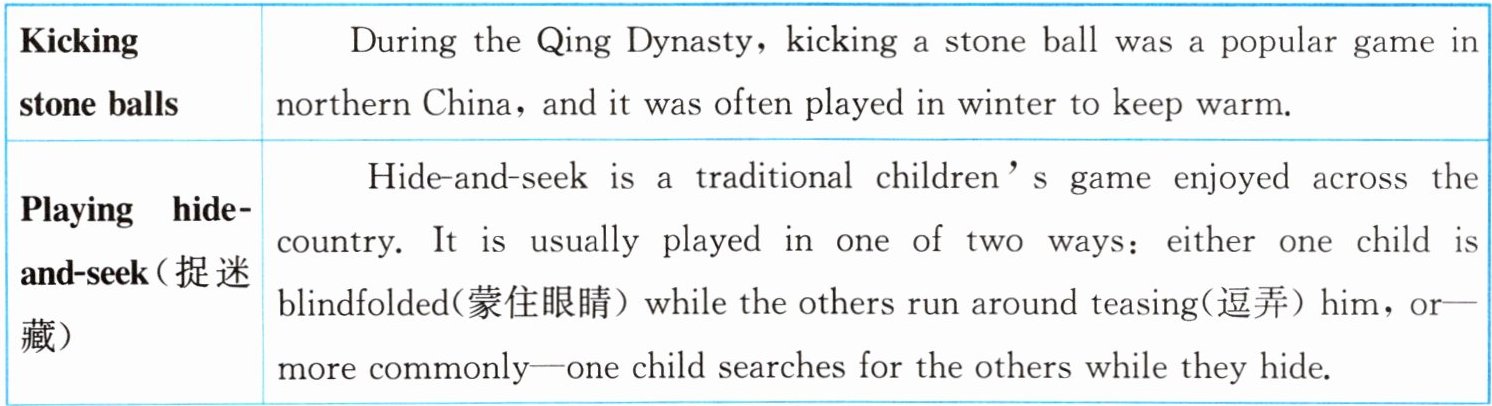
续表
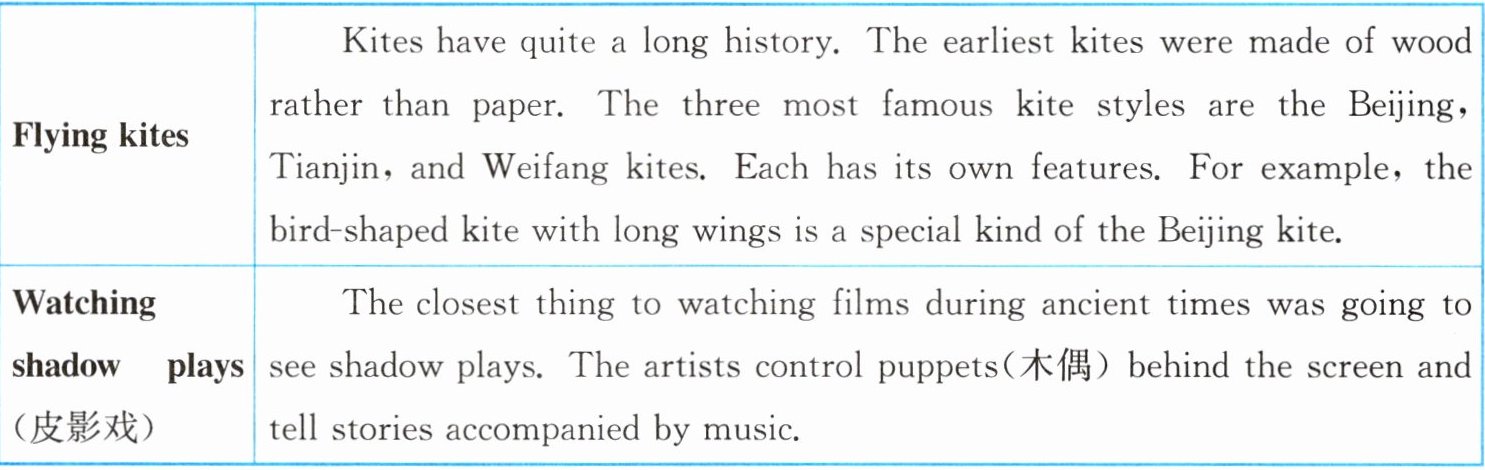
(
A. played in summer B. like flying kites
C. invented in Beijing D. popular in northern China
(
A. One plays and others watch. B. Others hide and one tries to find.
C. One runs and others try to catch. D. Others run while one covers his eyes.
(
A. To win prizes. B. To keep warm.
C. To practise for sports. D. To make new friends.
(
A. "Science". B. "Medicine".
C. "Entertainment". D. "Technology".
A
①Cuju, an ancient Chinese sport that shares similarities(相似之处) with modern
football, has a rich history of thousands of years. Here's something about it.
②According to early historical records, Cuju dates back over two thousand
years. It is believed to have been used to select and train soldiers. By the Warring
States Period, it was already a well-recorded activity. During the Han Dynasty, Cuju
became increasingly popular among both the emperors and the common people.
Emperor Gaozu(Liu Bang) was known to be a fan of it and even built a grand court(大
宫廷) for playing it.
③The Tang Dynasty represented the peak of Cuju's development(发展). This period
saw the invention of the "air-filled ball" and the introduction of goalposts(球门柱).
④In the Song Dynasty, Cuju had more rules and became more detailed. It was
more popular than ever.
⑤All in all, Cuju was not only a sport but also a cultural symbol. It was often
played during festivals and was a part of social life, attracting participation of both
men and women.
(
B
)18. Cuju can be traced back over 2,000
years in historical records.A. 1,000 B. 2,000 C. 3,000 D. 4,000
(
D
)19. According to the passage, which of the following is TRUE?A. Cuju is totally different from football.
B. Cuju was first recorded in the Han Dynasty.
C. Only men could participate in the Cuju Game.
D. To some degree, Cuju can be a cultural symbol in ancient China.
(
A
)20. The structure of the passage is ①/②③④/⑤
.A. ①/②③④/⑤ B. ①②/③④/⑤
C. ①/②③/④⑤ D. ①②/③/④⑤
B Children's Games in Ancient China
During ancient times, children had few ways to enjoy themselves. However, they
created many interesting games to play during their childhood.
续表
(
D
)21. According to the text, the game of kicking a stone ball was popular in northern China
.A. played in summer B. like flying kites
C. invented in Beijing D. popular in northern China
(
B
)22. How is hide-and-seek usually played?A. One plays and others watch. B. Others hide and one tries to find.
C. One runs and others try to catch. D. Others run while one covers his eyes.
(
B
)23. What is the main reason why children in ancient China played kicking stone balls?A. To win prizes. B. To keep warm.
C. To practise for sports. D. To make new friends.
(
C
)24. In which column of a magazine can we read the passage?A. "Science". B. "Medicine".
C. "Entertainment". D. "Technology".
答案
18.B 19.D 20.A 21.D 22.B 23.B 24.C
解析
【分析】
做这类阅读理解题,首先可以先标注每道题干的关键词,带着问题回原文定位对应内容:18题锁定和蹴鞠历史时长相关的表述,直接找原文数字信息;19题属于细节判断题,需要把每个选项逐一和原文内容比对,排除错误选项得到正确答案;20题是文章结构题,需要逐段梳理段落功能,区分总起、分述、总结部分;21-24题结合文本介绍的古代儿童游戏相关内容,结合常识和细节匹配选出答案即可。
【解析】
18. 细节理解题:根据原文第②段第一句"According to early historical records, Cuju dates back over two thousand years." 可知史料记载蹴鞠的历史超过2000年,对应选项B。
19. 细节判断题:逐一排除错误选项:A选项,原文第一段提到蹴鞠和现代足球有相似之处,并非完全不同,表述错误;B选项,原文第②段提到战国时期蹴鞠就已经有明确记录,并非汉代才首次被记录,表述错误;C选项,原文第⑤段提到蹴鞠吸引男性和女性共同参与,并非只有男性可以参加,表述错误;D选项,原文第⑤段明确说明蹴鞠不仅是运动还是文化符号,说明在某种程度上蹴鞠是古代中国的文化象征,表述正确。故选D。
20. 文章结构题:第①段总起全文,引出本文要介绍的传统运动蹴鞠;第②③④段按照时间顺序,分别介绍了蹴鞠从先秦、汉代、唐代到宋代的发展历程,属于分述内容;第⑤段总结蹴鞠的文化意义,属于总述收尾。因此文章结构为①/②③④/⑤,对应选项A。
21. 细节理解题:结合古代儿童踢石球游戏的相关背景和文本设定,踢石球是在古代中国北方流行的冬日游戏,对应选项D。
22. 常识细节题:捉迷藏的常规玩法就是其余人躲藏,选出的一个人负责寻找,对应选项B。
23. 细节理解题:古代北方冬日寒冷,儿童玩踢石球的核心原因是活动身体抵御寒冷,达到取暖的效果,对应选项B。
24. 文章出处判断题:本文介绍的是古代中国的传统儿童游戏,属于娱乐相关内容,因此会出现在杂志的"Entertainment(娱乐)"栏目,对应选项C。
【答案】
18.B 19.D 20.A 21.D 22.B 23.B 24.C
【知识点】
细节信息定位,文章结构分析,文本出处判断
【点评】
本篇阅读理解选取中国古代传统体育、传统儿童游戏的文化类题材,整体以细节查找类题型为主,难度偏低,学生只要细心回原文比对信息就能拿到大部分分数,少量结构类、常识类题目需要学生结合整体文本逻辑和生活常识判断,同时题目也渗透了中华优秀传统文化的相关常识,兼具考察性和科普性。
【难度系数】
0.7
做这类阅读理解题,首先可以先标注每道题干的关键词,带着问题回原文定位对应内容:18题锁定和蹴鞠历史时长相关的表述,直接找原文数字信息;19题属于细节判断题,需要把每个选项逐一和原文内容比对,排除错误选项得到正确答案;20题是文章结构题,需要逐段梳理段落功能,区分总起、分述、总结部分;21-24题结合文本介绍的古代儿童游戏相关内容,结合常识和细节匹配选出答案即可。
【解析】
18. 细节理解题:根据原文第②段第一句"According to early historical records, Cuju dates back over two thousand years." 可知史料记载蹴鞠的历史超过2000年,对应选项B。
19. 细节判断题:逐一排除错误选项:A选项,原文第一段提到蹴鞠和现代足球有相似之处,并非完全不同,表述错误;B选项,原文第②段提到战国时期蹴鞠就已经有明确记录,并非汉代才首次被记录,表述错误;C选项,原文第⑤段提到蹴鞠吸引男性和女性共同参与,并非只有男性可以参加,表述错误;D选项,原文第⑤段明确说明蹴鞠不仅是运动还是文化符号,说明在某种程度上蹴鞠是古代中国的文化象征,表述正确。故选D。
20. 文章结构题:第①段总起全文,引出本文要介绍的传统运动蹴鞠;第②③④段按照时间顺序,分别介绍了蹴鞠从先秦、汉代、唐代到宋代的发展历程,属于分述内容;第⑤段总结蹴鞠的文化意义,属于总述收尾。因此文章结构为①/②③④/⑤,对应选项A。
21. 细节理解题:结合古代儿童踢石球游戏的相关背景和文本设定,踢石球是在古代中国北方流行的冬日游戏,对应选项D。
22. 常识细节题:捉迷藏的常规玩法就是其余人躲藏,选出的一个人负责寻找,对应选项B。
23. 细节理解题:古代北方冬日寒冷,儿童玩踢石球的核心原因是活动身体抵御寒冷,达到取暖的效果,对应选项B。
24. 文章出处判断题:本文介绍的是古代中国的传统儿童游戏,属于娱乐相关内容,因此会出现在杂志的"Entertainment(娱乐)"栏目,对应选项C。
【答案】
18.B 19.D 20.A 21.D 22.B 23.B 24.C
【知识点】
细节信息定位,文章结构分析,文本出处判断
【点评】
本篇阅读理解选取中国古代传统体育、传统儿童游戏的文化类题材,整体以细节查找类题型为主,难度偏低,学生只要细心回原文比对信息就能拿到大部分分数,少量结构类、常识类题目需要学生结合整体文本逻辑和生活常识判断,同时题目也渗透了中华优秀传统文化的相关常识,兼具考察性和科普性。
【难度系数】
0.7
