

 登录
登录
六、(2026·徐州东苑中学期中)阅读理解(10 分)
Over the past 25 years, I've studied twenty languages. You might think I'm a gifted language learner, but I'm not. I make plenty of mistakes when learning languages.
That's not really a bad thing. I learn a lot from my mistakes. There is a reason behind each one. Understanding these reasons keeps learning exciting.
My native language is French. English was the first foreign language I learnt. When I was trying to pick up the language, I often mixed up the vowel sounds(元音). This was especially true for vowel sounds that you make in the centre and back of your mouth, like those in "but" "boat" and "bought". For example, I said "collar" when I meant "colour". I pronounced the "o" in "posture" like the "o" in "post". This was because French doesn't have as many vowel sounds as English. After years of practice, I now get it right most of the time.
When I was learning Spanish, I had trouble with the numbers. Instead of saying the "-enta" ending(as in cuarenta for "forty"), I used "-anta" as the ending. My brain was applying a rule it had learnt years before, when I was learning Italian. This is just another classic case of language interference(干扰).
Making mistakes is a natural part of learning. Mistakes also add fun to our language-learning adventure. Instead of being afraid of them, try to accept mistakes and learn from them.
(
A. It has fewer vowel sounds than English.
B. It has as many vowel sounds as English.
C. Its native speakers have no trouble making vowel sounds.
D. Most of its vowel sounds are made in the centre and back of the mouth.
(
A. It's terrible and boring.
B. It's natural and helpful.
C. It slows down learning.
D. It makes him give up.
(
A. English, Spanish, Italian.
B. English, Italian, Spanish.
C. Spanish, English, Italian.
D. Italian, English, Spanish.
(
A. Turn a blind eye to our mistakes.
B. Avoid making mistakes at all costs.
C. Always ask our teachers to explain our mistakes.
D. Try to understand the reasons behind our mistakes.
(
A. The writer's language learning experience.
B. How to avoid mistakes in language learning.
C. Different difficulties in learning foreign languages.
D. Mistakes are part of language learning and useful.
Over the past 25 years, I've studied twenty languages. You might think I'm a gifted language learner, but I'm not. I make plenty of mistakes when learning languages.
That's not really a bad thing. I learn a lot from my mistakes. There is a reason behind each one. Understanding these reasons keeps learning exciting.
My native language is French. English was the first foreign language I learnt. When I was trying to pick up the language, I often mixed up the vowel sounds(元音). This was especially true for vowel sounds that you make in the centre and back of your mouth, like those in "but" "boat" and "bought". For example, I said "collar" when I meant "colour". I pronounced the "o" in "posture" like the "o" in "post". This was because French doesn't have as many vowel sounds as English. After years of practice, I now get it right most of the time.
When I was learning Spanish, I had trouble with the numbers. Instead of saying the "-enta" ending(as in cuarenta for "forty"), I used "-anta" as the ending. My brain was applying a rule it had learnt years before, when I was learning Italian. This is just another classic case of language interference(干扰).
Making mistakes is a natural part of learning. Mistakes also add fun to our language-learning adventure. Instead of being afraid of them, try to accept mistakes and learn from them.
(
A
)1. What can we learn about French from the article?A. It has fewer vowel sounds than English.
B. It has as many vowel sounds as English.
C. Its native speakers have no trouble making vowel sounds.
D. Most of its vowel sounds are made in the centre and back of the mouth.
(
B
)2. What does the writer think of making mistakes in language learning?A. It's terrible and boring.
B. It's natural and helpful.
C. It slows down learning.
D. It makes him give up.
(
B
)3. 新考法 事件排序 In what order did the writer pick up the three languages below?A. English, Spanish, Italian.
B. English, Italian, Spanish.
C. Spanish, English, Italian.
D. Italian, English, Spanish.
(
D
)4. What should we do when we learn a language according to the writer?A. Turn a blind eye to our mistakes.
B. Avoid making mistakes at all costs.
C. Always ask our teachers to explain our mistakes.
D. Try to understand the reasons behind our mistakes.
(
D
)5. 新考法 主旨归纳 What's the main idea of the passage?A. The writer's language learning experience.
B. How to avoid mistakes in language learning.
C. Different difficulties in learning foreign languages.
D. Mistakes are part of language learning and useful.
答案
[文章大意]本文是一篇说明文。作者分享了自己 25 年间学习 20 种语言的经历,说明自己并非天赋型学习者,学习过程中常犯错误,但犯这些错误并非全是坏事。
语篇结构
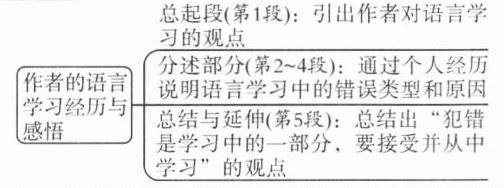
1. A [解析]细节理解题。根据“This was because French doesn't have as many vowel sounds as English.”可知,法语的元音数量比英语少。故选 A。
2. B [解析]推理判断题。根据第二段中的“That's not really a bad thing. I learn a lot from my mistakes.”(那其实并不是一件坏事。我从错误中学到很多。)以及末段首句“Making mistakes is a natural part of learning.”(犯错是学习中很自然的一部分。)可知,“not really a bad thing”“learn a lot”“natural”体现了“犯错是自然且有帮助的”。故选 B。
3. B [解析]事件排序题。根据“English was the first foreign language I learnt.”可知,英语是作者学习的第一门外语;再根据“When I was learning Spanish, I had trouble with the numbers. Instead of saying the "-enta" ending(as in cuarenta for "forty"), I used "-anta" as the ending. My brain was applying a rule it had learnt years before, when I was learning Italian.”可知,作者学习西班牙语前先学了意大利语。因此作者学习外语的顺序是英语、意大利语、西班牙语。故选 B。
4. D [解析]细节理解题。根据“I learn a lot from my mistakes. There is a reason behind each one. Understanding these reasons keeps learning exciting.”以及“try to accept mistakes and learn from them”可知,作者认为学习语言时应尝试理解错误背后的原因。故选 D。
5. D [解析]主旨大意题。文章围绕作者学习语言时犯错误的经历展开,强调错误是语言学习中很自然的一部分,它能让人从中学习并为学习增添乐趣,其核心是想说明错误在语言学习中的重要作用。故选 D。
