

 登录
登录
三、信息还原(每小题2分,满分10分)
阅读下面短文,从方框中选出能填入空白处的最佳选项。选项中有两项多余。
After you see somebody else yawn(打哈欠), your mouth opens wide and a big yawn comes out. 31 Is it only a coincidence(巧合)? In fact, this is called contagious(传染性的) yawning.
Contagious yawning doesn't depend on your brain. It's just like a reflex(反射动作) you don't have to think about. Scientists say that it only starts around the age of four or five. At that time, kids begin to develop better empathy(同理心). 32 In this view, when someone sees another yawn, he follows as if experiencing the same tiredness or stress.
33 That explains why you're more likely to catch a yawn from your best friend or family member than from a stranger. It also supports the idea that empathy plays a big role in contagious yawning. The less empathy someone has, the less likely they are to yawn back. Contagious yawning can also help people build social connections with each other. 34 It also works well on some animals like dogs and chimpanzees(黑猩猩).
What happens in the brain when we catch yawns? Your brain has special cells called mirror neurons(镜像神经元). These neurons become active when you see someone do something, and they make you feel like doing the same thing, like yawning. 35
So, the next time you see someone yawn and cannot help yawning, you know it's your brain's way of building a connection with your friends, family and even pets.
A. You aren't especially tired, but it still happens.
B. In fact, yawning is not just a sign of sleepiness.
C. It means understanding and sharing the feelings of others.
D. It's like your brain is mirroring what the other person is doing.
E. Kids under the age of 4 are not able to consider others' feelings.
F. In other words, it's one way our brains help us connect with others.
G. Scientists find that it is more common among those with strong connections.
31.
阅读下面短文,从方框中选出能填入空白处的最佳选项。选项中有两项多余。
After you see somebody else yawn(打哈欠), your mouth opens wide and a big yawn comes out. 31 Is it only a coincidence(巧合)? In fact, this is called contagious(传染性的) yawning.
Contagious yawning doesn't depend on your brain. It's just like a reflex(反射动作) you don't have to think about. Scientists say that it only starts around the age of four or five. At that time, kids begin to develop better empathy(同理心). 32 In this view, when someone sees another yawn, he follows as if experiencing the same tiredness or stress.
33 That explains why you're more likely to catch a yawn from your best friend or family member than from a stranger. It also supports the idea that empathy plays a big role in contagious yawning. The less empathy someone has, the less likely they are to yawn back. Contagious yawning can also help people build social connections with each other. 34 It also works well on some animals like dogs and chimpanzees(黑猩猩).
What happens in the brain when we catch yawns? Your brain has special cells called mirror neurons(镜像神经元). These neurons become active when you see someone do something, and they make you feel like doing the same thing, like yawning. 35
So, the next time you see someone yawn and cannot help yawning, you know it's your brain's way of building a connection with your friends, family and even pets.
A. You aren't especially tired, but it still happens.
B. In fact, yawning is not just a sign of sleepiness.
C. It means understanding and sharing the feelings of others.
D. It's like your brain is mirroring what the other person is doing.
E. Kids under the age of 4 are not able to consider others' feelings.
F. In other words, it's one way our brains help us connect with others.
G. Scientists find that it is more common among those with strong connections.
31.
A
32. C
33. G
34. F
35. D
答案
三、信息还原
【文章大意】本文是一篇说明文,主要介绍了传染性打哈欠这一现象,包括其发生的原因、与同理心的关系、在社交中的作用以及大脑中的相关机制。
31.A 32.C 33.G 34.F 35.D
【文章大意】本文是一篇说明文,主要介绍了传染性打哈欠这一现象,包括其发生的原因、与同理心的关系、在社交中的作用以及大脑中的相关机制。
31.A 32.C 33.G 34.F 35.D
四、任务型阅读(每小题 1.5 分,满分 15 分)
阅读下面短文,并根据所读内容在文章后的表格里填入最恰当的单词,每个空格只填一个单词。
Have you ever found it difficult to get up early on cold mornings? We often feel tired and sleepy when we wake up. It really needs strong courage to get up in winter. Here are some tips for you to make "getting up on cold mornings" easy.
Get as much natural light as you can
Enough natural light will help you get up early, says Jennifer Martin, a doctor from the American University of Sleep Medicine. That's because light influences melatonin(褪黑素), which plays an important role in sleep. As a result, when you wake up, taking a walk or enjoying coffee outside will be good. Some people prefer to use curtains or wear eye masks to create a dark sleeping environment, but that will be a bad idea if you want to get up early the next day.
Form the fixed(固定的) early rising habit
There are two ways to help you get up early. First, you can force yourself to get up at a fixed time. It must be difficult in the beginning but after a few weeks, you will not feel hard. Martin recommends people try another way. You can get up ten minutes earlier than usual on the first day. After a few days, you can get up another ten minutes earlier. Finally, you will get used to the new habit.
Go to bed early in the evening
A fixed bedtime is also important to make sure you're getting enough sleep. Most people should have at least seven hours of sleep. So you'll probably need to go to bed early if you want to change your habit. Research shows that we should make sure we are not in the bright light for at least an hour before we sleep. Bright light will influence our ability to fall asleep. Listening to soft music or doing some reading may be helpful before you sleep.
Plan something to look forward to
To encourage you to get out of bed, Martin suggests treating yourself to some special things that you can enjoy. Go and buy your favourite coffee or pick up some delicious breakfast. Start a day with something nice, and you will find getting up early on cold mornings is not difficult.
|$ How to get up early \underline{36} on cold mornings $|
| --- |
|$ Most people have \underline{37} getting up early on cold mornings. It does need strong courage to get up in winter. $|
|$ Get as much natural light as \underline{38} $|$ \underline{39} for a walk or enjoy coffee outside for more natural light.$
$Don't sleep in a dark environment by \underline{40} curtains or wearing eye masks. $|
| Form the fixed early rising habit | Force yourself to get up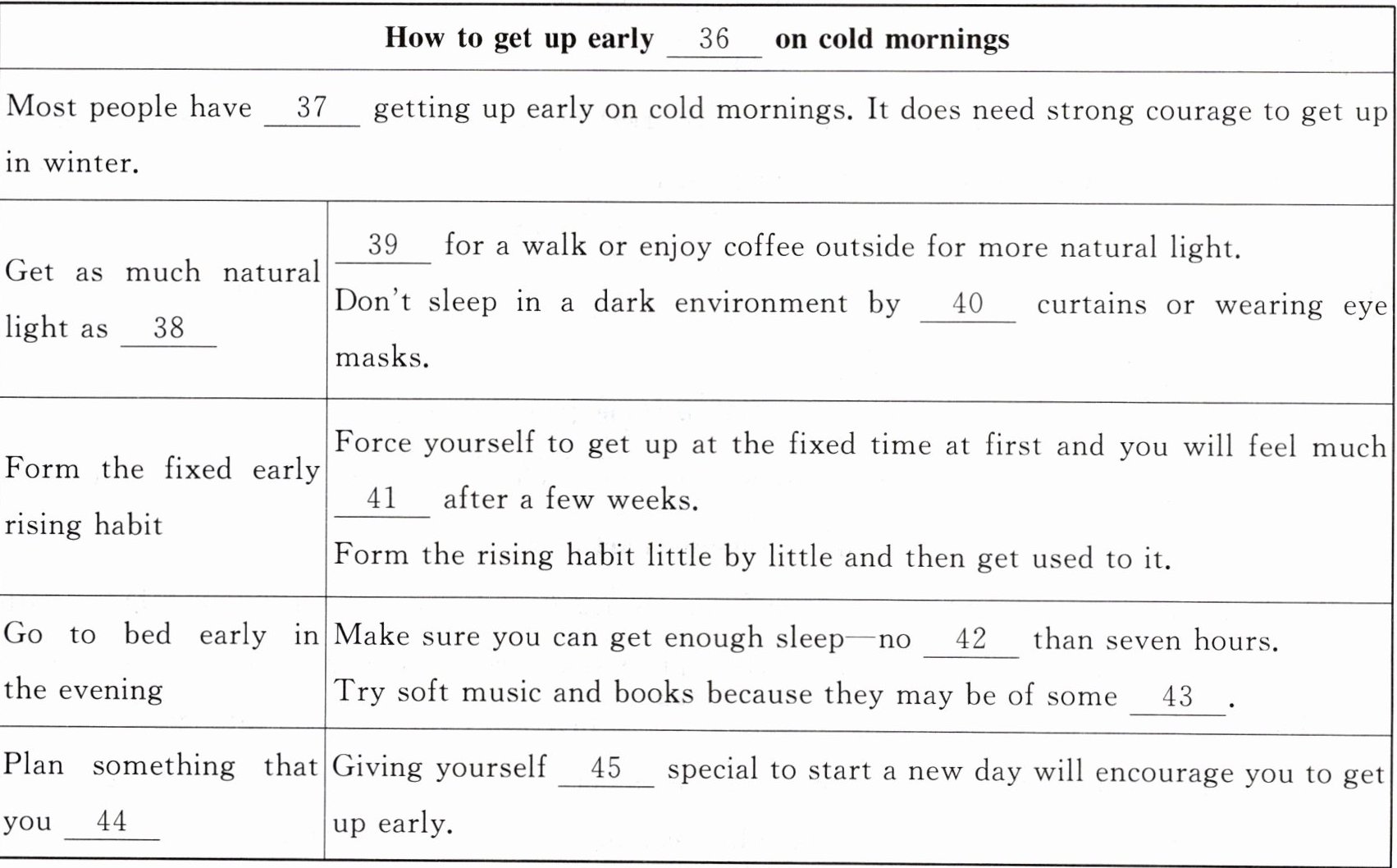 $ the fixed time at first and you will feel much \underline{41} after a few weeks.$
Form the rising habit little by little and then get used to it. |
| Go to bed early in the evening |$ Make sure you can get enough sleep—no \underline{42} than seven hours.$
$Try soft music and books because they may be of some \underline{43}. $|
|$ Plan something that you \underline{44} $|$ Giving yourself \underline{45} special to start a new day will encourage you to get up early. $|
36. _________ 37. _________ 38. _________ 39. _________ 40. _________
41. _________ 42. _________ 43. _________ 44. _________ 45. _________
阅读下面短文,并根据所读内容在文章后的表格里填入最恰当的单词,每个空格只填一个单词。
Have you ever found it difficult to get up early on cold mornings? We often feel tired and sleepy when we wake up. It really needs strong courage to get up in winter. Here are some tips for you to make "getting up on cold mornings" easy.
Get as much natural light as you can
Enough natural light will help you get up early, says Jennifer Martin, a doctor from the American University of Sleep Medicine. That's because light influences melatonin(褪黑素), which plays an important role in sleep. As a result, when you wake up, taking a walk or enjoying coffee outside will be good. Some people prefer to use curtains or wear eye masks to create a dark sleeping environment, but that will be a bad idea if you want to get up early the next day.
Form the fixed(固定的) early rising habit
There are two ways to help you get up early. First, you can force yourself to get up at a fixed time. It must be difficult in the beginning but after a few weeks, you will not feel hard. Martin recommends people try another way. You can get up ten minutes earlier than usual on the first day. After a few days, you can get up another ten minutes earlier. Finally, you will get used to the new habit.
Go to bed early in the evening
A fixed bedtime is also important to make sure you're getting enough sleep. Most people should have at least seven hours of sleep. So you'll probably need to go to bed early if you want to change your habit. Research shows that we should make sure we are not in the bright light for at least an hour before we sleep. Bright light will influence our ability to fall asleep. Listening to soft music or doing some reading may be helpful before you sleep.
Plan something to look forward to
To encourage you to get out of bed, Martin suggests treating yourself to some special things that you can enjoy. Go and buy your favourite coffee or pick up some delicious breakfast. Start a day with something nice, and you will find getting up early on cold mornings is not difficult.
|$ How to get up early \underline{36} on cold mornings $|
| --- |
|$ Most people have \underline{37} getting up early on cold mornings. It does need strong courage to get up in winter. $|
|$ Get as much natural light as \underline{38} $|$ \underline{39} for a walk or enjoy coffee outside for more natural light.$
$Don't sleep in a dark environment by \underline{40} curtains or wearing eye masks. $|
| Form the fixed early rising habit | Force yourself to get up
$ the fixed time at first and you will feel much \underline{41} after a few weeks.$Form the rising habit little by little and then get used to it. |
| Go to bed early in the evening |$ Make sure you can get enough sleep—no \underline{42} than seven hours.$
$Try soft music and books because they may be of some \underline{43}. $|
|$ Plan something that you \underline{44} $|$ Giving yourself \underline{45} special to start a new day will encourage you to get up early. $|
36. _________ 37. _________ 38. _________ 39. _________ 40. _________
41. _________ 42. _________ 43. _________ 44. _________ 45. _________
答案
四、任务型阅读
【文章大意】本文是一篇说明文,主要介绍了一些可以让你在寒冷的早晨轻松早起的小贴士。
36. easily 37. difficulty 38. possible 39. Go 40. using
41. easier 42. less 43. help 44. expect/enjoy 45. something
【文章大意】本文是一篇说明文,主要介绍了一些可以让你在寒冷的早晨轻松早起的小贴士。
36. easily 37. difficulty 38. possible 39. Go 40. using
41. easier 42. less 43. help 44. expect/enjoy 45. something
