

 登录
Ⅰ. 听说训练。
(Ⅰ)听后选择。
听下面一段对话,选择正确答案。
(
A. He has a cold.
B. He has a high fever.
C. He has a stomachache.
(
A. Wednesday. B. Saturday.
C. Sunday.
(
A. Seafood. B. Fast food.
C. Healthy food.
(Ⅰ)听后选择。
听下面一段对话,选择正确答案。
(
C
)1. What’s the matter with the man?A. He has a cold.
B. He has a high fever.
C. He has a stomachache.
(
C
)2. What day is it probably today?A. Wednesday. B. Saturday.
C. Sunday.
(
B
)3. What food does the man usually eat?A. Seafood. B. Fast food.
C. Healthy food.
答案
1.C 2.C 3.B
解析
翻译:
Ⅰ. 听说训练。
(Ⅰ)听后选择。
听下面一段对话,选择正确答案。
( )1. 这位男士怎么了?
A. 他感冒了。
B. 他发高烧了。
C. 他肚子疼。
( )2. 今天可能是星期几?
A. 星期三。
B. 星期六。
C. 星期日。
( )3. 这位男士通常吃什么食物?
A. 海鲜。
B. 快餐。
C. 健康食品。
(Ⅱ)听记转述。
A. 听后记录。
听短文,然后根据表格提示和所听内容完成下列各小题(每空1词)。在听该短文之前,你将有15秒钟的时间阅读表格中的内容。听完该短文后,你将有2分钟的时间检查答案,并将正确答案填入相应的空白处。该短文读两遍。
| Our Summer Camp | |
| When | On 4.
| Where | A small mountain 5.
| Who | Stay with the 6.
| What | * In the morning, we’ll learn to 7.
* In the afternoon, we’ll walk along the river.
* In the evening, we’ll enjoy the 8.
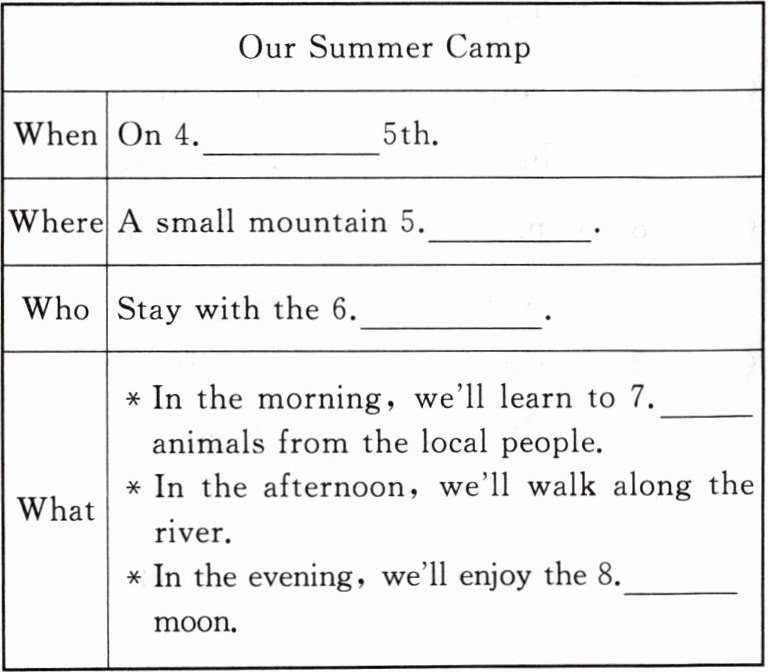
B. 听后转述。
现在你看到的是上一节记录的信息表,你将第三次听该录音材料,请做好记录。听完后,你将有2分30秒的时间做转述准备。听到提示音后,你将有80秒的时间完成对所听内容的转述并录音。
你的转述可以这样开始: Hello, everyone. I’d like to tell you something about the summer camp...
A. 听后记录。
听短文,然后根据表格提示和所听内容完成下列各小题(每空1词)。在听该短文之前,你将有15秒钟的时间阅读表格中的内容。听完该短文后,你将有2分钟的时间检查答案,并将正确答案填入相应的空白处。该短文读两遍。
| Our Summer Camp | |
| When | On 4.
August
5th. || Where | A small mountain 5.
village
. || Who | Stay with the 6.
farmers
. || What | * In the morning, we’ll learn to 7.
feed
animals from the local people. * In the afternoon, we’ll walk along the river.
* In the evening, we’ll enjoy the 8.
bright
moon. |B. 听后转述。
现在你看到的是上一节记录的信息表,你将第三次听该录音材料,请做好记录。听完后,你将有2分30秒的时间做转述准备。听到提示音后,你将有80秒的时间完成对所听内容的转述并录音。
你的转述可以这样开始: Hello, everyone. I’d like to tell you something about the summer camp...
答案
4.August 5.village 6.farmers 7.feed 8.bright
Ⅱ. 语法填空。
Do you often think of your parents?
“Yes, of course. ”You may answer. “I buy a present (1)
Day, and on Father’s day I give my father a present too.” But what about the other (2)
My friend is a good girl. She is always thinking of her parents. You also want to be a good son or daughter, right? So why not learn from (10)
Do you often think of your parents?
“Yes, of course. ”You may answer. “I buy a present (1)
for
my mother on Mother’sDay, and on Father’s day I give my father a present too.” But what about the other (2)
days
(day) of the year? Always remember (3)to think
(think) of your parents, not just on some special days. One day I went to visit my friend. Then she wanted (4)to make
(make) a call. So she dialed the number, but then she (5)put
(put) down the phone. After about fifteen seconds, she dialed the number again. Later I asked, “Why did you dial the number (6)twice
(two)?” She smiled, “My parents are old and (7)unhealthy
(healthy). They can’t get close to the telephone (8)quickly
(quick). I always do so when I call them. I just want to give them enough time (9)to answer
(answer) the call.”My friend is a good girl. She is always thinking of her parents. You also want to be a good son or daughter, right? So why not learn from (10)
her
(she)?答案
(1)for
(2)days
(3)to think
(4)to make
(5)put
(6)twice
(7)unhealthy
(8)quickly
(9)to answer
(10)her
解析
翻译:
Ⅱ. 语法填空。
你经常想起你的父母吗?
“当然。”你可能会回答。“我在母亲节给妈妈买了一份礼物,父亲节我也给爸爸送了一份礼物。”但是一年中的其他日子呢?永远记住要想着你的父母,而不仅仅是在一些特殊的日子里。有一天我去拜访我的朋友。然后她想打个电话。于是她拨了号码,但随后又放下了电话。大约十五秒后,她又拨了一次号码。后来我问:“你为什么拨了两次号码?”她笑着说:“我的父母年纪大了,身体也不好。他们不能很快地走到电话旁。我给他们打电话的时候总是这样做。我只是想给他们足够的时间来接电话。”
我的朋友是个好女孩。她总是想着她的父母。你也想成为一个好儿子或好女儿,对吗?那么为什么不向她学习呢?
