

 登录
Read and talk 读一读,并和同学谈一谈。
Look, it’s windy and cold in Bei-jing. What’s the weather like in Guangzhou?
Snowy Cold
Cloudy Warm
Windy Warm
Sunny Hot
JAN FEB MAR APR MAY JUN JUL AUG SEP OCT NOV DEC
LHASA
SHANGHAI
GUANGZHOU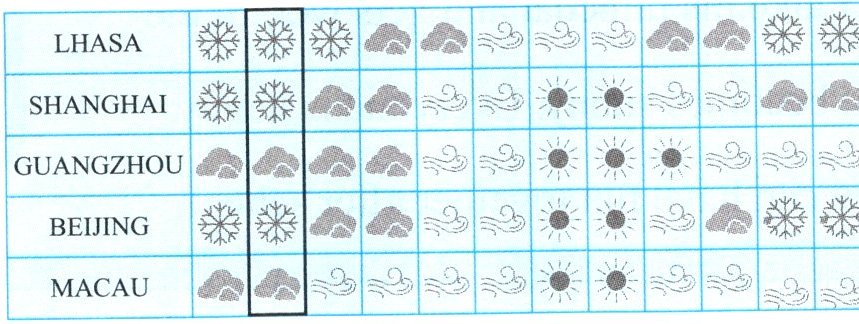
BEIJING
MACAU
It’s cloudy, but it’s warm.

Look, it’s windy and cold in Bei-jing. What’s the weather like in Guangzhou?
Snowy Cold
Cloudy Warm
Windy Warm
Sunny Hot
JAN FEB MAR APR MAY JUN JUL AUG SEP OCT NOV DEC
LHASA
SHANGHAI
GUANGZHOU
BEIJING
MACAU
It’s cloudy, but it’s warm.
答案
针对问题“What's the weather like in Guangzhou?”的回答为:It's cloudy, but it's warm.
还可以拓展同类问答和同学互动,例如:
1. —What's the weather like in Lhasa in February? —It's snowy and cold.
2. —What's the weather like in Macau in July? —It's sunny and hot.
还可以拓展同类问答和同学互动,例如:
1. —What's the weather like in Lhasa in February? —It's snowy and cold.
2. —What's the weather like in Macau in July? —It's sunny and hot.
解析
【分析】
首先明确题目要求是读给定内容并与同学谈论天气,核心任务是回答“广州的天气怎么样”,需先定位广州对应的天气描述,再结合其他城市(拉萨、澳门等)和月份,运用询问天气的句型拓展同类问答,掌握相关表达。
【解析】
1. 针对问题“What's the weather like in Guangzhou?”,从给定信息中提取广州的天气描述为“It's cloudy, but it's warm.”;
2. 结合其他城市和月份的天气信息,拓展同类问答,例如询问拉萨二月、澳门七月的天气,对应给出的天气描述,用于和同学互动。
【答案】
针对问题“What's the weather like in Guangzhou?”的回答为:It's cloudy, but it's warm. 还可以拓展同类问答和同学互动,例如:1. —What's the weather like in Lhasa in February? —It's snowy and cold. 2. —What's the weather like in Macau in July? —It's sunny and hot.
【知识点】
询问天气的表达、描述天气的词汇、口语交际
【点评】
本题为英语口语交际练习题,聚焦天气相关的日常问答,帮助学生巩固询问和描述天气的基础句型与词汇,适合基础阶段英语学习者练习。
【难度系数】
0.7
基础训练 6分钟夯基础
Look and tick or cross 看图,读句子,相符的在括号里打“√”,不相符的打“×”。
It’s starting to snow. (
Please close the window. (
Put on your coat. (
Look and tick or cross 看图,读句子,相符的在括号里打“√”,不相符的打“×”。
It’s starting to snow. (
×
)Please close the window. (
√
)Put on your coat. (
√
)答案
1. ×
2. √
3. √
2. √
3. √
解析
【分析】
本题为图文匹配判断题,解题思路为:①先理解每个英语句子的含义;②结合图片呈现的场景(如天气、物品状态、人物动作),逐一核对句子描述与图意是否一致;③相符打“√”,不相符打“×”。
【解析】
1. 句子“It’s starting to snow.”意为“开始下雪了”,若图片中未呈现下雪的场景,故判断为×;
2. 句子“Please close the window.”意为“请关上窗户”,若图片中窗户处于关闭状态,故判断为√;
3. 句子“Put on your coat.”意为“穿上你的外套”,若图片中人物穿着外套,故判断为√。
【答案】
1. ×
2. √
3. √
【知识点】
图文匹配判断 日常英语表达
【点评】
本题为基础英语的图文匹配题,考察学生对日常场景英语句子的理解及图文对应能力,是夯实英语基础的典型题目。
【难度系数】
0.8
