

 登录
二、阅读理解

①Do you wear clothes with colourful patterns(图案)? People usually use machines to make these patterns in modern times. But how did people in old times make them?
②People in old times used tie-dye(扎染). Tie-dye is a very old way of dyeing clothes in China—it's more than 1,000 years old! It is popular in Yunnan. People first put cloth(布料) into the blue dye(染料). Some parts of the cloth become blue, but other parts have a lighter colour. When you open out the cloth, you'll see beautiful patterns.
③Now, the tie-dye skill is China's national intangible cultural heritage(国家级非物质文化遗产). Anning in Yunnan is famous for tie-dye.
④Yang Cheng got the old skills from his mother in the 1980s. At the same time, he studied tie-dye in other countries, such as Japan, India and France. It once took Yang two years to make two tie-dyed dresses! He used many skills of Anning tie-dye. Some patterns on the dresses are traditional, while some are modern. He used images of Dianchi Lake and eight popular flowers in Yunnan. “I want to put all the beautiful things into tie-dye works,” he said.
⑤Now Yang is still dyeing and teaches his daughter tie-dye. “We have the duty to pass down the skill to younger generations,” Yang says. Yang now teaches tie-dye in schools, communities, and companies. More than 100,000 people learn from him.
⑥Some worry that tie-dye may die out because using machines is fast and cheap. But Yang says, “Machines can't take the place of our creative hands.”
(
A. Make cloth. B. Grow popular flowers.
C. Make colourful patterns. D. Practise skills.
(
A. Tie-dye is going to die out.
B. We can find tie-dye only in China.
C. Yang Cheng not only uses traditional patterns but also modern ones.
D. Younger generations learn tie-dye to make beautiful clothes for themselves.
(
A. not so useful as before B. popular with young people
C. hard to see in other places D. still meaningful(有意义的) to us
(
①Do you wear clothes with colourful patterns(图案)? People usually use machines to make these patterns in modern times. But how did people in old times make them?
②People in old times used tie-dye(扎染). Tie-dye is a very old way of dyeing clothes in China—it's more than 1,000 years old! It is popular in Yunnan. People first put cloth(布料) into the blue dye(染料). Some parts of the cloth become blue, but other parts have a lighter colour. When you open out the cloth, you'll see beautiful patterns.
③Now, the tie-dye skill is China's national intangible cultural heritage(国家级非物质文化遗产). Anning in Yunnan is famous for tie-dye.
④Yang Cheng got the old skills from his mother in the 1980s. At the same time, he studied tie-dye in other countries, such as Japan, India and France. It once took Yang two years to make two tie-dyed dresses! He used many skills of Anning tie-dye. Some patterns on the dresses are traditional, while some are modern. He used images of Dianchi Lake and eight popular flowers in Yunnan. “I want to put all the beautiful things into tie-dye works,” he said.
⑤Now Yang is still dyeing and teaches his daughter tie-dye. “We have the duty to pass down the skill to younger generations,” Yang says. Yang now teaches tie-dye in schools, communities, and companies. More than 100,000 people learn from him.
⑥Some worry that tie-dye may die out because using machines is fast and cheap. But Yang says, “Machines can't take the place of our creative hands.”
(
C
)1. What can tie-dye help people do?A. Make cloth. B. Grow popular flowers.
C. Make colourful patterns. D. Practise skills.
(
C
)2. According to the passage, which of the following is TRUE?A. Tie-dye is going to die out.
B. We can find tie-dye only in China.
C. Yang Cheng not only uses traditional patterns but also modern ones.
D. Younger generations learn tie-dye to make beautiful clothes for themselves.
(
D
)3. The last paragraph mainly shows that tie-dye is ______.A. not so useful as before B. popular with young people
C. hard to see in other places D. still meaningful(有意义的) to us
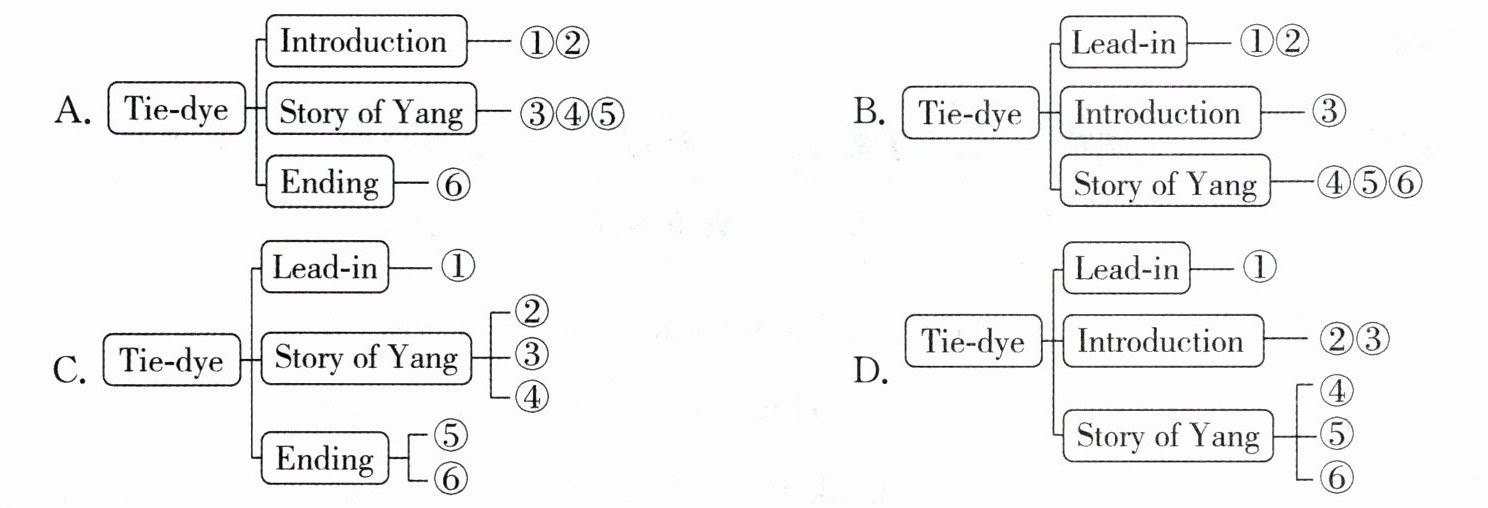
(
B
)4. Which of the following is the structure(结构) of this passage?答案
1. C 2. C 3. D 4. B
解析
翻译:
### 二、阅读理解
①你会穿带有彩色图案的衣服吗?在现代,人们通常用机器来制作这些图案。但是在古代,人们是如何制作它们的呢?
②古代的人们使用扎染。扎染是中国一种非常古老的染布方式——它已经有1000多年的历史了!它在云南很受欢迎。人们首先把布料放进蓝色染料里。布料的一些部分变成蓝色,但其他部分颜色较浅。当你展开布料时,你会看到美丽的图案。
③现在,扎染技艺是中国的国家级非物质文化遗产。云南的安宁以扎染闻名。
④杨成在20世纪80年代从他母亲那里学到了这项古老的技艺。与此同时,他还在日本、印度和法国等其他国家学习扎染。杨成曾经花了两年时间制作两件扎染连衣裙!他运用了许多安宁扎染的技艺。连衣裙上的一些图案是传统的,而一些是现代的。他使用了滇池的图像和云南的八种流行花卉。“我想把所有美好的事物都融入扎染作品中,”他说。
⑤现在杨成仍然在进行扎染创作,并教他的女儿扎染。“我们有责任把这项技艺传承给年轻一代,”杨成说。杨成现在在学校、社区和公司教授扎染。超过10万人向他学习。
⑥有些人担心扎染可能会消失,因为使用机器又快又便宜。但杨成说:“机器无法取代我们富有创造力的双手。”
(C)1. 扎染能帮助人们做什么?
A. 制作布料。
B. 种植流行花卉。
C. 制作彩色图案。
D. 练习技艺。
(C)2. 根据文章,下列哪项是正确的?
A. 扎染即将消失。
B. 我们只能在中国找到扎染。
C. 杨成不仅使用传统图案,还使用现代图案。
D. 年轻一代学习扎染是为了给自己做漂亮的衣服。
(D)3. 最后一段主要表明扎染对我们来说是______。
A. 不像以前那么有用了
B. 受年轻人欢迎
C. 在其他地方很难见到
D. 仍然有意义
(B)4. 以下哪项是这篇文章的结构?
