

 登录
登录
探究点1 fill...with...的用法
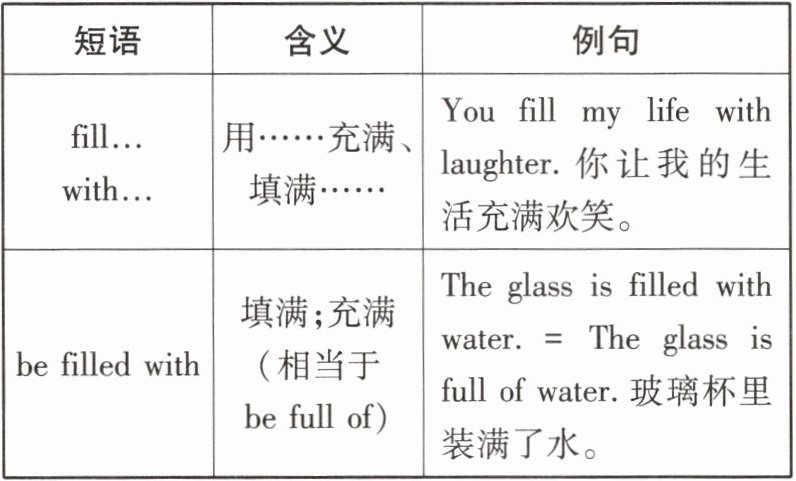
|短语|含义|例句|
|fill...with...|用……充满、填满……|You fill my life with laughter. 你让我的生活充满欢笑。|
|be filled with|填满;充满(相当于be full of)|The glass is filled with water. = The glass is full of water. 玻璃杯里装满了水。|
[知识拓展]
be full of 意为“充满……”,通常用于主动语态,强调“充满”的状态。
情境应用
1. The garden will
A. be fill with
B. be filled
C. be full of
D. fill
2. My father is going to
3. We
|短语|含义|例句|
|fill...with...|用……充满、填满……|You fill my life with laughter. 你让我的生活充满欢笑。|
|be filled with|填满;充满(相当于be full of)|The glass is filled with water. = The glass is full of water. 玻璃杯里装满了水。|
[知识拓展]
be full of 意为“充满……”,通常用于主动语态,强调“充满”的状态。
情境应用
1. The garden will
be full of
green grass and red flowers.A. be fill with
B. be filled
C. be full of
D. fill
2. My father is going to
fill
the basket ______with
oranges.(填满)3. We
are filled with
hope for the future. = We ______are full of
hope for the future.(充满)答案
1. C
2. fill, with
3. are filled with, are full of
2. fill, with
3. are filled with, are full of
解析
1. 句意:花园里将满是绿草和红花。be full of 意为“充满……”,通常用于主动语态,强调“充满”的状态;be filled with 意为“被……填满/充满”,表示被动。根据题干可知,“green grass and red flowers”与“装满”的关系应为主动,且空格后为名词短语,故应使用“be full of”结构。
选项:
A. “be fill with”结构错误,fill 为动词原形,不能直接与 be 连用。
B. “be filled”后缺少介词 with,结构不完整。
C. “be full of”符合题意,表示“充满”。
D. “fill”为动词原形,不能直接用于此句。
因此,正确答案为 C。
2. 根据短语“fill...with...”,意为“用……填满……”,可知句子应为“My father is going to fill the basket with oranges.”。
3. 根据短语“be filled with”和“be full of”,可知句子应为“We are filled with hope for the future. = We are full of hope for the future.”。
选项:
A. “be fill with”结构错误,fill 为动词原形,不能直接与 be 连用。
B. “be filled”后缺少介词 with,结构不完整。
C. “be full of”符合题意,表示“充满”。
D. “fill”为动词原形,不能直接用于此句。
因此,正确答案为 C。
2. 根据短语“fill...with...”,意为“用……填满……”,可知句子应为“My father is going to fill the basket with oranges.”。
3. 根据短语“be filled with”和“be full of”,可知句子应为“We are filled with hope for the future. = We are full of hope for the future.”。
探究点2 secret的用法
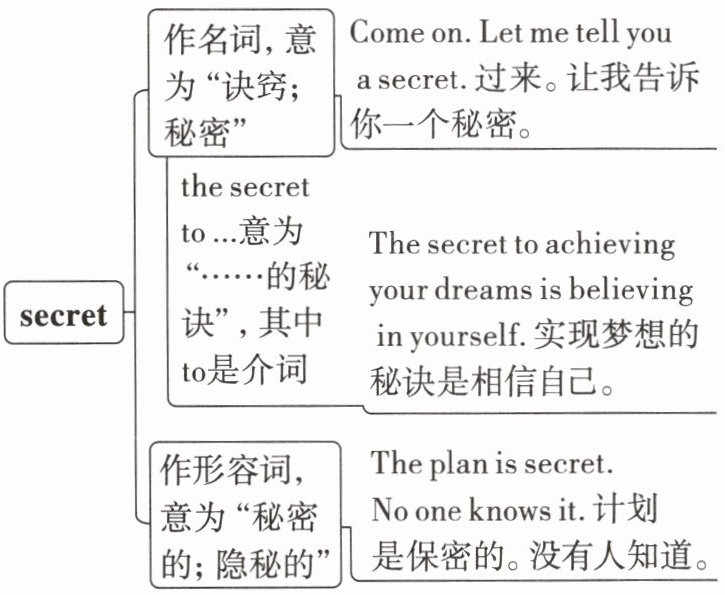
secret
- 作名词,意为“诀窍;秘密”:Come on. Let me tell you a secret. 过来。让我告诉你一个秘密。
- the secret to...意为……“的秘诀”,其中to是介词:The secret to achieving your dreams is believing in yourself. 实现梦想的秘诀是相信自己。
- 作形容词,意为“秘密的;隐秘的”:The plan is secret. No one knows it. 计划是保密的。没有人知道。
情境应用
1. Can you
2. They are happy because they know
secret
- 作名词,意为“诀窍;秘密”:Come on. Let me tell you a secret. 过来。让我告诉你一个秘密。
- the secret to...意为……“的秘诀”,其中to是介词:The secret to achieving your dreams is believing in yourself. 实现梦想的秘诀是相信自己。
- 作形容词,意为“秘密的;隐秘的”:The plan is secret. No one knows it. 计划是保密的。没有人知道。
情境应用
1. Can you
keep a secret
if I tell you one?(保守秘密)2. They are happy because they know
the secret to
happiness.(……的秘诀)答案
1. keep a secret 2. the secret to
解析
1. "保守秘密"常用短语"keep a secret",情态动词can后接动词原形,故填keep a secret。2. "……的秘诀"为"the secret to...",此处指"幸福的秘诀",故填the secret to。
探究点3 whenever的用法
whenever作连词时,意为“每当;在任何……的时候”。
Whenever she comes, she brings a gift. 她每次来都带个礼物。
You can ask for help whenever you need it. 你如果需要帮助,随时可以提出来。
[知识拓展]
whenever引导让步状语从句时,相当于no matter when。
I'll discuss it with you whenever you like. = I'll discuss it with you no matter when you like. 任何时候你愿意,我将和你讨论。
情境应用
1. Kate's dad is getting old. She goes back home to see him
A. because
B. whenever
C. although
D. until
2.
whenever作连词时,意为“每当;在任何……的时候”。
Whenever she comes, she brings a gift. 她每次来都带个礼物。
You can ask for help whenever you need it. 你如果需要帮助,随时可以提出来。
[知识拓展]
whenever引导让步状语从句时,相当于no matter when。
I'll discuss it with you whenever you like. = I'll discuss it with you no matter when you like. 任何时候你愿意,我将和你讨论。
情境应用
1. Kate's dad is getting old. She goes back home to see him
B
she is free.A. because
B. whenever
C. although
D. until
2.
Whenever
you have free time, use it to learn something new.(不论什么时候)答案
1.B
2.Whenever
2.Whenever
解析
1.题干意思是:“凯特的爸爸越来越老了。她_____有空就回家看他。”
选项A,because的意思是“因为”,常用于引导原因状语从句,表示因果关系,代入题干表示“她因为有空所以回家看爸爸”,不符合逻辑,因此排除。
选项B,whenever的意思是“无论何时”,代入题干,表示“无论什么时候有空,她都会回家看她的爸爸”,符合题干语境。
选项C,although的意思是“尽管”,常用于引导让步状语从句,代入题干表示“尽管她是有空的,她回家看她的爸爸”,不符合逻辑,因此排除。
选项D,until的意思是“直到”,常用于引导时间状语从句,代入题干表示“直到她有空,她才会回家看她的爸爸”,不符合逻辑,因此排除。
因此,本小题应选:B.whenever。
2.题干的意思是“_____你有空,利用它来学习新东西。”根据题干括号中的提示“不论什么时候”,可知题干想表达的意思是“不论什么时候你有空,利用它来学习新东西。”题干缺失部分为句子的时间状语从句的引导词,且该引导词有“不论什么时候”的意思,因此应使用whenever,又因该词位于句首,因此首字母应大写,即Whenever。
因此,本小题应填:Whenever。
选项A,because的意思是“因为”,常用于引导原因状语从句,表示因果关系,代入题干表示“她因为有空所以回家看爸爸”,不符合逻辑,因此排除。
选项B,whenever的意思是“无论何时”,代入题干,表示“无论什么时候有空,她都会回家看她的爸爸”,符合题干语境。
选项C,although的意思是“尽管”,常用于引导让步状语从句,代入题干表示“尽管她是有空的,她回家看她的爸爸”,不符合逻辑,因此排除。
选项D,until的意思是“直到”,常用于引导时间状语从句,代入题干表示“直到她有空,她才会回家看她的爸爸”,不符合逻辑,因此排除。
因此,本小题应选:B.whenever。
2.题干的意思是“_____你有空,利用它来学习新东西。”根据题干括号中的提示“不论什么时候”,可知题干想表达的意思是“不论什么时候你有空,利用它来学习新东西。”题干缺失部分为句子的时间状语从句的引导词,且该引导词有“不论什么时候”的意思,因此应使用whenever,又因该词位于句首,因此首字母应大写,即Whenever。
因此,本小题应填:Whenever。
