

 登录
登录
(
A.few
B.little
C.a few
D.a little
D
) 3.The foreign visitor can speak only ______ Chinese, but he can talk with us.A.few
B.little
C.a few
D.a little
答案
D
解析
首先分析选项,few 和 a few 修饰可数名词复数,little 和 a little 修饰不可数名词。Chinese 作为“汉语”讲时是不可数名词,所以 A、C 选项可排除。再根据句意“这位外国游客只会说一点汉语,但他能和我们交谈”,little 表示“几乎没有”,a little 表示“一点”,这里表示会说一点汉语,应该用 a little。
(
—Yes, and he will visit me this winter vacation.
A.hear from
B.come from
C.learn from
D.keep away from
A
) 4.—Did you ______ your penfriend last Sunday?—Yes, and he will visit me this winter vacation.
A.hear from
B.come from
C.learn from
D.keep away from
答案
A
解析
根据答句“he will visit me”可知问句应是询问是否收到笔友消息。“hear from”意为“收到……的来信/消息”,符合语境;“come from”来自;“learn from”向……学习;“keep away from”远离。所以选A。
( ) 5.—Amy, my class will visit the Bird's Nest this afternoon. —
A.Good luck
B.Best wishes
C.Good idea
D.Have a good time
D
.A.Good luck
B.Best wishes
C.Good idea
D.Have a good time
答案
D
解析
题目是一个对话情境,其中一方说“我的班级今天下午将参观鸟巢。” 另一方需要给出一个恰当的回应。A选项“Good luck”通常用于祝愿某人在即将进行的尝试或挑战中好运;B选项“Best wishes”多用于信件结尾或节日、特殊场合的祝福;C选项“Good idea”通常用于回应一个提议,表示赞同;D选项“Have a good time”用于祝愿某人玩得开心,享受某个活动或时光。根据对话内容,参观鸟巢是一个休闲活动,所以D选项最符合语境。
(
A.exercises
B.to exercise
C.exercise
D.to exercises
C
) 6.You are not strong. You must do more ______.A.exercises
B.to exercise
C.exercise
D.to exercises
答案
C
解析
首先分析句子结构,“You must do more ______.”中,“do”是谓语动词,后面需要接名词作宾语。选项B“to exercise”是动词不定式,通常表示目的或将来,不符合此处语法结构;选项D“to exercises”形式错误,“to”后应接动词原形构成不定式,或接名词但此处“exercises”作为复数形式不符合语境。接下来区分“exercise”和“exercises”:当“exercise”表示“锻炼”这一行为时,是不可数名词;当表示具体的“练习”或“体操”时,可以是可数名词,但通常以复数形式“exercises”出现。在此句中,“你必须多做锻炼”,指的是锻炼这一行为,故应用不可数名词“exercise”。
三、阅读理解
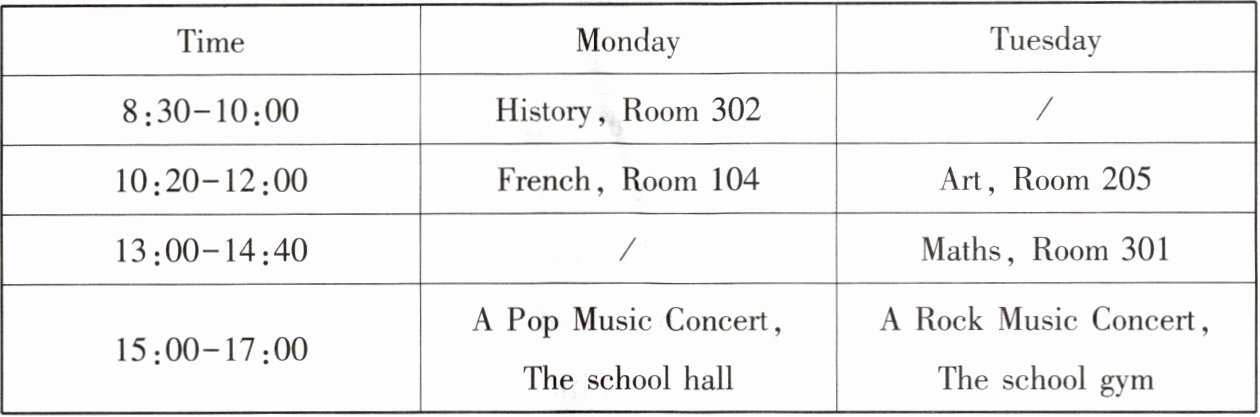
Betty is studying in a school in Paris now. Let's take a look at her timetable.
| Time | Monday | Tuesday |
| 8:30-10:00 | History, Room 302 | / |
| 10:20-12:00 | French, Room 104 | Art, Room 205 |
| 13:00-14:40 | / | Maths, Room 301 |
| 15:00-17:00 | A Pop Music Concert, The school hall | A Rock Music Concert, The school gym |
(
A. History.
B. Art.
C. Music.
D. Maths.
(
A. In Room 205.
B. In Room 104.
C. In Room 302.
D. In Room 301.
(
A. 8:30-10:00.
B. 10:20-12:00.
C. 13:00-14:40.
D. 15:00-17:00.
(
A. On Monday morning.
B. On Monday afternoon.
C. On Tuesday morning.
D. On Tuesday afternoon.
(
A. In Room 205.
B. In Room 301.
C. In the school hall.
D. In the school gym.
Betty is studying in a school in Paris now. Let's take a look at her timetable.
| Time | Monday | Tuesday |
| 8:30-10:00 | History, Room 302 | / |
| 10:20-12:00 | French, Room 104 | Art, Room 205 |
| 13:00-14:40 | / | Maths, Room 301 |
| 15:00-17:00 | A Pop Music Concert, The school hall | A Rock Music Concert, The school gym |
(
A
) 1. What lesson does Betty have on Monday morning?A. History.
B. Art.
C. Music.
D. Maths.
(
B
) 2. Where does Betty have the French lesson?A. In Room 205.
B. In Room 104.
C. In Room 302.
D. In Room 301.
(
C
) 3. What time does Betty have the Maths lesson?A. 8:30-10:00.
B. 10:20-12:00.
C. 13:00-14:40.
D. 15:00-17:00.
(
B
) 4. When is the pop music concert?A. On Monday morning.
B. On Monday afternoon.
C. On Tuesday morning.
D. On Tuesday afternoon.
(
D
) 5. Where is the rock music concert?A. In Room 205.
B. In Room 301.
C. In the school hall.
D. In the school gym.
答案
1. A
2. B
3. C
4. B
5. D
2. B
3. C
4. B
5. D
四、短文填空
This boy is Zhang Hua. He is a middle school student. He g
1. ______ 2. ______ 3. ______ 4. ______ 5. ______
6. ______ 7. ______ 8. ______ 9. ______ 10. ______
This boy is Zhang Hua. He is a middle school student. He g
goes
to school at 7:00 and he is never llate
for school. His first lesson sstarts
at 8:00. He likes PE bbest
. Doing exercise makes him llook
strong. He is good at pplaying
basketball. He is a mmember
of the school basketball team. He ppractises
after school every day. But his father isn't hhappy
about that. He thinks Zhang Hua nneeds
to do his homework first.1. ______ 2. ______ 3. ______ 4. ______ 5. ______
6. ______ 7. ______ 8. ______ 9. ______ 10. ______
答案
1. goes
2. late
3. starts
4. best
5. look
6. playing
7. member
8. practises
9. happy
10. needs
2. late
3. starts
4. best
5. look
6. playing
7. member
8. practises
9. happy
10. needs
解析
1. 根据语境“他7点去学校”可知,此处应填“goes”,表示“去”,且主语He是第三人称单数,所以go要用第三人称单数形式goes。
2. “be late for”是固定短语,意为“迟到”,根据“he is never...for school”可知,此处应填late,表示他上学从不迟到。
3. 根据语境“他的第一节课在8点开始”可知,此处应填starts,表示“开始”,且主语His first lesson是第三人称单数,所以start要用第三人称单数形式starts。
4. 根据语境“他最喜欢体育”可知,此处应填best,“like...best”表示“最喜欢……”。
5. “make sb do sth”表示“使某人做某事”,根据“做运动让他看起来强壮”可知,此处应填look,表示“看起来”。
6. “be good at doing sth”表示“擅长做某事”,根据“他擅长打篮球”可知,此处应填playing,play basketball表示“打篮球”。
7. 根据“他是学校篮球队的一员”可知,此处应填member,表示“成员”。
8. 根据上文“他擅长打篮球”以及“他每天放学后练习”可知,此处应填practises,表示“练习”,且主语He是第三人称单数,所以practise要用第三人称单数形式practises。
9. “be happy about...”表示“对……感到高兴”,根据“但是他父亲对此不高兴”可知,此处应填happy。
10. 根据语境“他认为张华需要先做作业”可知,此处应填needs,need to do sth表示“需要做某事”,且主语Zhang Hua是第三人称单数,所以need要用第三人称单数形式needs。
2. “be late for”是固定短语,意为“迟到”,根据“he is never...for school”可知,此处应填late,表示他上学从不迟到。
3. 根据语境“他的第一节课在8点开始”可知,此处应填starts,表示“开始”,且主语His first lesson是第三人称单数,所以start要用第三人称单数形式starts。
4. 根据语境“他最喜欢体育”可知,此处应填best,“like...best”表示“最喜欢……”。
5. “make sb do sth”表示“使某人做某事”,根据“做运动让他看起来强壮”可知,此处应填look,表示“看起来”。
6. “be good at doing sth”表示“擅长做某事”,根据“他擅长打篮球”可知,此处应填playing,play basketball表示“打篮球”。
7. 根据“他是学校篮球队的一员”可知,此处应填member,表示“成员”。
8. 根据上文“他擅长打篮球”以及“他每天放学后练习”可知,此处应填practises,表示“练习”,且主语He是第三人称单数,所以practise要用第三人称单数形式practises。
9. “be happy about...”表示“对……感到高兴”,根据“但是他父亲对此不高兴”可知,此处应填happy。
10. 根据语境“他认为张华需要先做作业”可知,此处应填needs,need to do sth表示“需要做某事”,且主语Zhang Hua是第三人称单数,所以need要用第三人称单数形式needs。
