

 登录
一、根据中文意思完成句子。
1. 在上课铃响前,学生们一个接一个地走进教室。
Before the bell rang, the students walked into the classroom
2. 这种漂亮的小花被叫作茉莉。
This kind of beautiful small flower
3. 多和说母语的人聊天对你来说是练习英语的好方法。
It is a good way for you to practice English by
4. 文化差异能影响我们如何使用肢体语言。
5. 她会拉小提琴,也会弹钢琴。
She can play the violin, and she can play the piano
1. 在上课铃响前,学生们一个接一个地走进教室。
Before the bell rang, the students walked into the classroom
one
by
one
.2. 这种漂亮的小花被叫作茉莉。
This kind of beautiful small flower
is
called
jasmine.3. 多和说母语的人聊天对你来说是练习英语的好方法。
It is a good way for you to practice English by
talking
with
the
native
speakers
more.4. 文化差异能影响我们如何使用肢体语言。
Cultural
differences
can affect how we use body language.5. 她会拉小提琴,也会弹钢琴。
She can play the violin, and she can play the piano
as
well
.答案
1. one by one
2. is called
3. talking with the native speakers
4. Cultural differences
5. as well
解析
【分析】本题为根据中文提示完成英语句子的基础题,需结合句子结构、固定短语、语法规则(如被动语态、介词后接动名词等)逐一解题:先明确每句中文对应的英语表达,再根据句子的时态、语态、成分要求调整形式,确保填空后句子语法正确、语义通顺。
【解析】1. “一个接一个地”对应固定短语one by one,在句中作方式状语修饰walked,符合语境;2. 中文“被叫作”需用一般现在时被动语态,主语this kind of beautiful small flower是单数,故填is called;3. 介词by后需接动名词,“和说母语的人聊天”为talk with the native speakers,动名词形式是talking with the native speakers;4. “文化差异”是名词短语Cultural differences,作主语,首字母大写;5. 表示“也”且放在句末的固定短语是as well,符合语境。
【答案】1. one by one 2. is called 3. talking with the native speakers 4. Cultural differences 5. as well
【知识点】固定短语、被动语态、介词用法
【点评】本题考查英语基础短语和核心语法,是日常学习中的常见基础题型,侧重对基础知识的掌握。
【难度系数】0.8
二、根据短文完成思维导图。
Sign language is more than a way for deaf people to communicate. It is the key to an inclusive life, where everyone can take part. We can use it in many daily situations.
In noisy places, like a busy street or a sports game, it’s hard to hear what people say. Sign language helps. We can use signs to say “Let’s go!” or “I’m here.” We can also use fingerspelling to share short messages. In quiet places, like a library or a hospital, we need to keep silent. Sign language enables us to talk without making noise. For example, students can use signs to ask the teacher for help, and friends can “chat” quietly during a show.
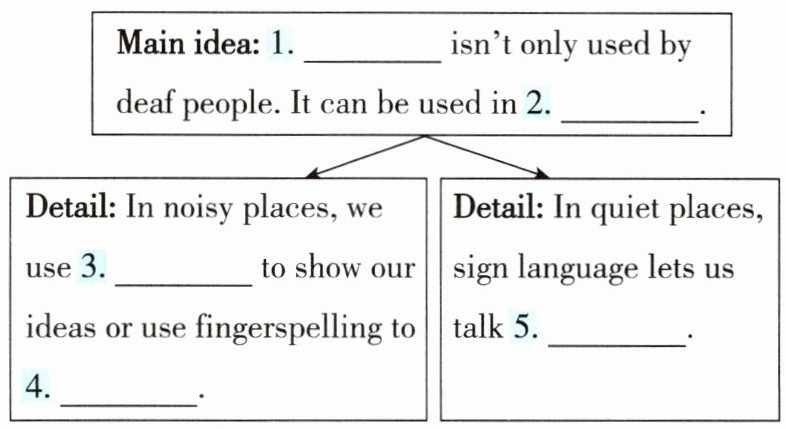
Main idea: 1.
Detail: In noisy places, we use 3.
Detail: In quiet places, sign language lets us talk 5.
Sign language is more than a way for deaf people to communicate. It is the key to an inclusive life, where everyone can take part. We can use it in many daily situations.
In noisy places, like a busy street or a sports game, it’s hard to hear what people say. Sign language helps. We can use signs to say “Let’s go!” or “I’m here.” We can also use fingerspelling to share short messages. In quiet places, like a library or a hospital, we need to keep silent. Sign language enables us to talk without making noise. For example, students can use signs to ask the teacher for help, and friends can “chat” quietly during a show.
Main idea: 1.
Sign language
isn’t only used by deaf people. It can be used in 2. many daily situations
.Detail: In noisy places, we use 3.
signs
to show our ideas or use fingerspelling to 4. share short messages
.Detail: In quiet places, sign language lets us talk 5.
without making noise
.答案
1. Sign language
2. many daily situations
3. signs
4. share short messages
5. without making noise
解析
【分析】
要完成思维导图的填空,需先通读短文把握主旨,再根据每个空的语境,从短文中定位对应信息:先确定主旨句中“不只是聋人使用”的主体,再找其使用场景;接着分嘈杂、安静两个场景,提取对应的具体用法和效果,即可完成填空。
【解析】
1. 短文第一句明确指出“Sign language is more than a way for deaf people to communicate”,说明手语不只是聋人使用,故填Sign language;
2. 短文提到“We can use it in many daily situations”,对应手语的使用场景,故填many daily situations;
3. 嘈杂场景的描述中“We can use signs to show our ideas”,对应此处填signs;
4. 短文提到“we can also use fingerspelling to share short messages”,对应此处填share short messages;
5. 安静场景的描述中“Sign language enables us to talk without making noise”,对应此处填without making noise。
【答案】
1. Sign language;2. many daily situations;3. signs;4. share short messages;5. without making noise
【知识点】
阅读理解,信息提取,词汇运用
【点评】
本题考查学生对短文关键信息的提取能力,属于基础题型,只要仔细阅读短文,对应思维导图各部分即可找到答案,难度较低。
【难度系数】
0.7
三、阅读理解。
World Braille Day(世界盲文日)is on the 4th of January every year. That's the birth date of Louis Braille. He invented Braille, which helps blind people read and write.
Braille was a Frenchman who lived between 1809 and 1852. He lost his sight in one eye at three and became completely blind by five. But he was a very talented boy. At school he learned to play two musical instruments and traveled around France, playing in churches. He was just 15 when he invented his reading and writing system.
This system was later called Braille. It was a big success. He used just six raised dots(凸起的圆点)to create the Braille alphabet on paper. ▲ Braille changed the lives of blind people forever. He had no idea how important it was because he died at the age of 43. Two years after his death, France officially recognized(认可)his system.
Now World Braille Day is celebrated all over the world. The day reminds people how Braille has changed the lives of blind people. It has given blind people a way to be more independent and educate themselves. Without it, many people could not read or write.
People used to use a special typewriter to write. Nowadays, computers make it very easy for people to read and write using Braille. A blind worker said, “With Braille, blind people can have the chance to get more information and communicate with the outside world.”
根据材料内容选择最佳答案。
(
A. An Englishman.
B. The inventor of Braille.
C. A singer.
D. A scientist.
(
A. In 1809.
B. In 1812.
C. In 1824.
D. In 1852.
(
A. He also drew some lines on the paper.
B. People could feel each letter with their fingers.
C. These dots made up a picture.
D. Blind people loved the dots on the paper.
(
A. Louis Braille became blind when he was five years old.
B. Louis Braille often traveled around Europe to play musical instruments.
C. Nowadays, blind people can read and write with their computers instead of Braille.
D. Braille is very important to blind people around the world.
(
A. Language.
B. Culture.
C. Nature.
D. Planet.
World Braille Day(世界盲文日)is on the 4th of January every year. That's the birth date of Louis Braille. He invented Braille, which helps blind people read and write.
Braille was a Frenchman who lived between 1809 and 1852. He lost his sight in one eye at three and became completely blind by five. But he was a very talented boy. At school he learned to play two musical instruments and traveled around France, playing in churches. He was just 15 when he invented his reading and writing system.
This system was later called Braille. It was a big success. He used just six raised dots(凸起的圆点)to create the Braille alphabet on paper. ▲ Braille changed the lives of blind people forever. He had no idea how important it was because he died at the age of 43. Two years after his death, France officially recognized(认可)his system.
Now World Braille Day is celebrated all over the world. The day reminds people how Braille has changed the lives of blind people. It has given blind people a way to be more independent and educate themselves. Without it, many people could not read or write.
People used to use a special typewriter to write. Nowadays, computers make it very easy for people to read and write using Braille. A blind worker said, “With Braille, blind people can have the chance to get more information and communicate with the outside world.”
根据材料内容选择最佳答案。
(
B
)1. Who is Louis Braille?A. An Englishman.
B. The inventor of Braille.
C. A singer.
D. A scientist.
(
C
)2. When did Louis Braille invent Braille?A. In 1809.
B. In 1812.
C. In 1824.
D. In 1852.
(
B
)3. Which of the following can be put in ▲?A. He also drew some lines on the paper.
B. People could feel each letter with their fingers.
C. These dots made up a picture.
D. Blind people loved the dots on the paper.
(
D
)4. What can we learn from the text?A. Louis Braille became blind when he was five years old.
B. Louis Braille often traveled around Europe to play musical instruments.
C. Nowadays, blind people can read and write with their computers instead of Braille.
D. Braille is very important to blind people around the world.
(
A
)5. In which part of a newspaper can you probably read the text?A. Language.
B. Culture.
C. Nature.
D. Planet.
答案
1. B 由第一段第三句可知,Braille 发明了盲文。
2. C 由第二段第一句和最后一句可知,Louis Braille 出生于1809年并在他15岁时发明了盲文,由此可推断出,他发明盲文是在1824年。
3. B 4. D 5. A
解析
【分析】
做这类阅读理解题,需先通读原文把握核心内容,再针对每道题的题型(细节题、推断题、逻辑衔接题等)回原文定位关键信息:1题考查人物身份,需定位原文对应描述;2题考查时间计算,需结合出生年份与发明时的年龄推导;3题考查上下文逻辑衔接,需关联前后文关于盲文圆点的表述;4题考查细节理解,需逐一核对选项与原文的匹配度;5题考查文章出处,需根据主题判断所属板块。
【解析】
1. 细节理解题:定位第一段第三句“He invented Braille, which helps blind people read and write.”可知,Louis Braille是盲文的发明者,对应选项B。
2. 细节+计算题:由第二段第一句“Braille was a Frenchman who lived between 1809 and 1852.”及最后一句“He was just 15 when he invented his reading and writing system.”可知,他出生于1809年,15岁时(1809+15=1824)发明了盲文,对应选项C。
3. 逻辑衔接题:前文提到“He used just six raised dots to create the Braille alphabet on paper.”,后文说“Braille changed the lives of blind people forever”,中间需衔接圆点的作用——盲人可通过触摸圆点识别字母,对应选项B。
4. 细节理解题:A选项原文是“became completely blind by five”(五岁时完全失明),选项A表述为“became blind when he was five”(五岁时失明),表述不准确;B选项原文是“traveled around France”而非欧洲;C选项原文是“computers make it very easy for people to read and write using Braille”,并非替代盲文;D选项对应原文“Braille changed the lives of blind people forever”,表述正确,对应选项D。
5. 文章出处题:文章围绕盲文(语言辅助工具)展开,属于语言相关内容,对应报纸的Language板块,选A。
【答案】
1.B 2.C 3.B 4.D 5.A
【知识点】
英语阅读理解、细节理解、逻辑衔接
【点评】
本题为关于盲文发明者及盲文意义的常规阅读理解题,侧重考查学生提取原文信息、逻辑推理及判断文章出处的能力,题型基础,难度适中。
【难度系数】
0.6
