

 登录
Ⅲ. 概要补全。
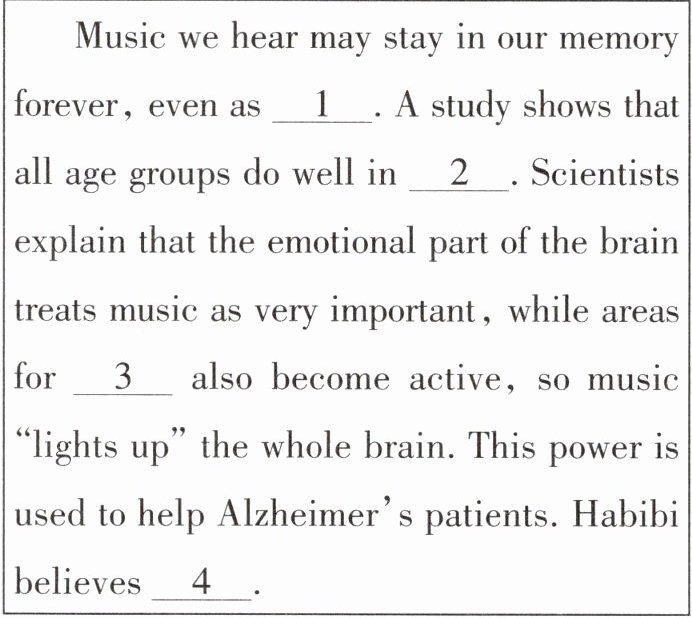
As we grow older, we may forget many things we once knew. But a new study shows that the music we have heard may stay in our minds forever.
The study was led by Sarah Sauve, a music scientist in the UK. She asked about 120 healthy adults, from 18 to 86 years old, to listen to three short pieces of music. These pieces would be played later at a concert. The people then went to the concert and wrote down every time they heard those pieces during the show.
The results showed that people of all ages could recognize the music pieces equally well. Scientists believe this happens because music activates the part of the brain that deals with feelings and emotions. This emotional part works like a “stamp of importance”—it tells the brain that music is important enough to be kept safe for a long time.
Musical memories also become hard to lose because other parts of the brain help. For example, the part of the brain that controls movement responds to the beat of a song, while the part that controls hearing responds to the highness or lowness of the sounds. So music can “light up” the whole brain, according to Science Daily.
Because of this, music can be used to help patients with brain diseases, such as those who lose their memory. Assal Habibi, a researcher in the US, is trying to help Alzheimer’s(阿尔茨海默病)patients reconnect with their sense of self through familiar music.
“When you hear familiar music, there is activity all over your brain, like a key to our deepest memories,” said Habibi.
1.
2.
3.
4.
As we grow older, we may forget many things we once knew. But a new study shows that the music we have heard may stay in our minds forever.
The study was led by Sarah Sauve, a music scientist in the UK. She asked about 120 healthy adults, from 18 to 86 years old, to listen to three short pieces of music. These pieces would be played later at a concert. The people then went to the concert and wrote down every time they heard those pieces during the show.
The results showed that people of all ages could recognize the music pieces equally well. Scientists believe this happens because music activates the part of the brain that deals with feelings and emotions. This emotional part works like a “stamp of importance”—it tells the brain that music is important enough to be kept safe for a long time.
Musical memories also become hard to lose because other parts of the brain help. For example, the part of the brain that controls movement responds to the beat of a song, while the part that controls hearing responds to the highness or lowness of the sounds. So music can “light up” the whole brain, according to Science Daily.
Because of this, music can be used to help patients with brain diseases, such as those who lose their memory. Assal Habibi, a researcher in the US, is trying to help Alzheimer’s(阿尔茨海默病)patients reconnect with their sense of self through familiar music.
“When you hear familiar music, there is activity all over your brain, like a key to our deepest memories,” said Habibi.
1.
we get older
2.
recognizing the music they've just heard
3.
movement and hearing
4.
familiar music can bring back their sense of self / familiar music can make brain active / when we hear familiar music our brain become active
答案
1. we get older
2. recognizing the music they've just heard
3. movement and hearing
4. familiar music can bring back their sense of self / familiar music can make brain active / when we hear familiar music our brain become active
