

 登录
五、看图根据上下文提示完成下列对话,每空填一词。
A: Hi, Mr Smith.
B: No. I
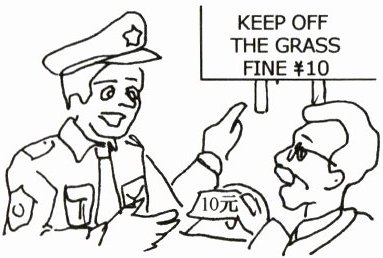
A: So you
B: Yes. I
A: What does it
B: Keep off the grass. Fine (罚款)¥10.
A: Oh, I see. You should
B: That's right.
A: Hi, Mr Smith.
Were
you at home yesterday morning?B: No. I
went
to the park. I saw/found
a ten-yuan note(钱币) on the grass.A: So you
picked
it up. Right?B: Yes. I
was
very happy. But then a park keeper(管理员) came up to me. He pointed
at a sign
.A: What does it
mean
?B: Keep off the grass. Fine (罚款)¥10.
A: Oh, I see. You should
give
ten
yuan to him. Ha ha, you've got nothing.B: That's right.
答案
Were; went; saw/found; picked; was; pointed; sign; mean; give ten
解析
【分析】本题是结合图片和上下文补全对话的题型,需根据时间标志(如yesterday morning)确定时态为一般过去时,再结合图片信息(公园标识、罚款10元)和语境逻辑填写单词。首先分析每个空的语境:1. 询问过去是否在家,用be动词过去式;2. 表达去公园的动作,用go的过去式;3. 描述在草地发现/看到钱的动作;4. 对应“捡起”的固定短语;5. 表达过去的情绪状态;6. 对应“指着”的固定短语;7. 管理员指的是公园标识;8. 询问标识的含义;9-10. 结合罚款信息,表达“给10元”的动作。
【解析】1. 第一空:由yesterday morning可知是一般过去时,主语为you,be动词用Were;2. 第二空:“去公园”用go的过去式went;3. 第三空:结合语境,在草地发现/看到钱,可用saw或found;4. 第四空:“捡起”是固定短语pick up,过去式为picked;5. 第五空:主语I,一般过去时be动词用was;6. 第六空:“指着”是固定短语point at,过去式为pointed;7. 第七空:管理员指的是公园的标识sign;8. 第八空:询问标识的意思,用动词mean;9-10空:结合图片中罚款10元的信息,表达“给10元”,即give ten。
【答案】Were; went; saw/found; picked; was; pointed; sign; mean; give ten
【知识点】一般过去时、固定搭配、词汇运用
【点评】本题以图文结合的形式考查英语基础知识,重点是一般过去时的动词变形和常用短语,学生需结合语境和图片信息答题,难度适中。
【难度系数】0.5
六、阅读理解。
A)阅读短文,根据短文内容给插图编序号,并选择正确答案。
A young(年轻的)man and an old man walked in the park. The old man was behind the young man. There was a chair over there. The old man was tired. He wanted to sit on the chair for a rest. He saw the young man walking to it too. So he began to run. The young man shouted, “Don’t sit on that chair!” The old man didn’t listen to him. He sat on it. He looked happy.
The young man came over to him. There was a sign in his hand. It said, “Wet Paint(油漆未干)”.

(
(
A. in front of B. behind C. beside
(
A. sit on the chair
B. drive the old man away
C. put a sign beside the chair
(
A. sick B. hungry C. tired
(
A. the young man sat on the chair first
B. the old man's clothes were wet with paint
C. the young and the old man became good friends
A)阅读短文,根据短文内容给插图编序号,并选择正确答案。
A young(年轻的)man and an old man walked in the park. The old man was behind the young man. There was a chair over there. The old man was tired. He wanted to sit on the chair for a rest. He saw the young man walking to it too. So he began to run. The young man shouted, “Don’t sit on that chair!” The old man didn’t listen to him. He sat on it. He looked happy.
The young man came over to him. There was a sign in his hand. It said, “Wet Paint(油漆未干)”.
(
2
) (3
) (4
) (1
)(
A
)1. The young man was in front of
the old man at first.A. in front of B. behind C. beside
(
C
)2. The young man wanted to put a sign beside the chair
.A. sit on the chair
B. drive the old man away
C. put a sign beside the chair
(
C
)3. The old man was tired
and he wanted to have a rest.A. sick B. hungry C. tired
(
B
)4. At last, the old man's clothes were wet with paint
.A. the young man sat on the chair first
B. the old man's clothes were wet with paint
C. the young and the old man became good friends
答案
插图序号:2 3 4 1 1. A 2. C 3. C 4. B
解析
【分析】首先梳理短文的情节发展,将四幅插图与情节对应排序;再根据短文细节逐一分析选择题的选项,明确每个问题的答案依据。
【解析】1. 插图排序:根据短文情节,老人想坐椅子跑向椅子对应插图2,年轻男子喊老人别坐对应插图3,年轻男子举“Wet Paint”牌子过来对应插图4,老人坐椅子后椅子被遮挡对应插图1,故插图序号为2、3、4、1。2. 选择题解析:①由短文“The old man was behind the young man”可知,年轻男子在老人前面,选A;②年轻男子手里有写着“Wet Paint”的牌子,他过来是要在椅子旁放置该牌子,选C;③短文提到“The old man was tired. He wanted to sit on the chair for a rest”,选C;④因椅子油漆未干,老人坐后衣服会被油漆弄湿,选B。
【答案】插图序号:2 3 4 1;1.A 2.C 3.C 4.B
【知识点】阅读理解,细节理解,图文匹配
【点评】本题是图文结合的阅读理解题,需学生读懂短文理清情节,匹配插图并根据细节答题,考查阅读理解与图文对应能力,难度适中。
【难度系数】0.6
