

 登录
登录
四、短文填空。
请从方框内选择适当的词并用其正确形式填空,使文章完整连贯。注意:每空一词,每词仅用一次,有两词为多余选项。

Today my parents had a party at home. They invited 1.
I never knew so many 3.
I learned a lot about my neighbours and felt the warmth of our 9.
请从方框内选择适当的词并用其正确形式填空,使文章完整连贯。注意:每空一词,每词仅用一次,有两词为多余选项。
Today my parents had a party at home. They invited 1.
everyone
who lives on our street. My parents thought it was a good way for the neighbours to get to know one another. After the party, I 2. certainly
agreed with them.I never knew so many 3.
interesting
people live around us. I learned that Ms Taylor teaches 4. children
to ride horses. It is cool to ride on horseback! I plan to learn it from her. Also, I learnt that our 5. neighbour
, Mr Allen, is a teacher. 6. But
I never knew his students are dogs! He trains dogs to be helpers for people who can't 7. see
. He told me how he chose the dogs. He also talked about how he taught the dogs to 8. communicate
with the people they would help.I learned a lot about my neighbours and felt the warmth of our 9.
community
. Our street now feels more 10. like
a big family. I'm thankful for this wonderful party.答案
1. everyone 2. certainly 3. interesting 4. children
5. neighbour 6. But 7. see 8. communicate
9. community 10. like
5. neighbour 6. But 7. see 8. communicate
9. community 10. like
解析
【分析】
本题为短文选词填空题,需先通读短文把握大意,再结合每个空格的语境、词性要求,从方框内选择合适的单词,同时注意单词的正确形式(如名词单复数、词性转换等),且每词仅用一次。解题时要逐空分析,结合上下文逻辑和语法规则确定答案。
【解析】
1. 空格作invited的宾语,指“住在街上的每个人”,方框内everyone符合语境,故填everyone。
2. 空格修饰动词agreed,需用副词,方框内certainly为副词,表“当然”,符合语境,故填certainly。
3. 空格修饰名词people,需用形容词,方框内名词interest转换为形容词interesting(有趣的),故填interesting。
4. 空格作teach的宾语,指“孩子们”,方框内名词child变为复数children,故填children。
5. 空格指“Allen先生”的身份,结合语境是“我们的邻居”,方框内neighbour符合,故填neighbour。
6. 前后句为转折关系,需用转折连词,方框内but符合,句首大写为But,故填But。
7. 空格前为情态动词can't,后接动词原形,结合语境“帮助不能看见的人”,方框内see符合,故填see。
8. 固定搭配communicate with(与……交流),方框内communicate符合,故填communicate。
9. 空格指“社区的温暖”,方框内community符合语境,故填community。
10. 固定搭配more like(更像),方框内like符合,故填like。
【答案】
1. everyone 2. certainly 3. interesting 4. children 5. neighbour 6. But 7. see 8. communicate 9. community 10. like
【知识点】
形容词用法、固定搭配、词性转换
【点评】
本题考查词汇在语境中的灵活运用,需学生掌握单词的词性转换、固定搭配及上下文逻辑,是基础类选词填空题型,难度适中。
【难度系数】
0.6
本题为短文选词填空题,需先通读短文把握大意,再结合每个空格的语境、词性要求,从方框内选择合适的单词,同时注意单词的正确形式(如名词单复数、词性转换等),且每词仅用一次。解题时要逐空分析,结合上下文逻辑和语法规则确定答案。
【解析】
1. 空格作invited的宾语,指“住在街上的每个人”,方框内everyone符合语境,故填everyone。
2. 空格修饰动词agreed,需用副词,方框内certainly为副词,表“当然”,符合语境,故填certainly。
3. 空格修饰名词people,需用形容词,方框内名词interest转换为形容词interesting(有趣的),故填interesting。
4. 空格作teach的宾语,指“孩子们”,方框内名词child变为复数children,故填children。
5. 空格指“Allen先生”的身份,结合语境是“我们的邻居”,方框内neighbour符合,故填neighbour。
6. 前后句为转折关系,需用转折连词,方框内but符合,句首大写为But,故填But。
7. 空格前为情态动词can't,后接动词原形,结合语境“帮助不能看见的人”,方框内see符合,故填see。
8. 固定搭配communicate with(与……交流),方框内communicate符合,故填communicate。
9. 空格指“社区的温暖”,方框内community符合语境,故填community。
10. 固定搭配more like(更像),方框内like符合,故填like。
【答案】
1. everyone 2. certainly 3. interesting 4. children 5. neighbour 6. But 7. see 8. communicate 9. community 10. like
【知识点】
形容词用法、固定搭配、词性转换
【点评】
本题考查词汇在语境中的灵活运用,需学生掌握单词的词性转换、固定搭配及上下文逻辑,是基础类选词填空题型,难度适中。
【难度系数】
0.6
Period 3 Section A 3a-3c
必备知识导学
核心词汇
知识点 difficulty 教材 p75 If the old man has difficulty in hearing, you can write things down for him.
difficulty n.
困难;难题
have difficulty (in) doing sth
=have trouble (in) doing sth
做某事有困难
→ Many beginners have difficulty (in) pronouncing these English words. 许多初学者在读这些英语单词时存在困难。
have difficulty/difficulties with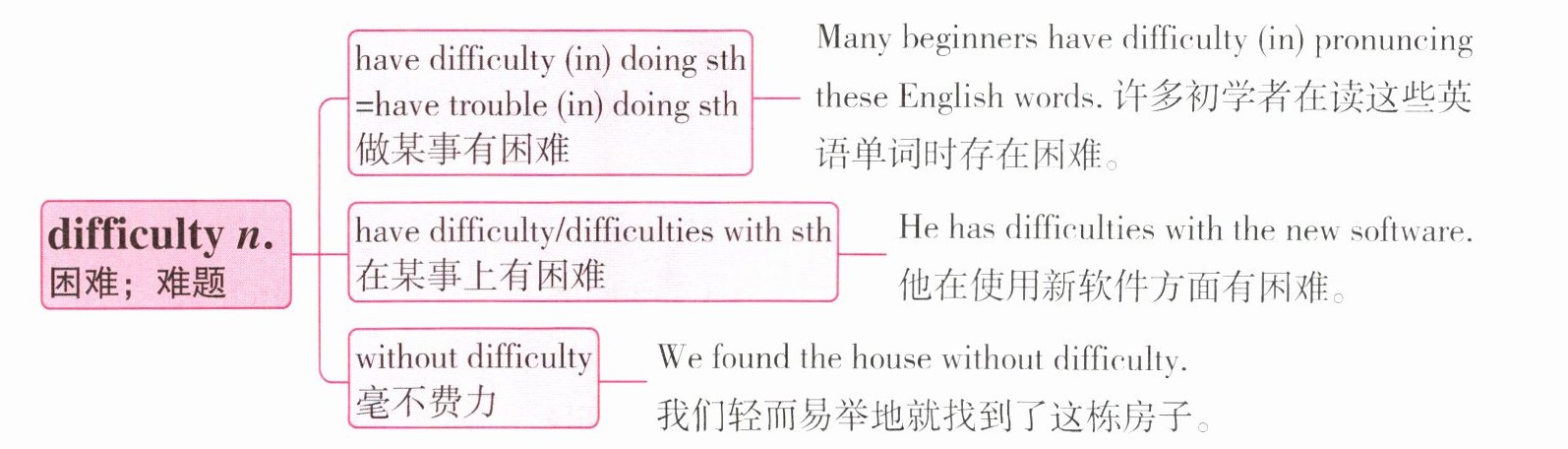 sth
sth
在某事上有困难
→ He has difficulties with the new software. 他在使用新软件方面有困难。
without difficulty
毫不费力
→ We found the house without difficulty. 我们轻而易举地就找到了这栋房子。
【情境运用】
用括号中所给单词的适当形式填空。
(1) He climbed to the top of the hill without
(2) I have difficulty in
必备知识导学
核心词汇
知识点 difficulty 教材 p75 If the old man has difficulty in hearing, you can write things down for him.
difficulty n.
困难;难题
have difficulty (in) doing sth
=have trouble (in) doing sth
做某事有困难
→ Many beginners have difficulty (in) pronouncing these English words. 许多初学者在读这些英语单词时存在困难。
have difficulty/difficulties with
sth在某事上有困难
→ He has difficulties with the new software. 他在使用新软件方面有困难。
without difficulty
毫不费力
→ We found the house without difficulty. 我们轻而易举地就找到了这栋房子。
【情境运用】
用括号中所给单词的适当形式填空。
(1) He climbed to the top of the hill without
difficulty
(difficult).(2) I have difficulty in
solving
(solve) the maths problem.答案
(1) difficulty (2) solving
解析
【分析】
本题考查名词difficulty的固定搭配用法。解题时需先回忆difficulty的相关固定短语和结构:第(1)题中,介词without后需接名词,对应固定短语without difficulty;第(2)题考查固定结构have difficulty (in) doing sth,介词后要接动词的动名词形式,据此确定单词的正确形式。
【解析】
(1) 空格前是介词without,固定短语without difficulty意为“毫不费力”,此处需要名词difficulty,故填difficulty。
(2) 固定结构have difficulty (in) doing sth表示“做某事有困难”,其中介词in可省略,介词后需接动词的动名词形式,solve的动名词为solving,故填solving。
【答案】
(1) difficulty (2) solving
【知识点】
difficulty的固定搭配;动名词的用法
【点评】
本题围绕difficulty的核心固定搭配展开,属于基础词汇运用题,考查学生对课本基础短语的掌握情况,难度较低。
【难度系数】
0.6
本题考查名词difficulty的固定搭配用法。解题时需先回忆difficulty的相关固定短语和结构:第(1)题中,介词without后需接名词,对应固定短语without difficulty;第(2)题考查固定结构have difficulty (in) doing sth,介词后要接动词的动名词形式,据此确定单词的正确形式。
【解析】
(1) 空格前是介词without,固定短语without difficulty意为“毫不费力”,此处需要名词difficulty,故填difficulty。
(2) 固定结构have difficulty (in) doing sth表示“做某事有困难”,其中介词in可省略,介词后需接动词的动名词形式,solve的动名词为solving,故填solving。
【答案】
(1) difficulty (2) solving
【知识点】
difficulty的固定搭配;动名词的用法
【点评】
本题围绕difficulty的核心固定搭配展开,属于基础词汇运用题,考查学生对课本基础短语的掌握情况,难度较低。
【难度系数】
0.6
