

 登录
China has sent many satellites and spaceships into space. When naming them, scientists get ideas from old stories and ancient famous people.
Long, long ago, Chinese people dreamed of going to the moon. Chang’ e Flies to the Moon is a very popular story. So, China’s first man-made satellite around the moon was named Chang’ e Ⅰ. What’s more, the moon rover(巡视器)was named after the Jade Rabbit. In the story, the Jade Rabbit is the good partner of Chang’ e. These old stories carry people’s best wishes and dreams. And with science and technology, scientists make them come true.
Kua Fu Runs After the Sun is another famous story. It shows that ancient Chinese people wanted to know the unknown world. Now, we have a space project called Kuafu Mission. It’s like Kua Fu is going with scientists to “visit” the sun.
Scientists also get ideas from ancient famous people. For example, Mozi was an ancient scientist. Over 2,000 years ago, he found that light travels in a straight line. This helped a lot with space study at that time. So, China’s first quantum(量子)science satellite was named Mozi. It made China the first country to achieve quantum communication between satellites and the ground.
From the names of these satellites, we can see how great our traditional culture is. It has a big influence on our modern science and technology.
根据材料内容选择最佳答案。
(
①old stories ②traditional projects ③ancient famous people ④ popular inventions
A. ①② B. ①③ C. ②④ D. ③④
(
A. It moves around the moon.
B. It protects the Jade Rabbit.
C. It “visits” the sun with the scientists.
D. It is the world’s first man-made satellite.
(
A. By listing numbers.
B. By comparing facts.
C. By giving an example.
D. By reporting a result.
(
(
A. To spread the traditional Chinese culture.
B. To explain how our scientists develop the space industry.
C. To introduce the achievements in our science and technology.
D. To tell how traditional Chinese culture influences our space science.
Long, long ago, Chinese people dreamed of going to the moon. Chang’ e Flies to the Moon is a very popular story. So, China’s first man-made satellite around the moon was named Chang’ e Ⅰ. What’s more, the moon rover(巡视器)was named after the Jade Rabbit. In the story, the Jade Rabbit is the good partner of Chang’ e. These old stories carry people’s best wishes and dreams. And with science and technology, scientists make them come true.
Kua Fu Runs After the Sun is another famous story. It shows that ancient Chinese people wanted to know the unknown world. Now, we have a space project called Kuafu Mission. It’s like Kua Fu is going with scientists to “visit” the sun.
Scientists also get ideas from ancient famous people. For example, Mozi was an ancient scientist. Over 2,000 years ago, he found that light travels in a straight line. This helped a lot with space study at that time. So, China’s first quantum(量子)science satellite was named Mozi. It made China the first country to achieve quantum communication between satellites and the ground.
From the names of these satellites, we can see how great our traditional culture is. It has a big influence on our modern science and technology.
根据材料内容选择最佳答案。
(
B
)26. In China, space scientists get ideas from when naming satellites.①old stories ②traditional projects ③ancient famous people ④ popular inventions
A. ①② B. ①③ C. ②④ D. ③④
(
A
)27. What do we know about Chang’ e Ⅰ according to the text?A. It moves around the moon.
B. It protects the Jade Rabbit.
C. It “visits” the sun with the scientists.
D. It is the world’s first man-made satellite.
(
C
)28. How does the writer support his opinion in Paragraph 4?A. By listing numbers.
B. By comparing facts.
C. By giving an example.
D. By reporting a result.
(
A
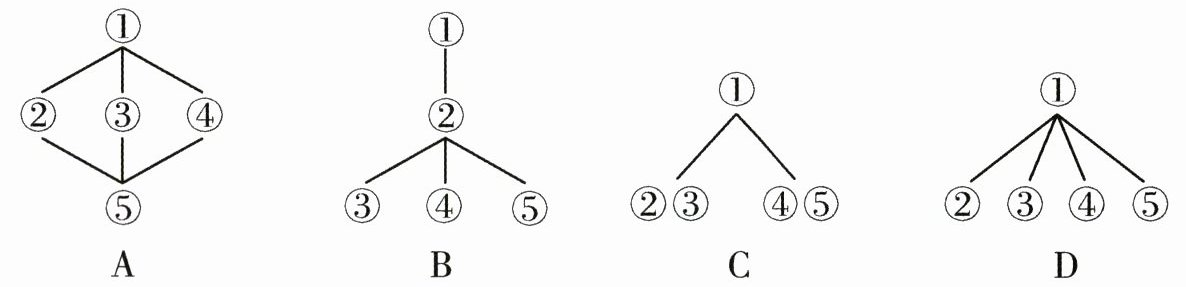
)29. Which is the right structure of the text? (①=Paragraph 1 ②=Paragraph 2,…)(
D
)30. What’s the writer’s main purpose of writing the text?A. To spread the traditional Chinese culture.
B. To explain how our scientists develop the space industry.
C. To introduce the achievements in our science and technology.
D. To tell how traditional Chinese culture influences our space science.
答案
26. B 27. A 28. C 29. A 30. D
解析
【分析】
本题为英语阅读理解题,需根据原文内容逐一分析各题:
1. 第26题:定位原文第一段,提取科学家命名卫星的灵感来源,匹配对应选项;
2. 第27题:定位原文关于嫦娥一号的描述,提取关键信息判断选项;
3. 第28题:分析第四段的论证方法,判断论证方式;
4. 第29题:梳理文章段落结构,匹配对应结构选项;
5. 第30题:定位最后一段,明确作者写作目的,匹配对应选项。
【解析】
26. 原文第一段明确说明“scientists get ideas from old stories and ancient famous people”,即命名灵感来自①老故事和③古代名人,对应选项B,故选B。
27. 原文第二段提到“China’s first man-made satellite around the moon was named Chang’ e Ⅰ”,可知嫦娥一号是绕月球运行的卫星,对应选项A,故选A。
28. 第四段通过列举墨子的例子说明卫星命名的灵感来源,采用举例子的论证方式,对应选项C,故选C。
29. 文章结构为:①总起段(引入命名灵感来源),②(嫦娥)、③(夸父)、④(墨子)三个分述例子,⑤总结段(点明传统文化对科技的影响),对应选项A的结构,故选A。
30. 最后一段指出“traditional culture has a big influence on our modern science and technology”,作者的写作目的是说明中国传统文化对航天科技的影响,对应选项D,故选D。
【答案】
26.B 27.A 28.C 29.A 30.D
【知识点】
阅读理解细节理解、阅读理解主旨大意、阅读理解推理判断
【点评】
本题考查英语阅读理解的综合能力,涵盖细节定位、结构分析、主旨把握等考点,需要学生准确提取原文信息,逻辑分析段落关系,整体难度适中,适合初中阶段学生练习。
【难度系数】
0.6
