

 登录
【学以致用】
假如你是赵娟,你的英国笔友 Diana 给你发来一封电子邮件,她向你询问中国的春节有哪些习俗。请你根据下面的图示,给她回复一封电子邮件。
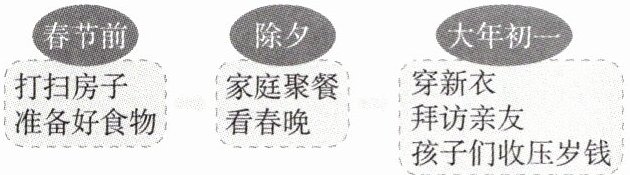
参考词汇:春晚 the Spring Festival Gala
要求:
1. 内容应包括图示中的所有信息,可以适当发挥;
2. 语句通顺、意思连贯、语法正确;
3. 70词左右(邮件的格式、开头和结尾已给出,不计入总词数)。
Dear Diana,
Let me tell you something about traditions of the Spring Festival in my country.
Tell me about a festival in your country.
Love from,
Zhao Juan
假如你是赵娟,你的英国笔友 Diana 给你发来一封电子邮件,她向你询问中国的春节有哪些习俗。请你根据下面的图示,给她回复一封电子邮件。
参考词汇:春晚 the Spring Festival Gala
要求:
1. 内容应包括图示中的所有信息,可以适当发挥;
2. 语句通顺、意思连贯、语法正确;
3. 70词左右(邮件的格式、开头和结尾已给出,不计入总词数)。
Dear Diana,
Let me tell you something about traditions of the Spring Festival in my country.
Tell me about a festival in your country.
Love from,
Zhao Juan
答案
One possible version:
Dear Diana,
Let me tell you something about traditions of the Spring Festival in my country.
The Spring Festival is a traditional festival in China. A few days before the Spring Festival, we clean our houses and get lots of food ready. On Chinese New Year's Eve, we have a big family dinner and watch the Spring Festival Gala. We usually eat dumplings. They're quite delicious. On the first day of the Spring Festival, we wear our new clothes and visit our family and friends. Usually, children get lucky money.
Tell me about a festival in your country.
Love from,
Zhao Juan
Ⅰ. 用所给词的适当形式填空
1. She will be able
2. I hate
3. We wanted
4. They regretted
5. He left the room without
1. She will be able
to work
(work) on time.2. I hate
washing
(wash) dishes. It's so boring.3. We wanted
to see
(see) the movie last night.4. They regretted
wasting
(waste) so much time.5. He left the room without
saying
(say) a word.答案
1. to work 2. washing 3. to see 4. wasting 5. saying
Ⅱ. 完成句子
1. 这个好消息使她高兴。
The good news
2. 他最终放弃了这项任务。
He finally
3. 他和他的朋友们对这个计划的看法不一致。
He
4. 他经常把这支钢笔当作记号笔。
He often
5. 让我们做一个漂亮的蛋糕。
1. 这个好消息使她高兴。
The good news
made
her
happy
.2. 他最终放弃了这项任务。
He finally
gave
up
the task.3. 他和他的朋友们对这个计划的看法不一致。
He
disagreed
with
his friends about the plan.4. 他经常把这支钢笔当作记号笔。
He often
uses
this pen as
a marker.5. 让我们做一个漂亮的蛋糕。
Let's
make
a beautiful cake.答案
1. made her happy 2. gave up 3. disagreed with 4. uses; as 5. Let's make
Ⅲ. 阅读理解
There are many different traditional festivals in China. The Double Ninth Festival is among them. It falls on the ninth day of the ninth Chinese lunar month. It has a history of over 2,000 years. It can be traced(追踪) back to the Pre-Qin period.
In different times, there were different customs. During the Double Ninth Festival, one of the most well-known customs is climbing mountains. As the saying goes, “Climbing high at the Double Ninth Festival brings good luck and wards off(避免) disasters(灾害).” People climb to the top, enjoying the autumn scenery and breathing fresh air. Also, they can build their bodies. The second custom has something to do with chrysanthemums(菊花). At that time, chrysanthemums are in full bloom. The flower symbolises long life. Drinking chrysanthemum wine(酒) is another custom. It is said that the wine has certain health benefits and can help to keep away illness. The third custom is that people often wear dogwood(茱萸) on that day to drive away evil spirits(恶魔).
It is said that these customs are from one legend(传说). Long long ago, there was a small village in the Ruhe River. There was a devil(魔鬼) and it brought disasters and deaths to local people. A young man named Huan Jing decided to get rid of(除掉) it. He found an immortal(仙人). The immortal told him the ways. So on that day, he led villagers to the top of the mountain. People prepared chrysanthemum wine and dogwood. At last, they drove away the devil. Since then, these traditions have been passed down.
In modern China, the Double Ninth Festival has more meanings. In addition to the traditional activities, people care more for the elders. Young people usually give presents to the elders and get together with them to show their respect and love.
1. When did the Double Ninth Festival start?
A. In 2000 BC.
B. In 2000.
C. Before the Qin Dynasty.
2. What does the underlined phrase “in full bloom” in paragraph 2 mean?
A. 凋谢
B. 盛开
C. 离开
3. Your penfriend Tom comes to China to study. He likes traditional Chinese festivals. What can he do to celebrate the traditional Double Ninth Festival at your home?
a. Eat mooncakes.
b. Climb a high mountain with you.
c. Drink chrysanthemum wine.
d. Wear dogwood.
e. Eat zongzi.
A. abe
B. acd
C. bcd
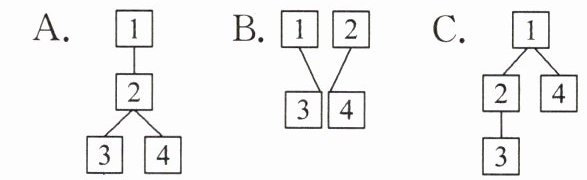
4. Which one is the best structure of the passage? (1=paragraph 1...)
There are many different traditional festivals in China. The Double Ninth Festival is among them. It falls on the ninth day of the ninth Chinese lunar month. It has a history of over 2,000 years. It can be traced(追踪) back to the Pre-Qin period.
In different times, there were different customs. During the Double Ninth Festival, one of the most well-known customs is climbing mountains. As the saying goes, “Climbing high at the Double Ninth Festival brings good luck and wards off(避免) disasters(灾害).” People climb to the top, enjoying the autumn scenery and breathing fresh air. Also, they can build their bodies. The second custom has something to do with chrysanthemums(菊花). At that time, chrysanthemums are in full bloom. The flower symbolises long life. Drinking chrysanthemum wine(酒) is another custom. It is said that the wine has certain health benefits and can help to keep away illness. The third custom is that people often wear dogwood(茱萸) on that day to drive away evil spirits(恶魔).
It is said that these customs are from one legend(传说). Long long ago, there was a small village in the Ruhe River. There was a devil(魔鬼) and it brought disasters and deaths to local people. A young man named Huan Jing decided to get rid of(除掉) it. He found an immortal(仙人). The immortal told him the ways. So on that day, he led villagers to the top of the mountain. People prepared chrysanthemum wine and dogwood. At last, they drove away the devil. Since then, these traditions have been passed down.
In modern China, the Double Ninth Festival has more meanings. In addition to the traditional activities, people care more for the elders. Young people usually give presents to the elders and get together with them to show their respect and love.
1. When did the Double Ninth Festival start?
C
A. In 2000 BC.
B. In 2000.
C. Before the Qin Dynasty.
2. What does the underlined phrase “in full bloom” in paragraph 2 mean?
B
A. 凋谢
B. 盛开
C. 离开
3. Your penfriend Tom comes to China to study. He likes traditional Chinese festivals. What can he do to celebrate the traditional Double Ninth Festival at your home?
C
a. Eat mooncakes.
b. Climb a high mountain with you.
c. Drink chrysanthemum wine.
d. Wear dogwood.
e. Eat zongzi.
A. abe
B. acd
C. bcd
4. Which one is the best structure of the passage? (1=paragraph 1...)
C
答案
1. C 2. B 3. C 4. C
