

 登录
登录
一、从方框中选择合适的句子,完成下面对话。(填序号)
A. Is there a library near here?
B. How can I get there?
C. Thank you very much.
D. How far is it from here?
E. Sorry, I don't know.
A: Excuse me, where is the library?
B:
A: Thank you. Excuse me.
C: No, there isn't a library near here. But there is one near the zoo.
A:
C: It's about 2km away.
A:
C: You can take a taxi. It's too late. There aren't any buses now.
A:
C: You're welcome.
A. Is there a library near here?
B. How can I get there?
C. Thank you very much.
D. How far is it from here?
E. Sorry, I don't know.
A: Excuse me, where is the library?
B:
E
You may ask that policeman for help.A: Thank you. Excuse me.
A
C: No, there isn't a library near here. But there is one near the zoo.
A:
D
C: It's about 2km away.
A:
B
C: You can take a taxi. It's too late. There aren't any buses now.
A:
C
C: You're welcome.
答案
E A D B C
二、阅读以下材料,选择正确的答案。
Our country is a large one. There are many differences between the north(北方) and the south(南方). Students are talking about them now.
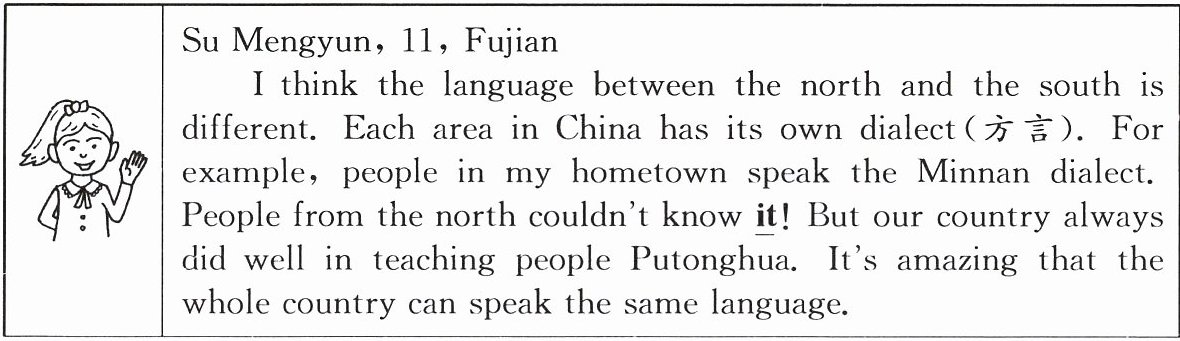
Su Mengyun, 11, Fujian
I think the language between the north and the south is different. Each area in China has its own dialect(方言). For example, people in my hometown speak the Minnan dialect. People from the north couldn't know it! But our country always did well in teaching people Putonghua. It's amazing that the whole country can speak the same language.
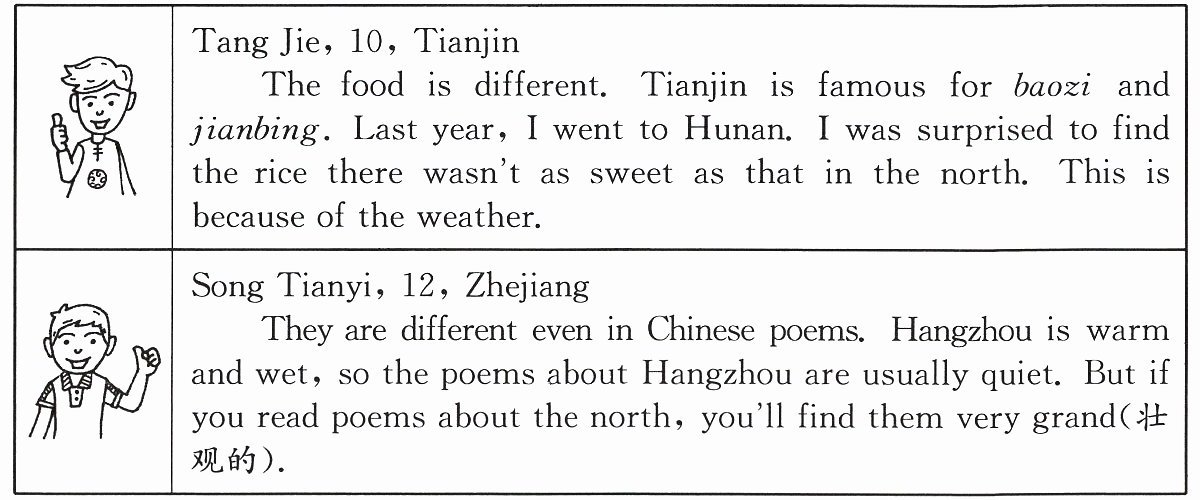
Tang Jie, 10, Tianjin
The food is different. Tianjin is famous for baozi and jianbing. Last year, I went to Hunan. I was surprised to find the rice there wasn't as sweet as that in the north. This is because of the weather.
Song Tianyi, 12, Zhejiang
They are different even in Chinese poems. Hangzhou is warm and wet, so the poems about Hangzhou are usually quiet. But if you read poems about the north, you'll find them very grand(壮观的).
(
A. the north dialect
B. Fujian
C. Minnan dialect
D. Putonghua
(
A. harder
B. cheaper
C. less delicious
D. sweeter
(
A. warm and cool
B. warm and wet
C. cool and wet
D. dry and cold
(
A. the differences in languages
B. the food of the north and the south
C. the differences between the north and the south
D. the most famous poems about weather
Our country is a large one. There are many differences between the north(北方) and the south(南方). Students are talking about them now.
Su Mengyun, 11, Fujian
I think the language between the north and the south is different. Each area in China has its own dialect(方言). For example, people in my hometown speak the Minnan dialect. People from the north couldn't know it! But our country always did well in teaching people Putonghua. It's amazing that the whole country can speak the same language.
Tang Jie, 10, Tianjin
The food is different. Tianjin is famous for baozi and jianbing. Last year, I went to Hunan. I was surprised to find the rice there wasn't as sweet as that in the north. This is because of the weather.
Song Tianyi, 12, Zhejiang
They are different even in Chinese poems. Hangzhou is warm and wet, so the poems about Hangzhou are usually quiet. But if you read poems about the north, you'll find them very grand(壮观的).
(
C
)1. The underlined word "it" in Su Mengyun's words refers to(指代) C
.A. the north dialect
B. Fujian
C. Minnan dialect
D. Putonghua
(
D
)2. Tang Jie thinks the rice is D
in the north.A. harder
B. cheaper
C. less delicious
D. sweeter
(
B
)3. The poems about Hangzhou are quiet because the weather is B
.A. warm and cool
B. warm and wet
C. cool and wet
D. dry and cold
(
C
)4. The text is mainly about C
in China.A. the differences in languages
B. the food of the north and the south
C. the differences between the north and the south
D. the most famous poems about weather
答案
1. C 2. D 3. B 4. C
