

 登录
登录
三、七选五阅读
阅读下面短文,从短文后的选项中选出能填入空白处的最佳选项。选项中有两项为多余选项。
Qipao is a kind of traditional Chinese dress for women. It stared from Manchu people of the Qing Dynasty in the early 17 century (世纪).
There is a legend (传说) about qipao. Once there was a young fisherwoman.
Later, she became the queen (皇后), bringing her beautiful qipao to Manchu women.
A. Do you know the history of qipao?
B. She lived near Jingbo Lake.
C. They all liked qipao and soon it became very popular.
D. Hanfu is usually close-fitting and usually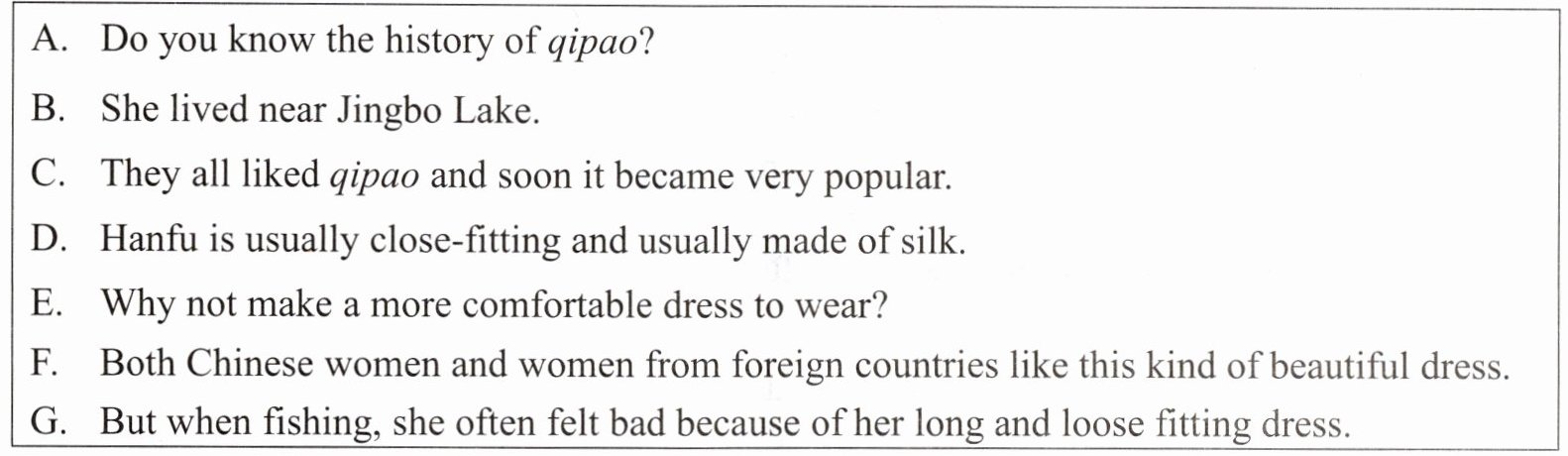 ade of silk.
E. Why not make a more comfortable dress to wear?
F. Both Chinese women and women from foreign countries like this kind of beautiful dress.
G. But when fishing, she often felt bad because of her long and loose fitting dress.
1.
阅读下面短文,从短文后的选项中选出能填入空白处的最佳选项。选项中有两项为多余选项。
Qipao is a kind of traditional Chinese dress for women. It stared from Manchu people of the Qing Dynasty in the early 17 century (世纪).
There is a legend (传说) about qipao. Once there was a young fisherwoman.
B
1 She was not only beautiful, but also clever and skillful. G
2 One day, she had a good idea and said to herself, “E
3” Then she invented (发明) qipao to help herself fish easily.Later, she became the queen (皇后), bringing her beautiful qipao to Manchu women.
C
4 Now it’s also popular around the world. F
5A. Do you know the history of qipao?
B. She lived near Jingbo Lake.
C. They all liked qipao and soon it became very popular.
D. Hanfu is usually close-fitting and usually
ade of silk.E. Why not make a more comfortable dress to wear?
F. Both Chinese women and women from foreign countries like this kind of beautiful dress.
G. But when fishing, she often felt bad because of her long and loose fitting dress.
1.
B
2. G
3. E
4. C
5. F
答案
1. B
2. G
3. E
4. C
5. F
2. G
3. E
4. C
5. F
解析
【分析】
本题为七选五阅读题,需结合上下文语境和故事发展逻辑选择合适选项。1空前介绍“年轻女渔民”,需补充她的基本情况;2空前讲女子的优点,后文说她有了好主意,中间应是她遇到的问题;3空是她针对问题的想法;4空前说她把旗袍带给满族女性,后文说旗袍流行;5空前说现在旗袍在世界流行,需对应全球喜爱的内容。
【解析】
1. 前文提到“a young fisherwoman”,需补充该女子的居住情况,选项B“She lived near Jingbo Lake.”符合语境,故1选B;
2. 前文介绍女子的优点,后文说她有了好主意,中间应是她遇到的麻烦,选项G“But when fishing, she often felt bad because of her long and loose fitting dress.”符合,故2选G;
3. 前文说她有了好主意,后文说她发明了旗袍,此处应是她的想法,选项E“Why not make a more comfortable dress to wear?”符合,故3选E;
4. 前文说她成为皇后,把旗袍带给满族女性,后文说旗袍流行,选项C“They all liked qipao and soon it became very popular.”承接上文,故4选C;
5. 前文说现在旗袍在世界流行,选项F“Both Chinese women and women from foreign countries like this kind of beautiful dress.”对应“around the world”,故5选F。
【答案】
1. B 2. G 3. E 4. C 5. F
【知识点】
七选五阅读、语境理解
【点评】
本题围绕旗袍的传说展开,考查学生对上下文逻辑和语境的把握,需结合故事发展顺序选择合适选项。
【难度系数】
0.6
本题为七选五阅读题,需结合上下文语境和故事发展逻辑选择合适选项。1空前介绍“年轻女渔民”,需补充她的基本情况;2空前讲女子的优点,后文说她有了好主意,中间应是她遇到的问题;3空是她针对问题的想法;4空前说她把旗袍带给满族女性,后文说旗袍流行;5空前说现在旗袍在世界流行,需对应全球喜爱的内容。
【解析】
1. 前文提到“a young fisherwoman”,需补充该女子的居住情况,选项B“She lived near Jingbo Lake.”符合语境,故1选B;
2. 前文介绍女子的优点,后文说她有了好主意,中间应是她遇到的麻烦,选项G“But when fishing, she often felt bad because of her long and loose fitting dress.”符合,故2选G;
3. 前文说她有了好主意,后文说她发明了旗袍,此处应是她的想法,选项E“Why not make a more comfortable dress to wear?”符合,故3选E;
4. 前文说她成为皇后,把旗袍带给满族女性,后文说旗袍流行,选项C“They all liked qipao and soon it became very popular.”承接上文,故4选C;
5. 前文说现在旗袍在世界流行,选项F“Both Chinese women and women from foreign countries like this kind of beautiful dress.”对应“around the world”,故5选F。
【答案】
1. B 2. G 3. E 4. C 5. F
【知识点】
七选五阅读、语境理解
【点评】
本题围绕旗袍的传说展开,考查学生对上下文逻辑和语境的把握,需结合故事发展顺序选择合适选项。
【难度系数】
0.6
四、综合填空
阅读下面短文,在空白处填入一个适当的单词或括号内单词的正确形式。
China is home to tea. Chinese tea culture has a 1 of more than 4,000 years. In the Tang Dynasty (朝代), people not 2 drank tea, but also ate the tea leaves. That was why tasting (品尝) tea was called “tea-eating”. In the Song Dynasty, the way people drank tea was full of art. In the Ming Dynasty, tasting tea came back to its true 3 (natural) of “drinking tea”. People put dry tea leaves in the cup and then poured (倒) boiled water into it before drinking. And in the Qing Dynasty, the tea culture came into common (普通的) 4 (family). Drinking tea became part of their daily life. At the same time, there were more tea houses.
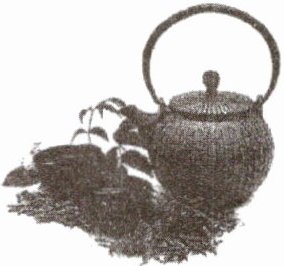
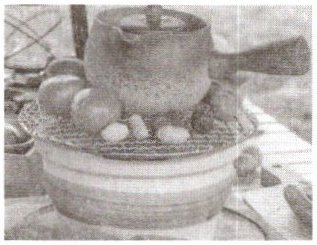
Nowadays, making tea around a stove (围炉煮茶) becomes 5 (popularity) with young people. This is a special way of 6 (drink) tea. Many young people like to choose a quiet and 7 (comfort) place to make tea. When making tea, there must be delicious snacks, such 8 small oranges and sweet potatoes on the stove. And beautiful cups and teapots can bring them more joy. What they enjoy are art, spiritual (心灵的) world and the Chinese tea culture. Away from their busy work and life, they enjoy a moment of calm and 9 (peaceful) together with their friends.
As time goes by, Chinese tea culture develops (发展) greatly. Modern tea culture 10 (mix) traditional and modern art and life, showing a more open and colorful culture.
1. 2. 3. 4. 5.
6. 7. 8. 9. 10.
阅读下面短文,在空白处填入一个适当的单词或括号内单词的正确形式。
China is home to tea. Chinese tea culture has a 1 of more than 4,000 years. In the Tang Dynasty (朝代), people not 2 drank tea, but also ate the tea leaves. That was why tasting (品尝) tea was called “tea-eating”. In the Song Dynasty, the way people drank tea was full of art. In the Ming Dynasty, tasting tea came back to its true 3 (natural) of “drinking tea”. People put dry tea leaves in the cup and then poured (倒) boiled water into it before drinking. And in the Qing Dynasty, the tea culture came into common (普通的) 4 (family). Drinking tea became part of their daily life. At the same time, there were more tea houses.
Nowadays, making tea around a stove (围炉煮茶) becomes 5 (popularity) with young people. This is a special way of 6 (drink) tea. Many young people like to choose a quiet and 7 (comfort) place to make tea. When making tea, there must be delicious snacks, such 8 small oranges and sweet potatoes on the stove. And beautiful cups and teapots can bring them more joy. What they enjoy are art, spiritual (心灵的) world and the Chinese tea culture. Away from their busy work and life, they enjoy a moment of calm and 9 (peaceful) together with their friends.
As time goes by, Chinese tea culture develops (发展) greatly. Modern tea culture 10 (mix) traditional and modern art and life, showing a more open and colorful culture.
1. 2. 3. 4. 5.
6. 7. 8. 9. 10.
答案
1. history
2. only
3. nature
4. families
5. popular
6. drinking
7. comfortable
8. as
9. peace
10. mixes
2. only
3. nature
4. families
5. popular
6. drinking
7. comfortable
8. as
9. peace
10. mixes
解析
【分析】
本题为英语综合填空题,需结合固定搭配、词性转换、语法结构及上下文语境完成填空。解题思路如下:1. 根据固定搭配“a history of”确定第1空;2. 依据固定结构“not only...but also”确定第2空;3. 形容词后需接名词,转换括号内单词词性确定第3空;4. 结合语境“普通的家庭”用复数形式确定第4空;5. 系动词后接形容词,转换括号内单词词性确定第5空;6. 介词后接动名词,转换括号内单词形式确定第6空;7. 并列结构需用相同词性,转换括号内单词词性确定第7空;8. 根据固定短语“such as”确定第8空;9. 并列名词需词性一致,转换括号内单词词性确定第9空;10. 主语为第三人称单数,一般现在时动词用单三形式确定第10空。
【解析】
1. 考查固定搭配。“a history of”意为“……的历史”,符合语境“中国茶文化有4000多年的历史”,故填history。
2. 考查固定结构。“not only...but also”是固定搭配,意为“不仅……而且……”,符合句意“人们不仅喝茶,还吃茶叶”,故填only。
3. 考查词性转换。形容词true后需接名词,natural的名词形式为nature,意为“本质”,符合语境“品茶回归‘喝茶’的本质”,故填nature。
4. 考查名词复数。此处指普通的多个家庭,family的复数形式为families,故填families。
5. 考查词性转换。become是系动词,后接形容词作表语,popularity的形容词形式为popular,意为“受欢迎的”,符合语境“围炉煮茶受年轻人欢迎”,故填popular。
6. 考查非谓语动词。介词of后需接动名词,drink的动名词形式为drinking,故填drinking。
7. 考查词性转换。and连接并列形容词修饰名词place,comfort的形容词形式为comfortable,意为“舒适的”,故填comfortable。
8. 考查固定短语。“such as”是固定短语,意为“比如”,用于列举事物,故填as。
9. 考查词性转换。and连接并列名词,calm是名词,peaceful的名词形式为peace,意为“平静”,符合语境“享受平静与安宁的时刻”,故填peace。
10. 考查主谓一致。主语Modern tea culture是第三人称单数,一般现在时中动词用单三形式,mix的单三形式为mixes,故填mixes。
【答案】
1. history 2. only 3. nature 4. families 5. popular 6. drinking 7. comfortable 8. as 9. peace 10. mixes
【知识点】
固定搭配、词性转换、主谓一致
【点评】
本题为英语综合填空基础题型,主要考查学生对英语固定短语、词性变化及语法规则的掌握,难度适中,需结合语境和语法知识逐一分析,适合初中阶段学生练习。
【难度系数】
0.6
本题为英语综合填空题,需结合固定搭配、词性转换、语法结构及上下文语境完成填空。解题思路如下:1. 根据固定搭配“a history of”确定第1空;2. 依据固定结构“not only...but also”确定第2空;3. 形容词后需接名词,转换括号内单词词性确定第3空;4. 结合语境“普通的家庭”用复数形式确定第4空;5. 系动词后接形容词,转换括号内单词词性确定第5空;6. 介词后接动名词,转换括号内单词形式确定第6空;7. 并列结构需用相同词性,转换括号内单词词性确定第7空;8. 根据固定短语“such as”确定第8空;9. 并列名词需词性一致,转换括号内单词词性确定第9空;10. 主语为第三人称单数,一般现在时动词用单三形式确定第10空。
【解析】
1. 考查固定搭配。“a history of”意为“……的历史”,符合语境“中国茶文化有4000多年的历史”,故填history。
2. 考查固定结构。“not only...but also”是固定搭配,意为“不仅……而且……”,符合句意“人们不仅喝茶,还吃茶叶”,故填only。
3. 考查词性转换。形容词true后需接名词,natural的名词形式为nature,意为“本质”,符合语境“品茶回归‘喝茶’的本质”,故填nature。
4. 考查名词复数。此处指普通的多个家庭,family的复数形式为families,故填families。
5. 考查词性转换。become是系动词,后接形容词作表语,popularity的形容词形式为popular,意为“受欢迎的”,符合语境“围炉煮茶受年轻人欢迎”,故填popular。
6. 考查非谓语动词。介词of后需接动名词,drink的动名词形式为drinking,故填drinking。
7. 考查词性转换。and连接并列形容词修饰名词place,comfort的形容词形式为comfortable,意为“舒适的”,故填comfortable。
8. 考查固定短语。“such as”是固定短语,意为“比如”,用于列举事物,故填as。
9. 考查词性转换。and连接并列名词,calm是名词,peaceful的名词形式为peace,意为“平静”,符合语境“享受平静与安宁的时刻”,故填peace。
10. 考查主谓一致。主语Modern tea culture是第三人称单数,一般现在时中动词用单三形式,mix的单三形式为mixes,故填mixes。
【答案】
1. history 2. only 3. nature 4. families 5. popular 6. drinking 7. comfortable 8. as 9. peace 10. mixes
【知识点】
固定搭配、词性转换、主谓一致
【点评】
本题为英语综合填空基础题型,主要考查学生对英语固定短语、词性变化及语法规则的掌握,难度适中,需结合语境和语法知识逐一分析,适合初中阶段学生练习。
【难度系数】
0.6
