

 登录
一、阅读理解。
阅读下面两篇语言材料,然后按文后要求做题。
A
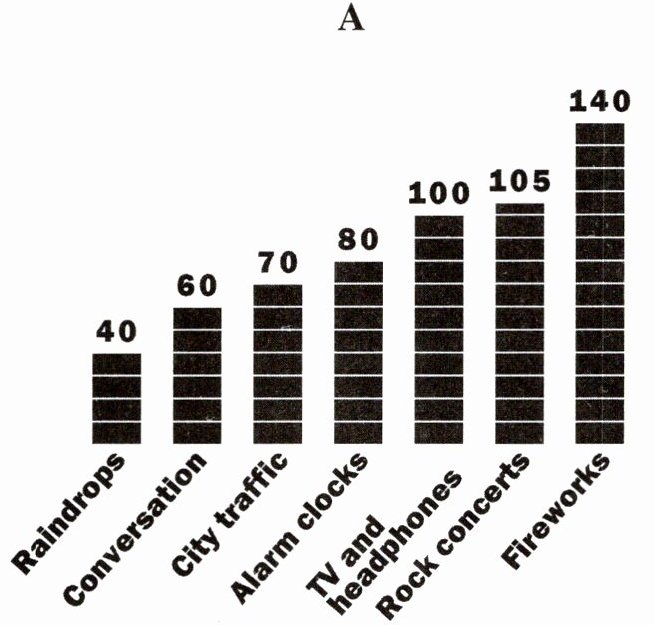
Every day, we hear sounds all around us — some soft, some loud. But do you know that loud sounds can harm your hearing?
We measure sounds in decibels (分贝). Look at the picture — some sounds are safe for our ears, but when a sound goes over 85 decibels, it can be harmful to our hearing. To reduce the risk of hearing loss, we should pay attention to the loudness of the noise, the distance between us and it and how long we listen to it.
You can measure noise levels with sound-level meters (噪声计), a device for noise testing, but you probably don’t always carry one with you. So how can you tell whether noises are too loud or not? Ask yourself: Do you have to raise your voice to be heard? Do you find it hard to hear someone about a meter away from you? Do the noises make your ears hurt or ring for some time? If your answer to any of these is YES, that probably means the noises are too loud.
Headphones are especially tricky. Many people enjoy using them, but they often listen to loud music for too long, or keep the volume (音量) so high that even other people can hear the noise from their headphones. These can lead to hearing loss.
Your hearing is a gift. You need it for learning, communicating and enjoying the world. Once your hearing is harmed, it may never come back.
根据材料内容选择最佳选项。
( )1. How does the writer begin the text?
A. By listing numbers.
B. By asking a question.
C. By telling a story.
D. By giving suggestions.
(
A. When it is below 85 decibels.
B. When it is exactly 85 decibels.
C. When it goes over 85 decibels.
D. When it is soft.
(
A. We have to raise our voice to be heard.
B. We find it hard to hear someone about a meter away.
C. We need to close the door when sleeping.
D. The noises make our ears hurt or ring for some time.
(
A. easy to cause problem
B. easy to use
C. cheap
D. beautiful
(
A. How to Use Headphones
B. Measuring Sounds with Meters
C. Different Kinds of Sounds
D. The Dangers of Loud Sounds
阅读下面两篇语言材料,然后按文后要求做题。
A
Every day, we hear sounds all around us — some soft, some loud. But do you know that loud sounds can harm your hearing?
We measure sounds in decibels (分贝). Look at the picture — some sounds are safe for our ears, but when a sound goes over 85 decibels, it can be harmful to our hearing. To reduce the risk of hearing loss, we should pay attention to the loudness of the noise, the distance between us and it and how long we listen to it.
You can measure noise levels with sound-level meters (噪声计), a device for noise testing, but you probably don’t always carry one with you. So how can you tell whether noises are too loud or not? Ask yourself: Do you have to raise your voice to be heard? Do you find it hard to hear someone about a meter away from you? Do the noises make your ears hurt or ring for some time? If your answer to any of these is YES, that probably means the noises are too loud.
Headphones are especially tricky. Many people enjoy using them, but they often listen to loud music for too long, or keep the volume (音量) so high that even other people can hear the noise from their headphones. These can lead to hearing loss.
Your hearing is a gift. You need it for learning, communicating and enjoying the world. Once your hearing is harmed, it may never come back.
根据材料内容选择最佳选项。
( )1. How does the writer begin the text?
A. By listing numbers.
B. By asking a question.
C. By telling a story.
D. By giving suggestions.
(
B
)2. When can a sound be harmful to our hearing according to the text?A. When it is below 85 decibels.
B. When it is exactly 85 decibels.
C. When it goes over 85 decibels.
D. When it is soft.
(
C
)3. Which of the following CANNOT show that the sounds around us are too loud?A. We have to raise our voice to be heard.
B. We find it hard to hear someone about a meter away.
C. We need to close the door when sleeping.
D. The noises make our ears hurt or ring for some time.
(
C
)4. What does the underlined word “tricky” in paragraph 4 probably mean?A. easy to cause problem
B. easy to use
C. cheap
D. beautiful
(
A
)5. What can be the best title for the text?A. How to Use Headphones
B. Measuring Sounds with Meters
C. Different Kinds of Sounds
D. The Dangers of Loud Sounds
答案
1. B 由第一段第二句可知,作者通过提出问题引出话题。
2. C 由第二段第二句可知,超过 85 分贝的声音对听觉有害。
3. C
4. A 后文提到很多人喜欢使用耳机,但他们用耳机时常把音量调得太高、使用时间又很长,这些都会导致听力损失。四个选项中只有 A 项与此处的语境相契合。
5. D
解析
【分析】
本题是关于噪音危害听力的英语阅读理解题,共5道选择题。解题思路为:先通读文章把握主旨,再针对每个问题定位到文章对应段落,提取关键信息,逐一分析选项,排除错误选项,得出正确答案。
【解析】
1. 第1题:根据第一段第二句“But do you know that loud sounds can harm your hearing?”可知,作者通过提出问题引出话题,故选B。
2. 第2题:根据第二段第二句“when a sound goes over 85 decibels, it can be harmful to our hearing”可知,超过85分贝的声音对听觉有害,故选C。
3. 第3题:根据第三段判断噪音过大的方法:“Do you have to raise your voice to be heard?(对应A)”“Do you find it hard to hear someone about a meter away from you?(对应B)”“Do the noises make your ears hurt or ring for some time?(对应D)”,C选项“睡觉时需要关房门”文中未提及,故选C。
4. 第4题:根据第四段后文“many people enjoy using them, but they often listen to loud music for too long... These can lead to hearing loss”可知,耳机容易引发问题,故“tricky”意为“容易导致问题”,选A。
5. 第5题:文章围绕“大声的危害”展开,A(如何用耳机)、B(用仪器测声音)、C(不同种类声音)均偏离主旨,D(大声的危害)最贴合,故选D。
【答案】
1.B 2.C 3.C 4.A 5.D
【知识点】
阅读理解、细节理解、词义猜测
【点评】
本题考查学生英语阅读理解的综合能力,需学生快速定位文章信息、理解词义、把握主旨,整体难度适中,适合学生巩固相关知识点。
【难度系数】
0.6
