

 登录
三、(真题改编)完形填空。
Paper is one of the most important inventions in human history. Before paper was invented, people used many kinds of materials to write on, such as animal bones, bamboo, silk and stones. But these materials were either
Cai Lun, a great Chinese inventor, wanted to find a
This new kind of paper was cheap, light, easy to write on and easy to make. It
Today, paper is
(
(
(
(
(
(
(
(
(
(
Paper is one of the most important inventions in human history. Before paper was invented, people used many kinds of materials to write on, such as animal bones, bamboo, silk and stones. But these materials were either
B
to use and carry, or too expensive for common people.Cai Lun, a great Chinese inventor, wanted to find a
C
way. He A
that bark, rags, fishing nets and other cheap things could be used to make paper. He mixed these materials with water, and then D
them into thin and soft sheets(薄片). After drying in the sun, the sheets became high-quality paper.This new kind of paper was cheap, light, easy to write on and easy to make. It
A
to the faster spread of knowledge and culture. Later, papermaking was B
to other countries and finally reached Europe.Today, paper is
A
used in our daily life—for writing, printing, packaging and many other things. We can also C
waste paper to protect trees and energy. It is important for us to use paper B
and love our A
.(
B
) 21. A. easy B. difficult C. good D. popular(
C
) 22. A. worse B. nearer C. better D. harder(
A
) 23. A. discovered B. gave C. sent D. carried(
D
) 24. A. cut B. turned C. pushed D. pressed(
A
) 25. A. led B. belonged C. stuck D. pointed(
B
) 26. A. sending B. sent C. to send D. send(
A
) 27. A. widely B. hardly C. seldom D. never(
C
) 28. A. waste B. buy C. recycle D. find(
B
) 29. A. slowly B. wisely C. badly D. luckily(
A
) 30. A. environment B. school C. home D. country答案
21-25 BCADA
26-30 BACBA
解析
【分析】做完形填空需先通读全文把握语篇主旨(本文围绕造纸术的发明、传播及现代应用与环保展开),再结合上下文逻辑、词汇词义辨析、固定搭配、语法知识逐个分析选项:1. 定位空格前后的语境提示,如21题由旧材料的缺点和后文“too expensive”确定对应形容词;2. 区分词汇含义,如23题“discover”指发现原有事物,符合语境;3. 注意语法形式,如26题被动语态的过去分词形式;4. 利用固定搭配,如25题“lead to”的用法。
【解析】21题:前文旧书写材料的缺点,后文or连接另一缺点“too expensive”,故空格表“难用难带”,选B difficult;22题:蔡伦要找比旧材料更好的方法,选C better;23题:他发现树皮等可造纸,discover(发现原有事物)符合,选A discovered;24题:将混合后的材料压成薄片,press(压)符合,选D pressed;25题:“lead to”是固定搭配,意为“导致”,选A led;26题:造纸术与“传播”是被动关系,用“was + 过去分词”,选B sent;27题:纸广泛用于日常生活,widely(广泛地)符合,选A widely;28题:回收废纸保护资源,recycle(回收利用)符合,选C recycle;29题:明智用纸,wisely(明智地)符合,选B wisely;30题:爱护环境,environment(环境)符合,选A environment。
【答案】21-25 BCADA
26-30 BACBA
【知识点】完形填空解题技巧、词汇词义辨析、固定搭配
【点评】本题以造纸术为话题,融合文化常识与英语知识,考查语篇理解、词汇及语法运用,是初中常见题型,需结合语境与语法作答。
【难度系数】0.5
四、阅读理解。
A
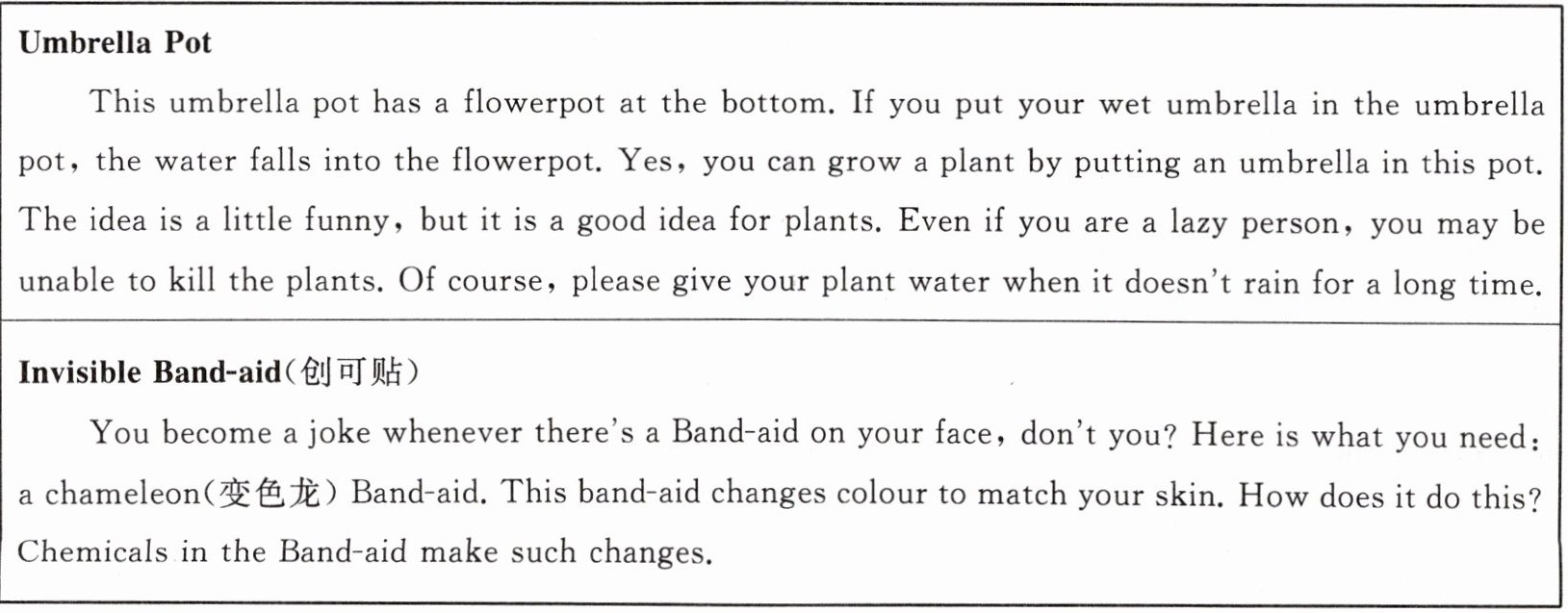
Umbrella Pot
This umbrella pot has a flowerpot at the bottom. If you put your wet umbrella in the umbrella pot, the water falls into the flowerpot. Yes, you can grow a plant by putting an umbrella in this pot. The idea is a little funny, but it is a good idea for plants. Even if you are a lazy person, you may be unable to kill the plants. Of course, please give your plant water when it doesn’t rain for a long time.
Invisible Band-aid(创可贴)
You become a joke whenever there’s a Band-aid on your face, don’t you? Here is what you need: a chameleon(变色龙) Band-aid. This band-aid changes colour to match your skin. How does it do this? Chemicals in the Band-aid make such changes.

World’s Cleverest Suitcase
Pulling a big suitcase around is tiring. The Hop suitcase saves you from that trouble. It’s made by a company in Spain. It receives signals sent from your mobile phone and follows you around. What if you stop suddenly? No worries. It’s “clever”. It keeps a fixed(固定的) distance from you. This way please, dear suitcase.
Handy Bike Grip(把手)
The comfort of the bicycle rider’s hands is important for a happy and safe journey. The X-ing Grip helps with this. In winter, a “hot wire” in the grip is solar(太阳能的) charged to warm your hands. In summer, the grip’s special design helps cool you down.
(
A. Drying flowers.
B. Growing plants.
C. Cleaning rainwater.
D. Colouring umbrellas.
(
A. The person who keeps a chameleon.
B. The person who wants to change the colour of the skin.
C. The person who has a cut on the face.
D. The person who teaches chemistry.
(
A. An X-ing Grip.
B. An umbrella pot.
C. A Hop suitcase.
D. An invisible Band-aid.
(
A. The Hop suitcase is invisible.
B. The umbrella pot is made in Spain.
C. The Band-aid is made from the chameleon.
D. The X-ing Grip is warm in winter and cool in summer.
(
A. In a travel guide.
B. In an invention magazine.
C. In a movie poster.
D. In a fairy tale.
A
Umbrella Pot
This umbrella pot has a flowerpot at the bottom. If you put your wet umbrella in the umbrella pot, the water falls into the flowerpot. Yes, you can grow a plant by putting an umbrella in this pot. The idea is a little funny, but it is a good idea for plants. Even if you are a lazy person, you may be unable to kill the plants. Of course, please give your plant water when it doesn’t rain for a long time.
Invisible Band-aid(创可贴)
You become a joke whenever there’s a Band-aid on your face, don’t you? Here is what you need: a chameleon(变色龙) Band-aid. This band-aid changes colour to match your skin. How does it do this? Chemicals in the Band-aid make such changes.
World’s Cleverest Suitcase
Pulling a big suitcase around is tiring. The Hop suitcase saves you from that trouble. It’s made by a company in Spain. It receives signals sent from your mobile phone and follows you around. What if you stop suddenly? No worries. It’s “clever”. It keeps a fixed(固定的) distance from you. This way please, dear suitcase.
Handy Bike Grip(把手)
The comfort of the bicycle rider’s hands is important for a happy and safe journey. The X-ing Grip helps with this. In winter, a “hot wire” in the grip is solar(太阳能的) charged to warm your hands. In summer, the grip’s special design helps cool you down.
(
B
) 31. What can the umbrella pot be used for?A. Drying flowers.
B. Growing plants.
C. Cleaning rainwater.
D. Colouring umbrellas.
(
C
) 32. Who needs a chameleon Band-aid most?A. The person who keeps a chameleon.
B. The person who wants to change the colour of the skin.
C. The person who has a cut on the face.
D. The person who teaches chemistry.
(
C
) 33. What is controlled by the signals from the mobile phone?A. An X-ing Grip.
B. An umbrella pot.
C. A Hop suitcase.
D. An invisible Band-aid.
(
D
) 34. What can we know from the passage?A. The Hop suitcase is invisible.
B. The umbrella pot is made in Spain.
C. The Band-aid is made from the chameleon.
D. The X-ing Grip is warm in winter and cool in summer.
(
B
) 35. Where can you find this material?A. In a travel guide.
B. In an invention magazine.
C. In a movie poster.
D. In a fairy tale.
答案
31-35 BCCDB
解析
【分析】
做此类英语阅读理解选择题时,需先通读全文把握核心内容,再针对每个小题的问题,回到原文对应段落定位关键信息,将选项与原文内容逐一比对,排除错误选项后选出正确答案。需重点关注各发明的功能、适用人群、相关细节及文章出处等信息。
【解析】
31题:定位Umbrella Pot段落,原文明确提到“you can grow a plant by putting an umbrella in this pot”,说明伞盆可用于种植植物,对应选项B;A、C、D选项内容原文未提及,排除。
32题:定位Invisible Band-aid段落,原文指出“You become a joke whenever there’s a Band-aid on your face”,说明脸上有伤口的人最需要这种变色龙创可贴,避免成为笑话,对应选项C;A、B、D选项不符合原文逻辑,排除。
33题:定位World’s Cleverest Suitcase段落,原文说明“It receives signals sent from your mobile phone and follows you around”,即Hop行李箱受手机信号控制,对应选项C;A、B、D选项与原文不符,排除。
34题:定位Handy Bike Grip段落,原文提到“In winter... warm your hands. In summer... cool you down”,说明X-ing把手冬暖夏凉,对应选项D;A、B、C选项均与原文细节矛盾,排除。
35题:全文介绍四项创意发明的特点,这类内容最可能出自发明杂志,对应选项B;A、C、D选项不符合文章题材,排除。
【答案】
31-35 BCCDB
【知识点】
英语阅读理解、细节理解题、推理判断题
【点评】
本文是一篇介绍创意发明的英语阅读理解,题型常规,主要考查学生定位原文信息、比对选项的能力,内容贴近生活,难度适中,适合初中阶段学生练习。
【难度系数】
0.6
