

 登录
[2025 苏州改编]A medical breakthrough in China is giving new hope to people with spinalcord injuries(脊髓损伤). Scientists have created a brain-spinal chip that allows paralyzed(瘫痪的)patients to move their legs, and even walk again.
The chip, only 1 mm wide, is designed to be fitted into the brain and spinal cord. If the natural communication between the brain and muscles(肌肉) is lost, this chip becomes the bridge. When the chips work, they create a direct connection between the brain and muscles.
The results have been amazing. A 34-year-old man, paralyzed after a fall, could move his legs just one day after the operation on January 8, 2025. Two weeks later, he walked five metres with help. Three other patients had similar operations in February and March, all getting better within weeks. Even though the patients' nervous systems were damaged, the chips helped them walk again. This marks a big step in China's progress in medical science and it brings hope for over 3.7 million people in China.
"This is just the beginning," Jia, the lead researcher, says. "With the technology, these people may one day leave wheelchairs behind after 3 to 5 years of training."
Behind this achievement is a long journey of careful research and bold thinking. It took the researchers over 10 years to develop the chip. They tested it on animals first, and then on people. They faced many challenges, yet they never gave up. Step by step, they developed a system to reconnect the mind and body in ways once appearing only in science fiction.
As the chip continues to improve, it lights a new path forward—one built on science, shaped by care, and aimed toward a brighter future.
6. What do we know about the chips mentioned in the passage?
A. They are only as wide as 2 mm.
B. They are fitted into the man's arms.
C. They help the patients walk again.
D. They improve the patients' memory.
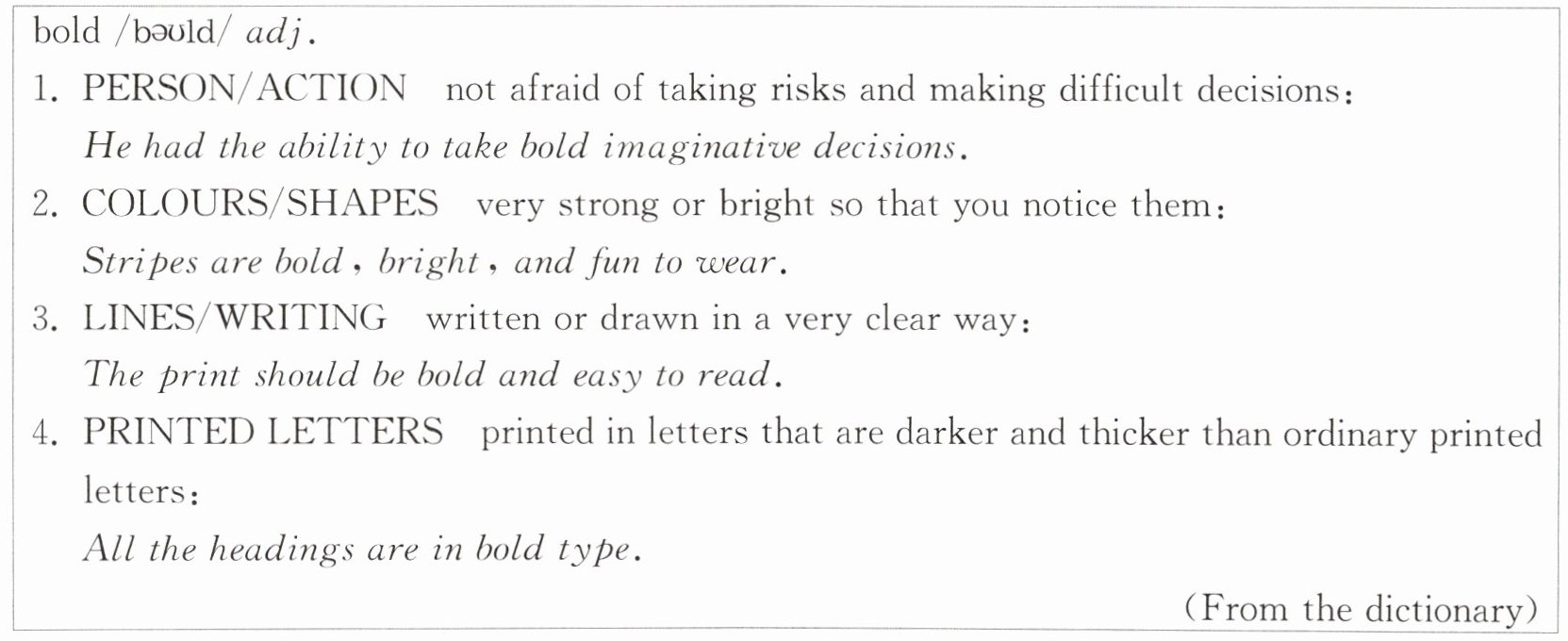
7. Which of the following meanings is suitable for the underlined word "bold"?
A. 1.
B. 2.
C. 3.
D. 4.
8. What is the writer's main reason for writing this passage?
A. To recommend a science story.
B. To report a pioneer doctor in medicine.
C. To compare different treatments.
D. To introduce a new medical success.
9. What can we infer from Paragraph 5?
A. The chip has already been perfect and needs no more improvement.
B. The researchers finished developing the chip in less than five years.
C. The development of the chip was full of difficulties but the researchers kept on.
D. Science fiction is more useful than real scientific research.
10. What would be the best title for this passage?
A. China's chips bring new hope
B. Future of China's medical science
C. Science fiction changes our lives
D. Challenges for Chinese scientists
The chip, only 1 mm wide, is designed to be fitted into the brain and spinal cord. If the natural communication between the brain and muscles(肌肉) is lost, this chip becomes the bridge. When the chips work, they create a direct connection between the brain and muscles.
The results have been amazing. A 34-year-old man, paralyzed after a fall, could move his legs just one day after the operation on January 8, 2025. Two weeks later, he walked five metres with help. Three other patients had similar operations in February and March, all getting better within weeks. Even though the patients' nervous systems were damaged, the chips helped them walk again. This marks a big step in China's progress in medical science and it brings hope for over 3.7 million people in China.
"This is just the beginning," Jia, the lead researcher, says. "With the technology, these people may one day leave wheelchairs behind after 3 to 5 years of training."
Behind this achievement is a long journey of careful research and bold thinking. It took the researchers over 10 years to develop the chip. They tested it on animals first, and then on people. They faced many challenges, yet they never gave up. Step by step, they developed a system to reconnect the mind and body in ways once appearing only in science fiction.
As the chip continues to improve, it lights a new path forward—one built on science, shaped by care, and aimed toward a brighter future.
6. What do we know about the chips mentioned in the passage?
A. They are only as wide as 2 mm.
B. They are fitted into the man's arms.
C. They help the patients walk again.
D. They improve the patients' memory.
7. Which of the following meanings is suitable for the underlined word "bold"?
A. 1.
B. 2.
C. 3.
D. 4.
8. What is the writer's main reason for writing this passage?
A. To recommend a science story.
B. To report a pioneer doctor in medicine.
C. To compare different treatments.
D. To introduce a new medical success.
9. What can we infer from Paragraph 5?
A. The chip has already been perfect and needs no more improvement.
B. The researchers finished developing the chip in less than five years.
C. The development of the chip was full of difficulties but the researchers kept on.
D. Science fiction is more useful than real scientific research.
10. What would be the best title for this passage?
A. China's chips bring new hope
B. Future of China's medical science
C. Science fiction changes our lives
D. Challenges for Chinese scientists
答案
6. C 细节理解题。根据“Scientists have created a brain-spinal chip that allows paralyzed patients to move their legs, and even walk again. ”可知,这种芯片可以帮助瘫痪患者重新行走。
7. A 词义猜测题。根据“Behind this achievement is a long journey of careful research and bold thinking. ”可知,bold thinking 与 careful research 为并列关系,描述研究历程。根据词典中的第一条释义可知,bold 可意为“敢于冒险和制定困难的决策”,这与研究者十多年攻坚、突破常规的背景匹配。
8. D 推理判断题。通读全文可知,文章首段点明主题,即医学上的突破,后续聚焦芯片原理、疗效及意义,末段展望未来。因此,作者的写作意图应是介绍一项新的医疗成果。
9. C 推理判断题。根据“They tested it on animals first, and then on people. They faced many challenges, yet they never gave up. ”可推断出研发过程充满困难,但他们坚持下来了。
10. A 标题概括题。本文介绍了中国科学家研发的一种脑脊髓芯片如何帮助脊髓损伤患者恢复行走能力,标志着中国在医学领域的重大进步,并为数百万患者带来新希望。
解析
【分析】
针对每道题的解题思路:1. 第6题是细节理解题,需定位原文中芯片的功能描述,逐一核对选项排除错误项;2. 第7题是词义猜测题,结合上下文语境分析“bold”的含义,匹配词典释义确定对应选项;3. 第8题是主旨大意题,通读全文梳理结构,明确作者写作意图;4. 第9题是推理判断题,定位第五段关键信息,推断合理结论;5. 第10题是标题概括题,提炼全文核心内容,选择贴合主旨的标题。
【解析】
6. 细节理解题:根据原文第一段“Scientists have created a brain-spinal chip that allows paralyzed patients to move their legs, and even walk again.”可知,该芯片可帮助瘫痪患者重新行走。A选项芯片宽度为1mm而非2mm,错误;B选项芯片植入脑和脊髓而非手臂,错误;D选项文中未提及改善记忆,错误。故选C。
7. 词义猜测题:原文“bold thinking”与“careful research”并列描述研究历程,结合词典中“bold”第一条释义“not afraid of taking risks and making difficult decisions(敢于冒险、做艰难决策)”,与研究者攻坚突破的背景匹配,故选A。
8. 主旨大意题:文章首段点明中国医学突破(脑脊髓芯片),后续介绍芯片原理、疗效及意义,核心是介绍新医疗成果,A(推荐科幻故事)、B(报道医生)、C(对比治疗)均不符合,故选D。
9. 推理判断题:第五段提到“They faced many challenges, yet they never gave up.”,可推断研发过程充满困难但研究者坚持下来;A(芯片已完美无需改进)与原文“continues to improve”矛盾;B(研发不到五年)与“over 10 years”矛盾;D(科幻比科研有用)无依据,故选C。
10. 标题概括题:全文围绕中国脑脊髓芯片帮助患者恢复行走、带来新希望展开,A选项贴合主旨;B(中国医学未来)范围过大;C(科幻改变生活)偏离核心;D(科学家的挑战)非重点,故选A。
【答案】
6. C 7. A 8. D 9. C 10. A
【知识点】
细节理解题、词义猜测题、主旨大意题
【点评】
本文为科技类阅读理解文本,考查学生细节定位、词汇推断、主旨把握及推理能力,需结合原文逐一分析选项,难度适中。
【难度系数】
0.6
