

 登录
登录
Ⅰ. 阅读 2b 部分的短文,寻找第一段和第二段的主题句及支撑细节,把握文章主旨内容
|Paragraph 1| |
|· I am having a great time on my 1. ____ in France.· My host family is really 2. ____.|make me feel at homelearned how to make 3. ____talk to me in French|
|Paragraph 2| |
|· My 4. ____ is learning how to behave at the dinner table.· Things are very 5. ____ the way they are at home.|put your bread 6. ____eat food with 7. ____say “That was 8. ____.”|
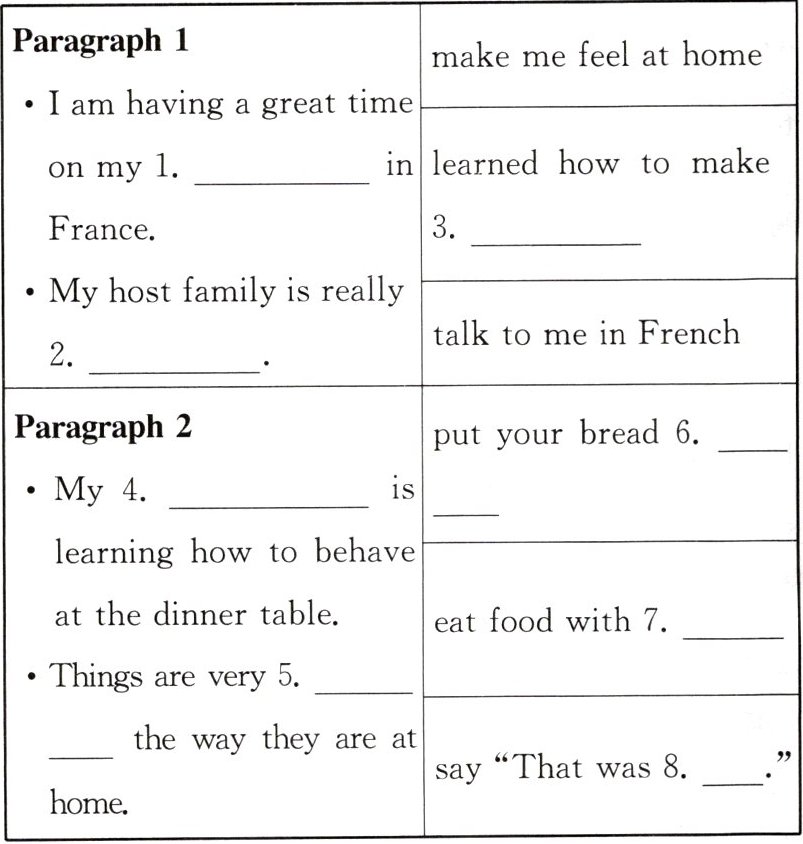
|Paragraph 1| |
|· I am having a great time on my 1. ____ in France.· My host family is really 2. ____.|make me feel at homelearned how to make 3. ____talk to me in French|
|Paragraph 2| |
|· My 4. ____ is learning how to behave at the dinner table.· Things are very 5. ____ the way they are at home.|put your bread 6. ____eat food with 7. ____say “That was 8. ____.”|
答案
1. trip 2. nice 3. French fries 4. biggest challenge 5. different from 6. on the table 7. a fork 8. delicious
解析
根据人教版英语九年级上册Section B(2a-2e)短文内容,第一段围绕在法国的经历展开,主题句中“on my...”后接表示行程的词,结合上下文可知是“trip”;“host family”的特点由“make me feel at home”等细节支撑,故填“nice”;“learned how to make”后接法国特色食物,即“French fries”。第二段主题是餐桌礼仪学习,“My...”后接指人的词,应为“biggest challenge”;“Things are very...”描述与家里的不同,填“different from”;餐桌礼仪细节中,面包放“on the table”,用“a fork”吃饭,饭后说“That was delicious”。
Ⅱ. 完成句子,明确本课重点句型
1. 我到这儿之前有点紧张,但这是毫无理由的。
I was ____ ____ ____ before I arrived here, but there was ____ ____ ____ ____.
2. 他们尽力让我感觉像在家里一样。
They ____ ____ ____ their ____ to ____ me ____ ____ ____.
3. 我最大的挑战是学习如何在餐桌上举止得体。
My biggest challenge is learning ____ ____ ____ ____ ____ ____ ____.
4. 我不得不承认,我发现要记住这一切很难,但是我渐渐习惯了。
I have to say that I ____ ____ ____ ____ remember everything, but I'm gradually ____ ____ ____ it.
1. 我到这儿之前有点紧张,但这是毫无理由的。
I was ____ ____ ____ before I arrived here, but there was ____ ____ ____ ____.
2. 他们尽力让我感觉像在家里一样。
They ____ ____ ____ their ____ to ____ me ____ ____ ____.
3. 我最大的挑战是学习如何在餐桌上举止得体。
My biggest challenge is learning ____ ____ ____ ____ ____ ____ ____.
4. 我不得不承认,我发现要记住这一切很难,但是我渐渐习惯了。
I have to say that I ____ ____ ____ ____ remember everything, but I'm gradually ____ ____ ____ it.
答案
1. a bit nervous; no reason to be
2. tried their best; make; feel at home
3. how to behave properly at the dinner table
4. find it difficult to; getting used to
2. tried their best; make; feel at home
3. how to behave properly at the dinner table
4. find it difficult to; getting used to
解析
1. "有点紧张"对应"a bit nervous";"毫无理由"对应"no reason to be"。
2. "尽力"对应"try one's best",主语是they,用"tried their best";"让我感觉像在家里一样"对应"make me feel at home"。
3. "如何在餐桌上举止得体"对应"how to behave properly at the dinner table"。
4. "发现要记住这一切很难"对应"find it difficult to remember everything";"渐渐习惯了"对应"getting used to"。
2. "尽力"对应"try one's best",主语是they,用"tried their best";"让我感觉像在家里一样"对应"make me feel at home"。
3. "如何在餐桌上举止得体"对应"how to behave properly at the dinner table"。
4. "发现要记住这一切很难"对应"find it difficult to remember everything";"渐渐习惯了"对应"getting used to"。
Ⅰ. 根据句意及首字母或汉语提示完成单词
1. Knowing how to b____ at the dinner table is very important.
2. My sister will go to France as an e____ student.
3. She said that learning ____(基本的)table manners was her biggest challenge.
4. The old woman often does some shopping with her ____(孙女).
5. He likes to put his ____(肘)on the table when he is eating.
1. Knowing how to b____ at the dinner table is very important.
2. My sister will go to France as an e____ student.
3. She said that learning ____(基本的)table manners was her biggest challenge.
4. The old woman often does some shopping with her ____(孙女).
5. He likes to put his ____(肘)on the table when he is eating.
答案
1. behave 2. exchange 3. basic 4. granddaughter 5. elbow
解析
1. 句意:知道在餐桌上如何表现是非常重要的。“表现”对应单词“behave”,how to后接动词原形,故填behave。
2. 句意:我姐姐将作为交换生去法国。“交换生”是“exchange student”,故填exchange。
3. “基本的”对应的单词是“basic”,修饰名词“table manners”,故填basic。
4. “孙女”的英文是“granddaughter”,此处用单数形式,故填granddaughter。
5. “肘”对应的单词是“elbow”,根据语境用单数,故填elbow。
2. 句意:我姐姐将作为交换生去法国。“交换生”是“exchange student”,故填exchange。
3. “基本的”对应的单词是“basic”,修饰名词“table manners”,故填basic。
4. “孙女”的英文是“granddaughter”,此处用单数形式,故填granddaughter。
5. “肘”对应的单词是“elbow”,根据语境用单数,故填elbow。
