

 登录
登录
Sumo wrestling (相扑) is a national sport in Japan. Every year there are six tournaments (联赛), and millions of Japanese watch them on television.
Sumo is almost as old as the nation of Japan itself. (1) ____________ There are written records of national sumo tournaments in the 8th century.
In many sports, athletes are thin and can move very quickly. However, sumo wrestlers weigh from 100 to 160 kilos. One of the famous wrestlers weighed 195 kilos. (2) ____________
Sumo wrestlers start training when they are boys. They exercise to make their bodies strong. They also eat a lot.
They wrestle in a round ring with a sand floor. (3) ____________ He is also the loser if any part of his body except his feet touches the floor. Each wrestler tries to push the other down on the floor or out of the ring. (4) ____________ Then, the wrestler who is rushing falls down or moves out of the ring.
Sumo is not very popular in other countries, but the Japanese think that it is a very exciting sport.
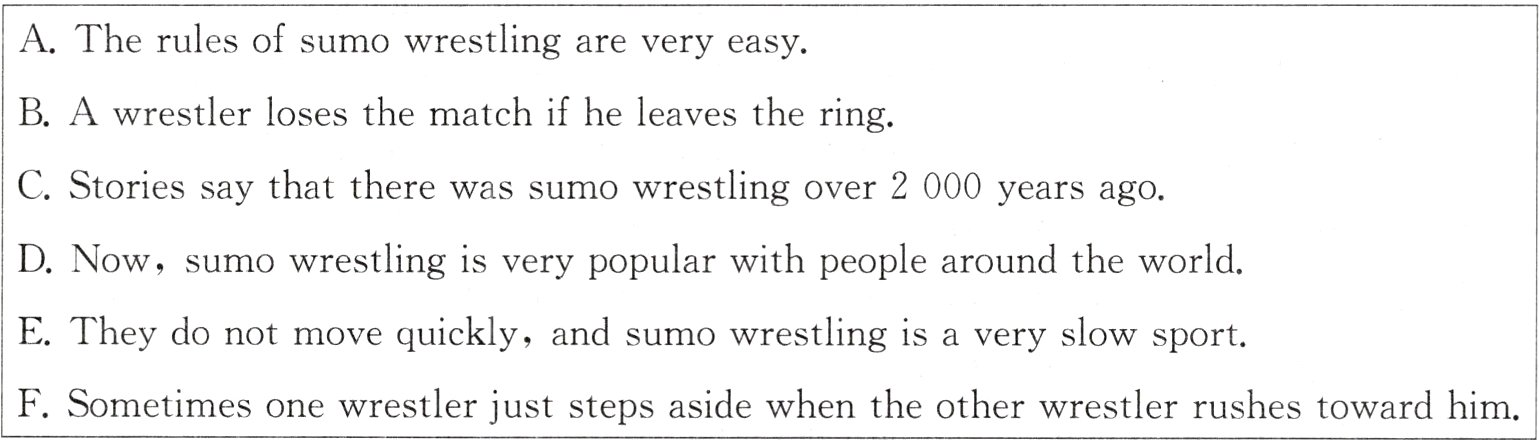
A. The rules of sumo wrestling are very easy.
B. A wrestler loses the match if he leaves the ring.
C. Stories say that there was sumo wrestling over 2 000 years ago.
D. Now, sumo wrestling is very popular with people around the world.
E. They do not move quickly, and sumo wrestling is a very slow sport.
F. Sometimes one wrestler just steps aside when the other wrestler rushes toward him.
Sumo is almost as old as the nation of Japan itself. (1) ____________ There are written records of national sumo tournaments in the 8th century.
In many sports, athletes are thin and can move very quickly. However, sumo wrestlers weigh from 100 to 160 kilos. One of the famous wrestlers weighed 195 kilos. (2) ____________
Sumo wrestlers start training when they are boys. They exercise to make their bodies strong. They also eat a lot.
They wrestle in a round ring with a sand floor. (3) ____________ He is also the loser if any part of his body except his feet touches the floor. Each wrestler tries to push the other down on the floor or out of the ring. (4) ____________ Then, the wrestler who is rushing falls down or moves out of the ring.
Sumo is not very popular in other countries, but the Japanese think that it is a very exciting sport.
A. The rules of sumo wrestling are very easy.
B. A wrestler loses the match if he leaves the ring.
C. Stories say that there was sumo wrestling over 2 000 years ago.
D. Now, sumo wrestling is very popular with people around the world.
E. They do not move quickly, and sumo wrestling is a very slow sport.
F. Sometimes one wrestler just steps aside when the other wrestler rushes toward him.
答案
1-4 CEBF
Bhola is the only child of his family. He behaves badly and always asks his parents for money. His father is (1) ____________ (worry) about him all the time.
One day, he said to Bhola, “You have nothing to eat today (2) ____________ you make fifty rupees (卢布).” Bhola's mother took pity on him and gave him fifty rupees. Bhola ran to his father happily. His father said angrily, “(3) ____________ (not try) to cheat me. You're expected to make money on your own.”
However, Bhola didn't take his father's words seriously. He went to his mother again, but this time she (4) ____________ (refuse). Feeling upset (不安的), Bhola started crying. A man passed by and asked him (5) ____________ he was crying so sadly. Bhola became even (6) ____________ (sad), “My father said if I couldn't make fifty rupees today, he wouldn't allow me (7) ____________ (eat) anything.”
The man said, “Well, if you carry my bag to the train station, I (8) ____________ (pay) you ten rupees.” Encouraged by the job, Bhola also helped other passengers carry bags.
At last, Bhola made fifty rupees. He gave (9) ____________ money to his father and said, “Dad, from now on, I'll study hard and never waste money.” Bhola learned the (10) ____________ (valuable) of hard work.
One day, he said to Bhola, “You have nothing to eat today (2) ____________ you make fifty rupees (卢布).” Bhola's mother took pity on him and gave him fifty rupees. Bhola ran to his father happily. His father said angrily, “(3) ____________ (not try) to cheat me. You're expected to make money on your own.”
However, Bhola didn't take his father's words seriously. He went to his mother again, but this time she (4) ____________ (refuse). Feeling upset (不安的), Bhola started crying. A man passed by and asked him (5) ____________ he was crying so sadly. Bhola became even (6) ____________ (sad), “My father said if I couldn't make fifty rupees today, he wouldn't allow me (7) ____________ (eat) anything.”
The man said, “Well, if you carry my bag to the train station, I (8) ____________ (pay) you ten rupees.” Encouraged by the job, Bhola also helped other passengers carry bags.
At last, Bhola made fifty rupees. He gave (9) ____________ money to his father and said, “Dad, from now on, I'll study hard and never waste money.” Bhola learned the (10) ____________ (valuable) of hard work.
答案
1. worried/worrying 2. unless/until 3. Don’t try 4. refused 5. why
6. sadder 7. to eat 8. will pay 9. the 10. value
6. sadder 7. to eat 8. will pay 9. the 10. value
