

 登录
登录
一、判断句子中画线部分发音是否相同,相同的写“T”,不相同的写“F”。
(
(
(
(
T
)1. The fly is on my cake.(
T
)2. Look at the happy baby.(
F
)3. Are you ready to have a try?答案
1. T 解析:“fly”“my”中画线部分“y”均发/ar/。
2. T 解析:“happy”“baby”中画线部分“y”均发/i/。
3. F 解析:“ready”中“y”发/i/,“try”中“y”发/ar/。
2. T 解析:“happy”“baby”中画线部分“y”均发/i/。
3. F 解析:“ready”中“y”发/i/,“try”中“y”发/ar/。
二、根据句意及首字母提示填空。
1. Be c
2. —Happy B
3. Sam wants to cook f
4. Bobby doesn’t know how to cook. Tina shows h
5. 时事热点 In an AI community canteen(餐厅), robots c
6. 科普知识 A t
1. Be c
areful
in the kitchen.2. —Happy B
irthday
! —Thank you.3. Sam wants to cook f
ish
soup
for his dad.4. Bobby doesn’t know how to cook. Tina shows h
im
a book.5. 时事热点 In an AI community canteen(餐厅), robots c
ook
for people.6. 科普知识 A t
omato
is a special kind of fruit that we often use like a vegetable.答案
1. careful 2. Birthday 3. fish soup 4. him
知识点拨
show 的用法
动词 show 表示“展示,表明”,可以接双宾语:show sb. sth. (show+间接宾语+直接宾语) 意为“给某人展示某物”,例如:show Sam the new book 给萨姆展示新书。
注意:动词后面的人称代词要用宾格。例如:show him the picture 给他展示图画;show me your toy 给我看你的玩具;show them the kite 给他们看风筝。
“show sb. sth.”的同义表达是“show sth. to sb. (show+直接宾语+to+间接宾语)”。例如:She shows us the menu. = She shows the menu to us. 她给我们看菜单。
5. cook 6. tomato
知识点拨
show 的用法
动词 show 表示“展示,表明”,可以接双宾语:show sb. sth. (show+间接宾语+直接宾语) 意为“给某人展示某物”,例如:show Sam the new book 给萨姆展示新书。
注意:动词后面的人称代词要用宾格。例如:show him the picture 给他展示图画;show me your toy 给我看你的玩具;show them the kite 给他们看风筝。
“show sb. sth.”的同义表达是“show sth. to sb. (show+直接宾语+to+间接宾语)”。例如:She shows us the menu. = She shows the menu to us. 她给我们看菜单。
5. cook 6. tomato
三、单项选择。
(
A.It’s
B.They’re
C.How
(
A
)1.Look at the food. good.A.It’s
B.They’re
C.How
答案
1. A
(
A.eat
B.have
C.wash
B
)2.Let’s some soup.A.eat
B.have
C.wash
答案
2. B
(
—I’m making *jiaozi*.
A.are;doing
B.do;do
C.do;doing
A
)3.—What you now?—I’m making *jiaozi*.
A.are;doing
B.do;do
C.do;doing
答案
3. A
四、从方框中选择合适的句子补全对话。(填序号,有一项多余)
A:1.
B:I’m making soup. What about you?
A:2.
B:Why do you cook noodles?
A:3.
B:4.
A:I usually add an egg, some vegetables and meat.
B:Sounds great! 5.
A:Sure. Let’s share.
A. What do you add to them?
B. They’re yummy, and easy to make.
C. Can I try your noodles?
D. I like having soup.
E. What are you doing?
F. I’m cooking noodles.
A:1.
E
B:I’m making soup. What about you?
A:2.
F
B:Why do you cook noodles?
A:3.
B
B:4.
A
A:I usually add an egg, some vegetables and meat.
B:Sounds great! 5.
C
A:Sure. Let’s share.
A. What do you add to them?
B. They’re yummy, and easy to make.
C. Can I try your noodles?
D. I like having soup.
E. What are you doing?
F. I’m cooking noodles.
答案
1. E 2. F 3. B 4. A 5. C
五、选词补全短文。
cooking happy kitchen washing nice
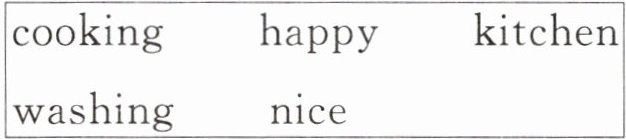
Mum and I are
cooking happy kitchen washing nice
Mum and I are
cooking
dinner in the kitchen
. She’s washing
vegetables while I’m setting the table. The soup is boiling(煮沸)on the stove(炉). The food smells nice
. We are busy but happy
!答案
五、cooking;kitchen;washing;nice;happy
解析:“cook dinner”(做晚餐)是固定搭配;做饭的地点是“kitchen”(厨房);“wash vegetables”(洗蔬菜)符合语境;“smells nice”(闻起来很香)描述食物气味;“busy but happy”(忙碌但开心)体现情绪。
解析:“cook dinner”(做晚餐)是固定搭配;做饭的地点是“kitchen”(厨房);“wash vegetables”(洗蔬菜)符合语境;“smells nice”(闻起来很香)描述食物气味;“busy but happy”(忙碌但开心)体现情绪。
