

 登录
登录
一、听力理解。
Ella 和 Jim 正在学校食堂里点餐。
A) 请听下面一段对话,回答第 1、2 小题。对话读两遍。
1. What kind of noodles would Ella like to eat? ()
A. Noodles with beef.
B. Noodles with mutton.
C. Noodles with cabbage.
2. What would Jim like to drink? ()
A. Coffee.
B. Apple juice.
C. Watermelon juice.
Mike 是一名在中国学习的英国交换生,他和同学 Li Ping 正在学校食堂里聊天。
Ella 和 Jim 正在学校食堂里点餐。
A) 请听下面一段对话,回答第 1、2 小题。对话读两遍。
1. What kind of noodles would Ella like to eat? ()
A. Noodles with beef.
B. Noodles with mutton.
C. Noodles with cabbage.
2. What would Jim like to drink? ()
A. Coffee.
B. Apple juice.
C. Watermelon juice.
Mike 是一名在中国学习的英国交换生,他和同学 Li Ping 正在学校食堂里聊天。
答案
由于您未提供听力对话内容,无法直接解答这两道听力理解题。建议您提供对话文本,以便根据对话中的关键信息(如Ella提到的面条种类、Jim提到的饮品)进行准确选择。
若您能补充对话内容,我将按照七年级下册Unit 4 "Eat Well"的知识点(如食物名称、点餐用语等)进行规范解答。
若您能补充对话内容,我将按照七年级下册Unit 4 "Eat Well"的知识点(如食物名称、点餐用语等)进行规范解答。
B) 请听下面一段对话,回答第 3 至第 5 小题。对话读两遍。
3. What does Li Ping usually have for breakfast? ()
A. Bread and milk.
B. Porridge and eggs.
C. Dumplings and noodles.
4. Where will Mike have dinner this evening? ()
A. At his home.
B. At Li Ping's home.
C. At Li Ping's grandparents' home.
5. Which of the following about Li Ping is TRUE? ()
A. She doesn't like vegetables.
B. She likes beef and onions a lot.
C. She often helps to cook at home.
3. What does Li Ping usually have for breakfast? ()
A. Bread and milk.
B. Porridge and eggs.
C. Dumplings and noodles.
4. Where will Mike have dinner this evening? ()
A. At his home.
B. At Li Ping's home.
C. At Li Ping's grandparents' home.
5. Which of the following about Li Ping is TRUE? ()
A. She doesn't like vegetables.
B. She likes beef and onions a lot.
C. She often helps to cook at home.
答案
3. B
4. C
5. C
4. C
5. C
解析
对于第3题,根据对话中Li Ping提到“I usually have porridge and eggs for breakfast.” 可知早餐吃粥和鸡蛋,答案选B。
第4题,从对话中“This evening I will have dinner at Li Ping's grandparents' home with Li Ping.”可知Mike今晚在Li Ping祖父母家吃晚餐,答案选C。
第5题,由对话“I like vegetables very much. I don't like beef but I like onions a lot. I often help my parents cook at home.”可知C选项“She often helps to cook at home.”正确。
第4题,从对话中“This evening I will have dinner at Li Ping's grandparents' home with Li Ping.”可知Mike今晚在Li Ping祖父母家吃晚餐,答案选C。
第5题,由对话“I like vegetables very much. I don't like beef but I like onions a lot. I often help my parents cook at home.”可知C选项“She often helps to cook at home.”正确。
二、根据首字母或音标提示补全单词。
1. The w is a kind of big, round and sweet fruit.
2. I like eating a /'kærət/ for lunch. It is healthy.
3. People in China like to eat /'mʌtn/ in winter.
4. Lily sometimes eats a c /'kʊki/ for a treat after dinner.
5. My mum likes to put an /'ʌnjən/ in the pot when she cooks meat.
1. The w is a kind of big, round and sweet fruit.
2. I like eating a /'kærət/ for lunch. It is healthy.
3. People in China like to eat /'mʌtn/ in winter.
4. Lily sometimes eats a c /'kʊki/ for a treat after dinner.
5. My mum likes to put an /'ʌnjən/ in the pot when she cooks meat.
答案
1. watermelon
2. carrot
3. mutton
4. cookie
5. onion
2. carrot
3. mutton
4. cookie
5. onion
解析
1. 根据描述“一种大而圆且甜的水果”,以w开头,应是“watermelon”。
2. 根据音标/'kærət/,可知是“carrot”,意为胡萝卜,符合句子表达喜欢吃胡萝卜且健康。
3. 根据音标/'mʌtn/,可知是“mutton”,意为羊肉,“in winter”表示在冬天,符合语境中国人冬天喜欢吃羊肉。
4. 根据音标/'kʊki/,以c开头,可知是“cookie”,意为饼干,“for a treat after dinner”表示作为饭后的一种款待。
5. 根据音标/'ʌnjən/,以an(元音音素开头用an)开头,可知是“onion”,意为洋葱,“put an onion in the pot”表示往锅里放一个洋葱。
2. 根据音标/'kærət/,可知是“carrot”,意为胡萝卜,符合句子表达喜欢吃胡萝卜且健康。
3. 根据音标/'mʌtn/,可知是“mutton”,意为羊肉,“in winter”表示在冬天,符合语境中国人冬天喜欢吃羊肉。
4. 根据音标/'kʊki/,以c开头,可知是“cookie”,意为饼干,“for a treat after dinner”表示作为饭后的一种款待。
5. 根据音标/'ʌnjən/,以an(元音音素开头用an)开头,可知是“onion”,意为洋葱,“put an onion in the pot”表示往锅里放一个洋葱。
三、根据要求完成下列题目。
(一)下表是 David 一日三餐的食谱。
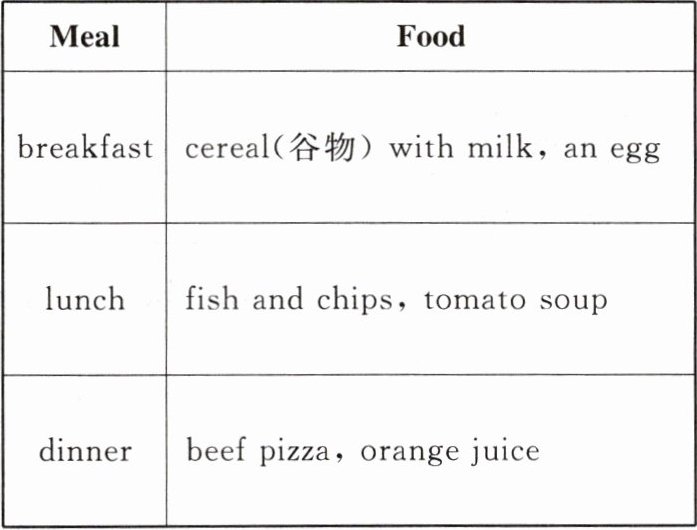
1. Match the meals with the pictures. (将每餐与对应的食物图片连线。)
(1) breakfast (2) lunch (3) dinner
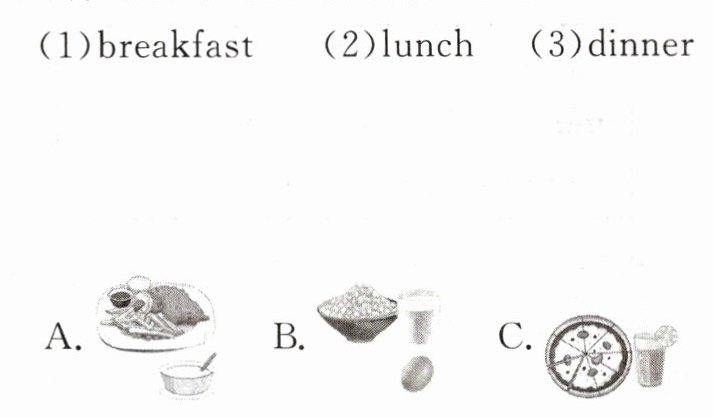
A.
B.
C.
2. 仿照示例,根据表格内容和图片仿写句子。
示例:David usually has cereal with milk and an egg for breakfast.
David usually has for lunch.
David usually has
(二)请根据你的实际情况介绍你一日三餐经常吃的食物。
I usually have for breakfast.
(一)下表是 David 一日三餐的食谱。
1. Match the meals with the pictures. (将每餐与对应的食物图片连线。)
(1) breakfast (2) lunch (3) dinner
A.
B.
C.
2. 仿照示例,根据表格内容和图片仿写句子。
示例:David usually has cereal with milk and an egg for breakfast.
David usually has for lunch.
David usually has
(二)请根据你的实际情况介绍你一日三餐经常吃的食物。
I usually have for breakfast.
答案
1. (1) B (2) A (3) C
2. David usually has fish and chips and tomato soup for lunch.
David usually has beef pizza and orange juice for dinner.
II. I usually have bread and milk for breakfast. I usually have rice and vegetables for lunch. I usually have noodles for dinner.
2. David usually has fish and chips and tomato soup for lunch.
David usually has beef pizza and orange juice for dinner.
II. I usually have bread and milk for breakfast. I usually have rice and vegetables for lunch. I usually have noodles for dinner.
解析
1. 题目要求将三餐与对应的食物图片连线。根据表格内容:
早餐(breakfast)是谷物加牛奶和一个鸡蛋,对应图片B。
午餐(lunch)是炸鱼薯条和番茄汤,对应图片A。
晚餐(dinner)是牛肉披萨和橙汁,对应图片C。
2. 根据示例和表格内容仿写句子:
午餐句子:David usually has fish and chips and tomato soup for lunch.
晚餐句子:David usually has beef pizza and orange juice for dinner.
3. 介绍自己一日三餐经常吃的食物,可以根据个人实际情况作答,示例:
I usually have bread and milk for breakfast.
I usually have rice and vegetables for lunch.
I usually have noodles for dinner.
早餐(breakfast)是谷物加牛奶和一个鸡蛋,对应图片B。
午餐(lunch)是炸鱼薯条和番茄汤,对应图片A。
晚餐(dinner)是牛肉披萨和橙汁,对应图片C。
2. 根据示例和表格内容仿写句子:
午餐句子:David usually has fish and chips and tomato soup for lunch.
晚餐句子:David usually has beef pizza and orange juice for dinner.
3. 介绍自己一日三餐经常吃的食物,可以根据个人实际情况作答,示例:
I usually have bread and milk for breakfast.
I usually have rice and vegetables for lunch.
I usually have noodles for dinner.
