

 登录
登录
五、(苏州张家港)看图,根据首字母提示填写单词,补全短文。
Long long ago, a boy had some sheep. He 1. t
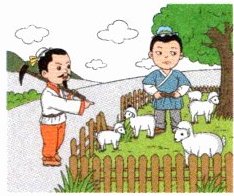
Long long ago, a boy had some sheep. He 1. t
ook
care of his sheep very well. One day, one of his sheep was lost, and he found a hole in the sheep pen(围栏). His neighbour(邻居)asked him to mend(修理)the pen. The boy said, “The sheep is lost. What’s the use of mending the pen? I’m 2. tired
today and want to have a good rest. I’ll mend it tomorrow.” But the next day, another sheep was lost. The boy was 3. sad
and 4. began
to cry. The neighbour said, “It’s never too 5. late
to mend the pen. Let me help you mend it now.”答案
五、1. took 2. tired 3. sad 4. began 5. late
解析
【解析】
1. 固定短语take care of意为“照顾”,短文为一般过去时,故填take的过去式took。
2. 根据后文“want to have a good rest”及首字母t,可知男孩很累,填tired。
3. 又一只羊丢失,男孩心情难过,结合首字母s,填sad。
4. 固定搭配begin to do sth.意为“开始做某事”,短文为一般过去时,故填begin的过去式began。
5. 谚语“It's never too late to mend.”意为“亡羊补牢,为时未晚”,结合首字母l,填late。
【答案】
1. took 2. tired 3. sad 4. began 5. late
【知识点】
固定短语搭配、动词过去式、英语谚语
【点评】
本题结合“亡羊补牢”的故事语境,考查学生对固定短语、动词时态及常见英语谚语的掌握,需结合首字母提示和上下文语义完成填空,注重对语篇理解和词汇运用能力的考查。
【难度系数】
0.7
1. 固定短语take care of意为“照顾”,短文为一般过去时,故填take的过去式took。
2. 根据后文“want to have a good rest”及首字母t,可知男孩很累,填tired。
3. 又一只羊丢失,男孩心情难过,结合首字母s,填sad。
4. 固定搭配begin to do sth.意为“开始做某事”,短文为一般过去时,故填begin的过去式began。
5. 谚语“It's never too late to mend.”意为“亡羊补牢,为时未晚”,结合首字母l,填late。
【答案】
1. took 2. tired 3. sad 4. began 5. late
【知识点】
固定短语搭配、动词过去式、英语谚语
【点评】
本题结合“亡羊补牢”的故事语境,考查学生对固定短语、动词时态及常见英语谚语的掌握,需结合首字母提示和上下文语义完成填空,注重对语篇理解和词汇运用能力的考查。
【难度系数】
0.7
六、[新素材]南湖小学六(3)班的张老师为了让同学们更加理解交通安全的重要性,以图表形式梳理了一些交通违规行为,请根据图表内容,选择正确的答案。
There are many kinds of traffic violations(违规行为). Here is a pie chart(圆形统计图)about different traffic violations.
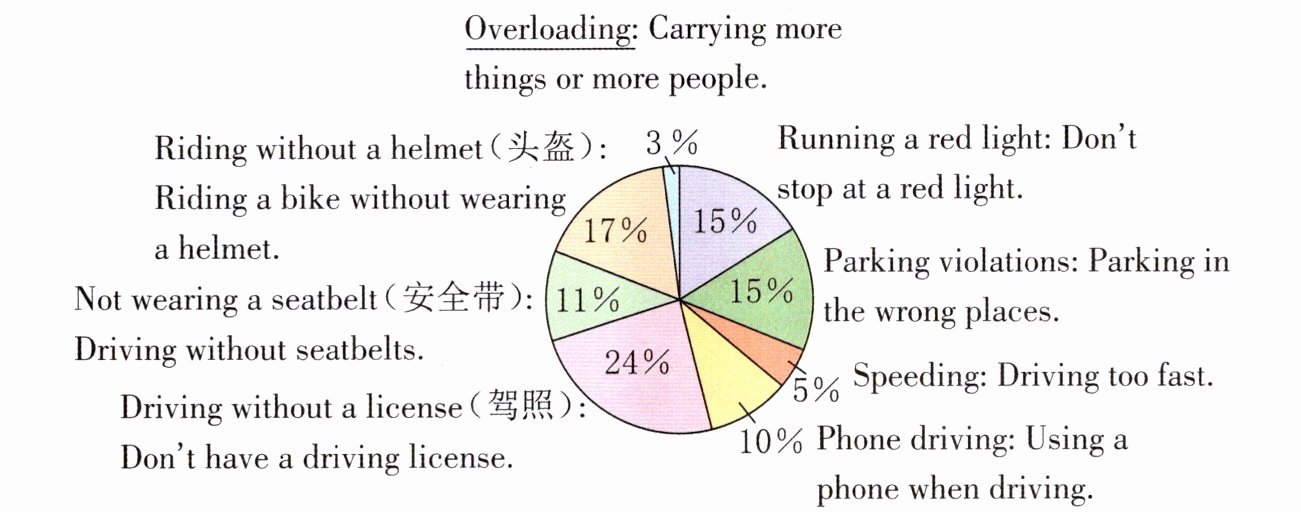
(
A. Eight.
B. Seven.
C. Six.
(
A. Speeding.
B. Parking violations.
C. Driving without a license.
(
A. Phone driving and speeding.
B. Parking violations and phone driving.
C. Parking violations and running a red light.
(
A. 超速
B. 超载
C. 超高
There are many kinds of traffic violations(违规行为). Here is a pie chart(圆形统计图)about different traffic violations.
(
A
) 1. How many violations are mentioned(提及)in the pie chart?A. Eight.
B. Seven.
C. Six.
(
C
) 2. According to the pie chart, which traffic violation has the largest number?A. Speeding.
B. Parking violations.
C. Driving without a license.
(
C
) 3. Which two parts have the same proportion(相同的比例)?A. Phone driving and speeding.
B. Parking violations and phone driving.
C. Parking violations and running a red light.
(
B
) 4. What does the underlined word “Overloading” mean in the pie chart?A. 超速
B. 超载
C. 超高
答案
六、1. A 2. C 3. C
4. B 解析:Carrying more things or more people意为“带更多的物或更多的人”,故该单词意为“超载”。
4. B 解析:Carrying more things or more people意为“带更多的物或更多的人”,故该单词意为“超载”。
解析
【解析】
1. 第1题:逐一统计饼图中的交通违规行为:Overloading、Running a red light、Parking violations、Speeding、Phone driving、Driving without a license、Not wearing a seatbelt、Riding without a helmet,共8种,故选A。
2. 第2题:观察饼图占比,Driving without a license(无照驾驶)占比24%,是所有违规行为中占比最高的,故选C。
3. 第3题:查看饼图比例可知,Running a red light(闯红灯)和Parking violations(违规停车)的占比均为15%,比例相同,故选C。
4. 第4题:根据饼图中Overloading的注释“Carrying more things or more people”(携带更多物品或搭载更多人),可推测该词意为“超载”,故选B。
【答案】
1. A
2. C
3. C
4. B
【知识点】
图表信息提取、词义猜测、细节理解
【点评】
本题结合交通安全的生活主题,以饼图形式呈现交通违规行为占比,既考查学生从图表中提取关键信息的能力,也考查词义猜测的阅读技巧,同时能引导学生认识交通违规行为,增强交通安全意识。
【难度系数】
0.75
1. 第1题:逐一统计饼图中的交通违规行为:Overloading、Running a red light、Parking violations、Speeding、Phone driving、Driving without a license、Not wearing a seatbelt、Riding without a helmet,共8种,故选A。
2. 第2题:观察饼图占比,Driving without a license(无照驾驶)占比24%,是所有违规行为中占比最高的,故选C。
3. 第3题:查看饼图比例可知,Running a red light(闯红灯)和Parking violations(违规停车)的占比均为15%,比例相同,故选C。
4. 第4题:根据饼图中Overloading的注释“Carrying more things or more people”(携带更多物品或搭载更多人),可推测该词意为“超载”,故选B。
【答案】
1. A
2. C
3. C
4. B
【知识点】
图表信息提取、词义猜测、细节理解
【点评】
本题结合交通安全的生活主题,以饼图形式呈现交通违规行为占比,既考查学生从图表中提取关键信息的能力,也考查词义猜测的阅读技巧,同时能引导学生认识交通违规行为,增强交通安全意识。
【难度系数】
0.75
