

 登录
登录
Mark is writing an online post about a hiking trip with his dog. Complete the post with
the correct forms of the words in brackets or by choosing the correct words in brackets.
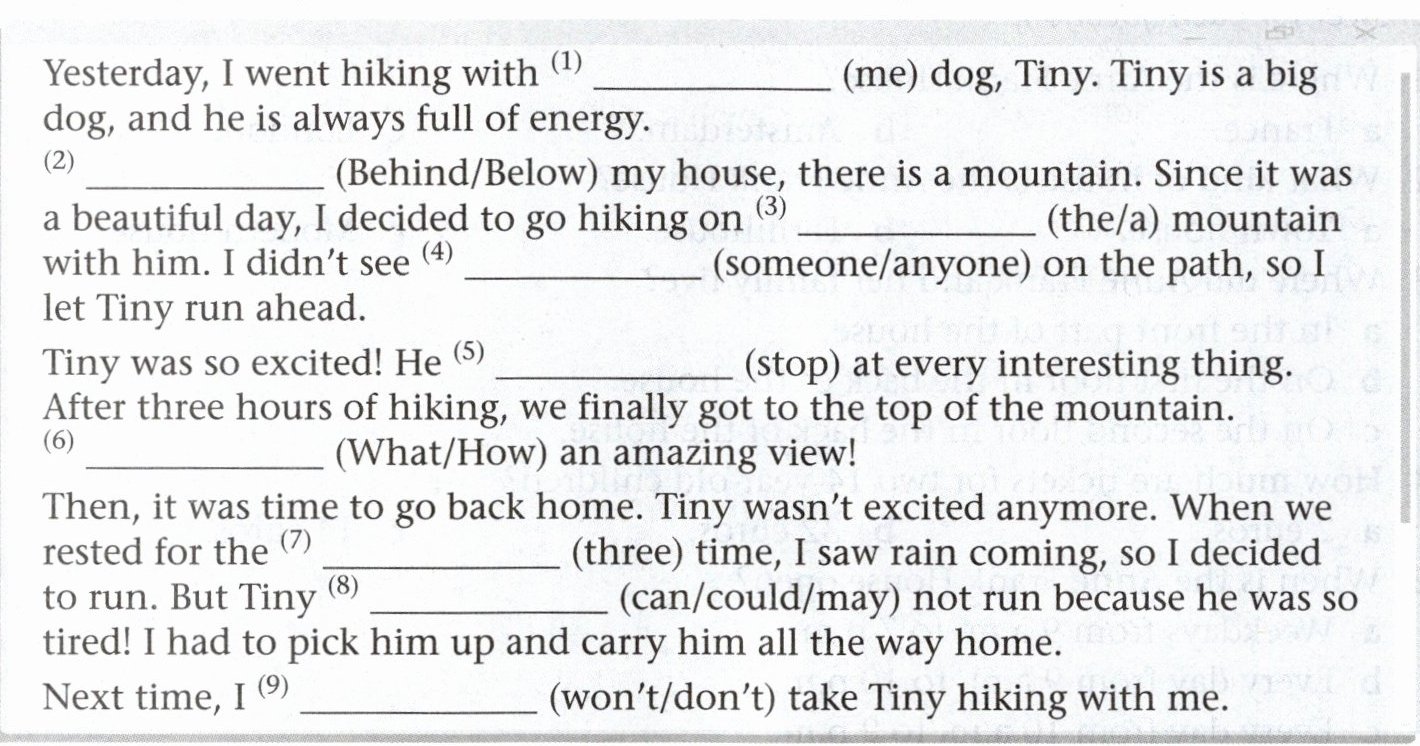
Yesterday, I went hiking with (1) (me) dog, Tiny. Tiny is a big
dog, and he is always full of energy.
(2) (Behind/Below) my house, there is a mountain. Since it was
a beautiful day, I decided to go hiking on (3) (the/a) mountain
with him. I didn't see (4) (someone/anyone) on the path, so I
let Tiny run ahead.
Tiny was so excited! He (5) (stop) at every interesting thing.
After three hours of hiking, we finally got to the top of the mountain.
(6) (What/How) an amazing view!
Then, it was time to go back home. Tiny wasn't excited anymore. When we
rested for the (7) (three) time, I saw rain coming, so I decided
to run. But Tiny (8) (can/could/may) not run because he was so
tired! I had to pick him up and carry him all the way home.
Next time, I (9) (won't/don't) take Tiny hiking with me.
the correct forms of the words in brackets or by choosing the correct words in brackets.
Yesterday, I went hiking with (1) (me) dog, Tiny. Tiny is a big
dog, and he is always full of energy.
(2) (Behind/Below) my house, there is a mountain. Since it was
a beautiful day, I decided to go hiking on (3) (the/a) mountain
with him. I didn't see (4) (someone/anyone) on the path, so I
let Tiny run ahead.
Tiny was so excited! He (5) (stop) at every interesting thing.
After three hours of hiking, we finally got to the top of the mountain.
(6) (What/How) an amazing view!
Then, it was time to go back home. Tiny wasn't excited anymore. When we
rested for the (7) (three) time, I saw rain coming, so I decided
to run. But Tiny (8) (can/could/may) not run because he was so
tired! I had to pick him up and carry him all the way home.
Next time, I (9) (won't/don't) take Tiny hiking with me.
答案
(1) my
(2) Behind
(3) the
(4) anyone
(5) stopped
(6) What
(7) third
(8) could
(9) won't
(2) Behind
(3) the
(4) anyone
(5) stopped
(6) What
(7) third
(8) could
(9) won't
解析
1. 第(1)空:需用形容词性物主代词修饰名词dog,me的形容词性物主代词为my。
2. 第(2)空:结合常识,山应在房子后方,Behind表示“在……后面”,符合语境;Below表示“在……下方”,不符合逻辑。
3. 第(3)空:前文已提及这座山,再次指代需用定冠词the。
4. 第(4)空:anyone用于否定句和疑问句,someone用于肯定句,本句为否定句,故用anyone。
5. 第(5)空:文章描述过去的经历,要用一般过去时,stop的过去式是stopped。
6. 第(6)空:感叹句中,中心词为名词view时,用“What + a/an + 形容词 + 可数名词单数”的结构,故用What。
7. 第(7)空:“the + 序数词”表示“第……次”,three的序数词是third。
8. 第(8)空:文章为一般过去时,could是can的过去式,符合时态要求;can和may为一般现在时形式,不符合。
9. 第(9)空:Next time表将来时间,要用一般将来时的否定形式,won't是will not的缩写,符合要求。
2. 第(2)空:结合常识,山应在房子后方,Behind表示“在……后面”,符合语境;Below表示“在……下方”,不符合逻辑。
3. 第(3)空:前文已提及这座山,再次指代需用定冠词the。
4. 第(4)空:anyone用于否定句和疑问句,someone用于肯定句,本句为否定句,故用anyone。
5. 第(5)空:文章描述过去的经历,要用一般过去时,stop的过去式是stopped。
6. 第(6)空:感叹句中,中心词为名词view时,用“What + a/an + 形容词 + 可数名词单数”的结构,故用What。
7. 第(7)空:“the + 序数词”表示“第……次”,three的序数词是third。
8. 第(8)空:文章为一般过去时,could是can的过去式,符合时态要求;can和may为一般现在时形式,不符合。
9. 第(9)空:Next time表将来时间,要用一般将来时的否定形式,won't是will not的缩写,符合要求。
A Nora is reading a travel plan for a tour around China from a travel agency. Write
a T if a sentence is true, an F if it is false or an NM if it is not mentioned in the text.
Days 1-2: We start our tour in beautiful Jiuzhaigou Valley in Sichuan Province.
Jiuzhaigou Valley is full of tall mountains and green forests. Enjoy the
famous Shuzheng Waterfall and Five Flowers Lake.
Day 3: Our next stop is Huanglong Scenic and Historic Interest Area, a
landscape of snow-covered mountains. It is also in Sichuan, and it has
an amazing rock landscape and colourful pools.
Day 4: Moving on to Hunan Province, we arrive at Zhangjiajie National
Forest Park. Zhangjiajie is famous for its tall towers of rock. Hike in a
landscape of green forests and clear waters in Zhangjiajie.
Days 5-6: Our last stop is the Lijiang River Scenic Zone. The Lijiang River
runs through Guangxi Province. Take a boat trip on the river to see
landscapes of rock hills all around. Make sure to take a picture at
Elephant Trunk Hill—a rock shaped like the trunk of an elephant!
1 The tour starts in Jiuzhaigou Valley in Hunan Province.
2 Both Jiuzhaigou Valley and Huanglong have mountain landscapes.
3 Zhangjiajie is larger than Huanglong by area.
4 Visitors don't have to hike a lot when visiting the Lijiang River.
a T if a sentence is true, an F if it is false or an NM if it is not mentioned in the text.
Days 1-2: We start our tour in beautiful Jiuzhaigou Valley in Sichuan Province.
Jiuzhaigou Valley is full of tall mountains and green forests. Enjoy the
famous Shuzheng Waterfall and Five Flowers Lake.
Day 3: Our next stop is Huanglong Scenic and Historic Interest Area, a
landscape of snow-covered mountains. It is also in Sichuan, and it has
an amazing rock landscape and colourful pools.
Day 4: Moving on to Hunan Province, we arrive at Zhangjiajie National
Forest Park. Zhangjiajie is famous for its tall towers of rock. Hike in a
landscape of green forests and clear waters in Zhangjiajie.
Days 5-6: Our last stop is the Lijiang River Scenic Zone. The Lijiang River
runs through Guangxi Province. Take a boat trip on the river to see
landscapes of rock hills all around. Make sure to take a picture at
Elephant Trunk Hill—a rock shaped like the trunk of an elephant!
1 The tour starts in Jiuzhaigou Valley in Hunan Province.
2 Both Jiuzhaigou Valley and Huanglong have mountain landscapes.
3 Zhangjiajie is larger than Huanglong by area.
4 Visitors don't have to hike a lot when visiting the Lijiang River.
答案
1. F;2. T;3. NM;4. NM
解析
1. 根据原文"Days 1-2: We start our tour in beautiful Jiuzhaigou Valley in Sichuan Province."可知,旅行始于四川省的九寨沟,而非湖南省,故该句错误。
2. 根据原文"Jiuzhaigou Valley is full of tall mountains..."和"Huanglong Scenic and Historic Interest Area, a landscape of snow-covered mountains."可知,九寨沟和黄龙都有山地景观,故该句正确。
3. 原文未提及张家界和黄龙的面积比较相关内容,故该句未被提及。
4. 原文仅提及漓江行程是乘船游览、在象鼻山拍照,未提到游客是否需要大量徒步,故该句未被提及。
2. 根据原文"Jiuzhaigou Valley is full of tall mountains..."和"Huanglong Scenic and Historic Interest Area, a landscape of snow-covered mountains."可知,九寨沟和黄龙都有山地景观,故该句正确。
3. 原文未提及张家界和黄龙的面积比较相关内容,故该句未被提及。
4. 原文仅提及漓江行程是乘船游览、在象鼻山拍照,未提到游客是否需要大量徒步,故该句未被提及。
