

 登录
登录
听一段对话,回答第11一12小题。答题完毕,请等待“嘀”的信号,进入第一篇短文。
( )11. What are most kites made of?
A. Bamboo and paper. B. Silk and wood. C. Bamboo and cotton.
( )12. When may the Kite Festival take place?
A. In January. B. In April. C. In October.
( )11. What are most kites made of?
A. Bamboo and paper. B. Silk and wood. C. Bamboo and cotton.
( )12. When may the Kite Festival take place?
A. In January. B. In April. C. In October.
答案
11.A 12.B
听第一篇短文,回答第13一15小题。请根据短文内容,选择正确答案,完成信息记录表。答题完毕,请等待“嘀”的信号,进入下一篇短文。
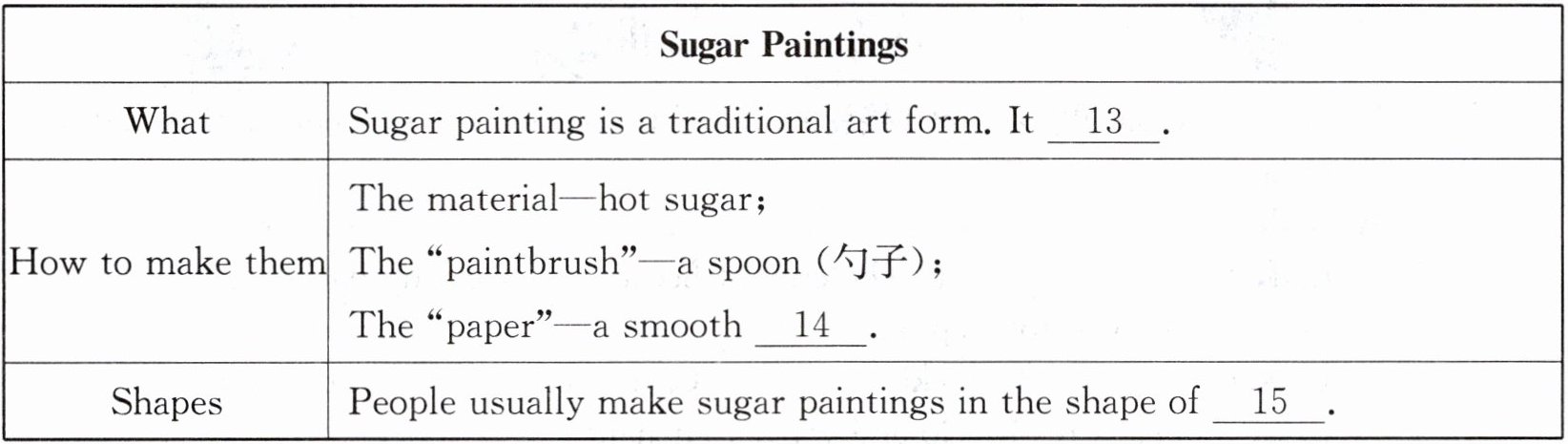
( )13. A. tastes good B. smells nice C. feels soft
( )14. A. chair B. knife C. table
( )15. A. people B. animals C. flowers
( )13. A. tastes good B. smells nice C. feels soft
( )14. A. chair B. knife C. table
( )15. A. people B. animals C. flowers
答案
13.A 14.C 15.B
听第二篇短文,回答第16一20小题。
( )16. Who is Zhang Lei's present for?
A. His friend. B. His teacher. C. His classmate.
( )17. What does the colour red stand for?
A. Good future. B. Long life. C. Good luck.
( )18. How long is the history of Chinese knots as a traditional art form?
A. More than 5,000 years. B. More than 1,000 years.
C. Less than 1,000 years.
( )19. How many kinds of knots are mentioned(提到)in this passage?
A. Three. B. Four. C. Five.
( )20. According to the passage, which kind of Chinese knot stands for(象征)money?
A. The Treasure Knot. B. The Jingdie Knot. C. The Wukong Knot.
( )16. Who is Zhang Lei's present for?
A. His friend. B. His teacher. C. His classmate.
( )17. What does the colour red stand for?
A. Good future. B. Long life. C. Good luck.
( )18. How long is the history of Chinese knots as a traditional art form?
A. More than 5,000 years. B. More than 1,000 years.
C. Less than 1,000 years.
( )19. How many kinds of knots are mentioned(提到)in this passage?
A. Three. B. Four. C. Five.
( )20. According to the passage, which kind of Chinese knot stands for(象征)money?
A. The Treasure Knot. B. The Jingdie Knot. C. The Wukong Knot.
答案
16.B 17.C 18.B 19.B 20.A
