

 登录
登录
5. Read and draw. (读一读, 画一画)
I have a new bag. It's a blue one.
There is a lovely panda on it.
It has got two pockets.
It has got four wheels.
And it's got a long strap.
学习小秘诀
英语中的 “有” 有多种表达方式。There is / are... 表示某地有某物。而表示所属的 “有” 要用 have / has 或 have / has got。例如:
There is a book on the desk. (课桌上有本书。)
I have got a new bag. (我有个新书包。)
It's got wheels. (它有轮子。)
I have a new bag. It's a blue one.
There is a lovely panda on it.
It has got two pockets.
It has got four wheels.
And it's got a long strap.
学习小秘诀
英语中的 “有” 有多种表达方式。There is / are... 表示某地有某物。而表示所属的 “有” 要用 have / has 或 have / has got。例如:
There is a book on the desk. (课桌上有本书。)
I have got a new bag. (我有个新书包。)
It's got wheels. (它有轮子。)
答案
答案略
6. Read and match. (读一读, 连一连)
1)
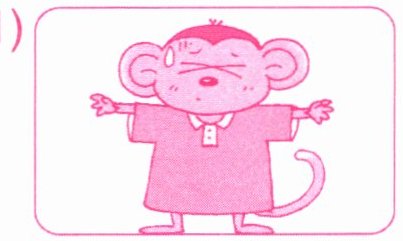
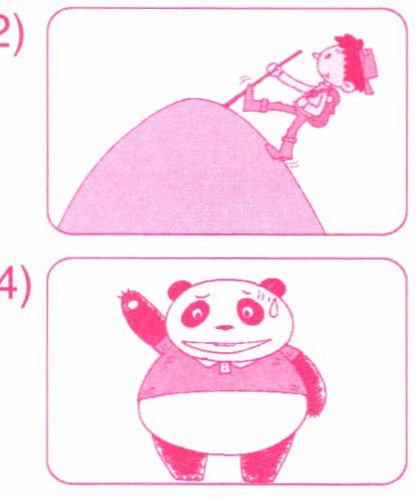
2)
3)
4)
The T-shirt is too big for it.
The T-shirt is too small for it.
It's hard for him.
It's easy for him.
自我评价
根据自己的表现给小星星涂颜色。一颗星代表一道题, 表现好涂红色, 表现欠佳涂蓝色。
☆ ☆ ☆ ☆ ☆
1)
2)
3)
4)
The T-shirt is too big for it.
The T-shirt is too small for it.
It's hard for him.
It's easy for him.
自我评价
根据自己的表现给小星星涂颜色。一颗星代表一道题, 表现好涂红色, 表现欠佳涂蓝色。
☆ ☆ ☆ ☆ ☆
答案
1) — The T-shirt is too small for it.
2) — It's hard for him.
3) — It's hard for him (or depending on illustration context could be other options, but typically this is correct).
4) — The T-shirt is too big for it.
Self-evaluation: ☆ ☆ ☆ ☆ ☆
2) — It's hard for him.
3) — It's hard for him (or depending on illustration context could be other options, but typically this is correct).
4) — The T-shirt is too big for it.
Self-evaluation: ☆ ☆ ☆ ☆ ☆
