

 登录
登录
Ⅰ. Circle the correct words to complete the sentences.
1. I've been a student of English (since / for) three years.
2. How long (have you known / do you know) Peter?
3. The last time I had a holiday was (for a year / a year ago).
4. I lived with my parents (until / since) I was 16.
5. Tina has lived with her parents (10 years ago / for 10 years).
6. I've (chose / chosen) a fantasy classic for my book report.
7. I haven't had anything to eat (since / for) three hours.
1. I've been a student of English (since / for) three years.
2. How long (have you known / do you know) Peter?
3. The last time I had a holiday was (for a year / a year ago).
4. I lived with my parents (until / since) I was 16.
5. Tina has lived with her parents (10 years ago / for 10 years).
6. I've (chose / chosen) a fantasy classic for my book report.
7. I haven't had anything to eat (since / for) three hours.
答案
Ⅰ. 1. for 2. have you known 3. a year ago 4. until 5. for 10 years 6. chosen 7. for
解析
【解析】
1. 空格后是时间段three years,“for+时间段”用于表示动作持续的时长,故选for。
2. how long询问动作持续的时间,需用现在完成时,结构为have/has+过去分词,故选have you known。
3. the last time后接过去的时间点,a year ago是时间点,符合语境;for a year是时间段,不适用,故选a year ago。
4. until表示“直到……为止”,符合“我和父母住到16岁”的语境;since表示“自从”,不符合逻辑,故选until。
5. 句子用现在完成时has lived,“for+时间段”可与现在完成时连用,10 years ago是过去时间点,不能搭配现在完成时,故选for 10 years。
6. 现在完成时的结构为have/has+过去分词,choose的过去分词是chosen,故选chosen。
7. 空格后是时间段three hours,“for+时间段”用于表示动作持续的时长,故选for。
【答案】
Ⅰ. 1. for 2. have you known 3. a year ago 4. until 5. for 10 years 6. chosen 7. for
【知识点】
现在完成时用法、since与for辨析、过去分词形式
【点评】
本题主要考查现在完成时的时态结构、时间状语搭配,以及连词的词义辨析,要求学生准确区分不同时间状语对应的时态和用法,有助于夯实英语时态基础。
【难度系数】
0.7
1. 空格后是时间段three years,“for+时间段”用于表示动作持续的时长,故选for。
2. how long询问动作持续的时间,需用现在完成时,结构为have/has+过去分词,故选have you known。
3. the last time后接过去的时间点,a year ago是时间点,符合语境;for a year是时间段,不适用,故选a year ago。
4. until表示“直到……为止”,符合“我和父母住到16岁”的语境;since表示“自从”,不符合逻辑,故选until。
5. 句子用现在完成时has lived,“for+时间段”可与现在完成时连用,10 years ago是过去时间点,不能搭配现在完成时,故选for 10 years。
6. 现在完成时的结构为have/has+过去分词,choose的过去分词是chosen,故选chosen。
7. 空格后是时间段three hours,“for+时间段”用于表示动作持续的时长,故选for。
【答案】
Ⅰ. 1. for 2. have you known 3. a year ago 4. until 5. for 10 years 6. chosen 7. for
【知识点】
现在完成时用法、since与for辨析、过去分词形式
【点评】
本题主要考查现在完成时的时态结构、时间状语搭配,以及连词的词义辨析,要求学生准确区分不同时间状语对应的时态和用法,有助于夯实英语时态基础。
【难度系数】
0.7
Ⅱ. Underline the mistake in each sentence and correct it on the right.
1. I haven't seen that new film already. yet
2. Jim has yet retired.
3. He works in the same school for 20 years.
4. I have studied at this school for September.
5. His grandfather died since ten years ago.
6. He has lived in London until he died last year.
7. Dave's not here. He's been to France on holiday.
8. You look tired! Where have you gone?
9. I can't believe I've left school for ten years.
10. I haven't spoken to Alice since months.
1. I haven't seen that new film already. yet
2. Jim has yet retired.
3. He works in the same school for 20 years.
4. I have studied at this school for September.
5. His grandfather died since ten years ago.
6. He has lived in London until he died last year.
7. Dave's not here. He's been to France on holiday.
8. You look tired! Where have you gone?
9. I can't believe I've left school for ten years.
10. I haven't spoken to Alice since months.
答案
Ⅱ. 2. yet, already 3. works, has worked 4. for, since 5. since, / 或 died, has been dead 6. has lived, lived 7. been, gone 8. gone, been 9. left, been away from 10. since, for
解析
【解析】
1. 现在完成时否定句中表“已经”应用yet,already多用于肯定句,故将already改为yet。
2. already多用于现在完成时肯定句,yet多用于否定句和疑问句,本句为肯定句,故将yet改为already。
3. 句中“for 20 years”是现在完成时的时间标志,谓语动词需用现在完成时形式,故将works改为has worked。
4. September是具体时间点,现在完成时中表从过去某时间点开始的动作应用since,故将for改为since。
5. die是非延续性动词,不能与since引导的时间段连用,可去掉since,或把died改为has been dead。
6. until引导的时间状语表动作到过去某时间结束,需用一般过去时,故将has lived改为lived。
7. 根据“Dave's not here”可知他去了法国未回,have gone to表去了某地未回,have been to表去过某地已回,故将been改为gone。
8. 此处询问对方去过哪里(已回来),have been to表去过某地已回,have gone to表去了某地未回,故将gone改为been。
9. leave是非延续性动词,不能与for引导的时间段连用,需转换为延续性短语been away from,故将left改为been away from。
10. since后接时间点,for后接时间段,months是时间段,故将since改为for。
【答案】
2. ______ yet ______ already ______
3. ______ works ______ has worked ______
4. ______ for ______ since ______
5. ______ since ______ / ______ 或 ______ died ______ has been dead ______
6. ______ has lived ______ lived ______
7. ______ been ______ gone ______
8. ______ gone ______ been ______
9. ______ left ______ been away from ______
10. ______ since ______ for ______
【知识点】
现在完成时用法、延续性动词转换、already/yet辨析
【点评】
本题聚焦现在完成时的常见易错点,涵盖标志词(since/for、already/yet)的正确使用、非延续性动词与延续性动词的转换等核心内容,能有效检验学生对现在完成时的掌握情况。
【难度系数】
0.4
1. 现在完成时否定句中表“已经”应用yet,already多用于肯定句,故将already改为yet。
2. already多用于现在完成时肯定句,yet多用于否定句和疑问句,本句为肯定句,故将yet改为already。
3. 句中“for 20 years”是现在完成时的时间标志,谓语动词需用现在完成时形式,故将works改为has worked。
4. September是具体时间点,现在完成时中表从过去某时间点开始的动作应用since,故将for改为since。
5. die是非延续性动词,不能与since引导的时间段连用,可去掉since,或把died改为has been dead。
6. until引导的时间状语表动作到过去某时间结束,需用一般过去时,故将has lived改为lived。
7. 根据“Dave's not here”可知他去了法国未回,have gone to表去了某地未回,have been to表去过某地已回,故将been改为gone。
8. 此处询问对方去过哪里(已回来),have been to表去过某地已回,have gone to表去了某地未回,故将gone改为been。
9. leave是非延续性动词,不能与for引导的时间段连用,需转换为延续性短语been away from,故将left改为been away from。
10. since后接时间点,for后接时间段,months是时间段,故将since改为for。
【答案】
2. ______ yet ______ already ______
3. ______ works ______ has worked ______
4. ______ for ______ since ______
5. ______ since ______ / ______ 或 ______ died ______ has been dead ______
6. ______ has lived ______ lived ______
7. ______ been ______ gone ______
8. ______ gone ______ been ______
9. ______ left ______ been away from ______
10. ______ since ______ for ______
【知识点】
现在完成时用法、延续性动词转换、already/yet辨析
【点评】
本题聚焦现在完成时的常见易错点,涵盖标志词(since/for、already/yet)的正确使用、非延续性动词与延续性动词的转换等核心内容,能有效检验学生对现在完成时的掌握情况。
【难度系数】
0.4
Ⅲ. Complete the sentences with the correct forms of the phrases in the box.
pick up make a difference help out take care of learn from
1. The website gives us a chance
2. My friend
3. Miss Smith is a nice nurse and she always
4. Planting trees in our community
5. I
pick up make a difference help out take care of learn from
1. The website gives us a chance
to learn from
experts.2. My friend
has helped out
at the food bank since last weekend.3. Miss Smith is a nice nurse and she always
takes care of
her patients very well.4. Planting trees in our community
has made a difference
to the environment.5. I
picked up
the bags and bottles in the park and threw them into bins.答案
Ⅲ. 1. to learn from 2. has helped out 3. takes care of 4. has made a difference 5. picked up
解析
【解析】
1. 固定搭配"a chance to do sth"表示“做某事的机会”,结合语境选短语learn from,故填to learn from。
2. "since last weekend"是现在完成时的标志,主语"My friend"为第三人称单数,选短语help out,故填has helped out。
3. "always"表明句子为一般现在时,主语"she"是第三人称单数,选短语take care of,故填takes care of。
4. 动名词短语"Planting trees"作主语,视为单数,结合语境强调对环境已产生的影响,用现在完成时,选短语make a difference,故填has made a difference。
5. 由并列连词"and"后的"threw"(过去式)可知,本句为一般过去时,选短语pick up,故填picked up。
【答案】
Ⅲ. 1. to learn from 2. has helped out 3. takes care of 4. has made a difference 5. picked up
【知识点】
动词不定式、现在完成时、一般现在时
【点评】
本题考查动词短语的正确形式运用,需结合时态标志词、固定搭配及语境判断,侧重对短语搭配与时态的综合考查,要求学生灵活运用语法知识。
【难度系数】
0.6
1. 固定搭配"a chance to do sth"表示“做某事的机会”,结合语境选短语learn from,故填to learn from。
2. "since last weekend"是现在完成时的标志,主语"My friend"为第三人称单数,选短语help out,故填has helped out。
3. "always"表明句子为一般现在时,主语"she"是第三人称单数,选短语take care of,故填takes care of。
4. 动名词短语"Planting trees"作主语,视为单数,结合语境强调对环境已产生的影响,用现在完成时,选短语make a difference,故填has made a difference。
5. 由并列连词"and"后的"threw"(过去式)可知,本句为一般过去时,选短语pick up,故填picked up。
【答案】
Ⅲ. 1. to learn from 2. has helped out 3. takes care of 4. has made a difference 5. picked up
【知识点】
动词不定式、现在完成时、一般现在时
【点评】
本题考查动词短语的正确形式运用,需结合时态标志词、固定搭配及语境判断,侧重对短语搭配与时态的综合考查,要求学生灵活运用语法知识。
【难度系数】
0.6
Ⅳ. Read and complete the tasks.
A. Complete the passage with the correct forms of the words in brackets.
I 1.
the community service programme, I 3.
every weekend.
Last month, we 4.
The shelter 5.
6.
support us, and we 8.
(tell) me the final amount yesterday.
At first, I felt nervous about talking to strangers, but now I 10.
(become) much more confident. I 11.
I took up volunteering. And volunteering 12.
of kindness!
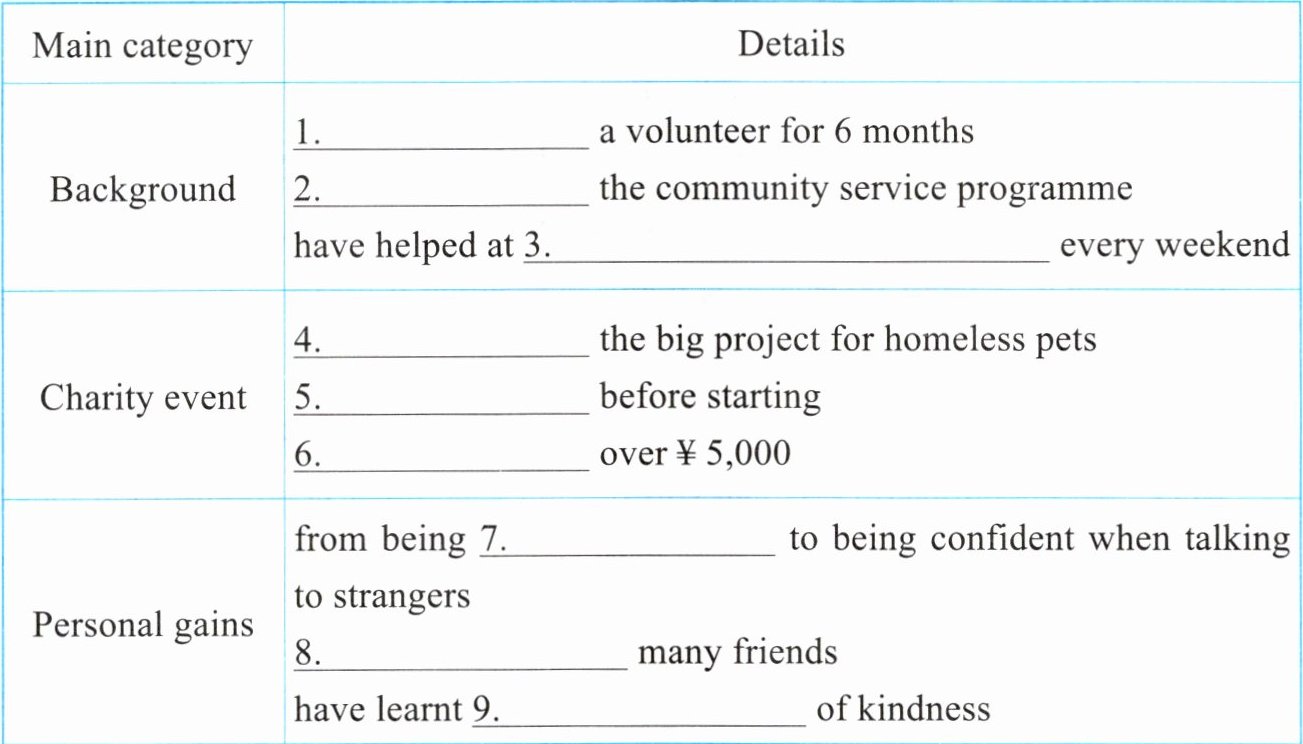
B. Complete the table.
C. Answer the questions.
1. How long has the writer been a volunteer?
2. How does volunteering help the writer become confident?
3. Why is volunteering a good way to make new friends?
A. Complete the passage with the correct forms of the words in brackets.
I 1.
have been
(be) a volunteer for six months. Since I 2. joined
(join)the community service programme, I 3.
have helped
(help) at the local animal shelterevery weekend.
Last month, we 4.
organized
(organize) a charity event for homeless pets.The shelter 5.
was
(be) very crowded that day. Before the event started, we6.
prepared
(prepare) everything carefully. Many people 7. came
(come) tosupport us, and we 8.
raised
(raise) over ¥5,000! My team leader 9. told
(tell) me the final amount yesterday.
At first, I felt nervous about talking to strangers, but now I 10.
have become
(become) much more confident. I 11.
have made
(make) many new friends sinceI took up volunteering. And volunteering 12.
has taught
(teach) me the importanceof kindness!
B. Complete the table.
C. Answer the questions.
1. How long has the writer been a volunteer?
For six months.
2. How does volunteering help the writer become confident?
He practises a lot by talking to many people every weekend. It helps him get better at communicating.
3. Why is volunteering a good way to make new friends?
One possible version: Because volunteers work together, and they can talk to and help each other often. They share the same kindness and interests. That makes it easy for them to become friends.
答案
Ⅳ. A. 1. have been 2. joined 3. have helped 4. organized 5. was 6. prepared 7. came 8. raised 9. told 10. have become 11. have made 12. has taught
B. 1. have been 2. joined 3. the local animal shelter 4. organized 5. prepared carefully 6. raised 7. nervous 8. have made 9. the importance
C. 1. For six months. 2. He practises a lot by talking to many people every weekend. It helps him get better at communicating. 3. One possible version: Because volunteers work together, and they can talk to and help each other often. They share the same kindness and interests. That makes it easy for them to become friends.
B. 1. have been 2. joined 3. the local animal shelter 4. organized 5. prepared carefully 6. raised 7. nervous 8. have made 9. the importance
C. 1. For six months. 2. He practises a lot by talking to many people every weekend. It helps him get better at communicating. 3. One possible version: Because volunteers work together, and they can talk to and help each other often. They share the same kindness and interests. That makes it easy for them to become friends.
解析
【解析】
这是一道基于志愿者经历的综合语用题,包含动词时态填空、信息提取和阅读理解问答三个部分。A部分需结合语境判断时态,现在完成时表持续动作/影响,一般过去时表过去具体动作,来填写动词正确形式;B部分需从A的文本中提取对应信息完成表格;C部分需根据文本内容总结、组织语言回答问题。
【答案】
Ⅳ. A. 1. have been 2. joined 3. have helped 4. organized 5. was 6. prepared 7. came 8. raised 9. told 10. have become 11. have made 12. has taught
B. 1. have been 2. joined 3. the local animal shelter 4. organized 5. prepared carefully 6. raised 7. nervous 8. have made 9. the importance
C. 1. For six months.
2. He practises a lot by talking to many people every weekend. It helps him get better at communicating.
3. One possible version: Because volunteers work together, and they can talk to and help each other often. They share the same kindness and interests. That makes it easy for them to become friends.
【知识点】
现在完成时运用、一般过去时运用、文本信息提取
【点评】
本题结合志愿者主题,综合考查动词时态运用与阅读理解能力,既锻炼学生的语法运用能力,也引导学生理解志愿活动的意义,贴近生活,实用性强。
【难度系数】
0.6
这是一道基于志愿者经历的综合语用题,包含动词时态填空、信息提取和阅读理解问答三个部分。A部分需结合语境判断时态,现在完成时表持续动作/影响,一般过去时表过去具体动作,来填写动词正确形式;B部分需从A的文本中提取对应信息完成表格;C部分需根据文本内容总结、组织语言回答问题。
【答案】
Ⅳ. A. 1. have been 2. joined 3. have helped 4. organized 5. was 6. prepared 7. came 8. raised 9. told 10. have become 11. have made 12. has taught
B. 1. have been 2. joined 3. the local animal shelter 4. organized 5. prepared carefully 6. raised 7. nervous 8. have made 9. the importance
C. 1. For six months.
2. He practises a lot by talking to many people every weekend. It helps him get better at communicating.
3. One possible version: Because volunteers work together, and they can talk to and help each other often. They share the same kindness and interests. That makes it easy for them to become friends.
【知识点】
现在完成时运用、一般过去时运用、文本信息提取
【点评】
本题结合志愿者主题,综合考查动词时态运用与阅读理解能力,既锻炼学生的语法运用能力,也引导学生理解志愿活动的意义,贴近生活,实用性强。
【难度系数】
0.6
