

 登录
登录
4. 看图,完成对话。
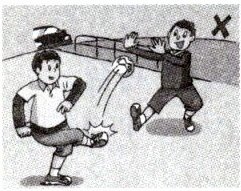
(1) A: Some children like or on the road.
B: Yes. It's a bad .
A: What must they do?
B: They must the rules and stay .
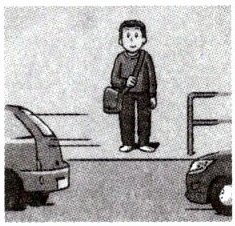
(2) A: There isn't a zebra crossing. Can I the road quickly?
B: No, you . You must wait on the pavement and out for cars and bikes. You can look , then and then left again.
(1) A: Some children like or on the road.
B: Yes. It's a bad .
A: What must they do?
B: They must the rules and stay .
(2) A: There isn't a zebra crossing. Can I the road quickly?
B: No, you . You must wait on the pavement and out for cars and bikes. You can look , then and then left again.
答案
(1) playing football; running; habit; follow; safe
(2) cross; can't; look; left; right
(2) cross; can't; look; left; right
以“Follow the rules”为题,说一说,写一写。
On the road, we must .
There's the red man. We must .
There isn't a zebra crossing. We must .
On the road, we must .
There's the red man. We must .
There isn't a zebra crossing. We must .
答案
1. follow the traffic rules
2. stop and wait
3. look left, then right, then left again and cross quickly
2. stop and wait
3. look left, then right, then left again and cross quickly
1. 读下列单词,再写出其否定形式。
can→() must→()
could→() are→()
can→() must→()
could→() are→()
答案
1.
can→(can not (或 cannot))
must→(must not (或 mustn't))
could→(could not (或 couldn't))
are→(are not (或 aren't))
can→(can not (或 cannot))
must→(must not (或 mustn't))
could→(could not (或 couldn't))
are→(are not (或 aren't))
2. 将下面句子正确、规范地抄写在四线三格上。
How can you cross the road safely?
You must look at the traffic lights.
How can you cross the road safely?
You must look at the traffic lights.
答案
How can you cross the road safely?
You must look at the traffic lights.
You must look at the traffic lights.
1. 与同伴练说“We must...”“We mustn't...”句型,同伴对你的评价是:☺。
答案
答题卡:
我与同伴使用的句型为:
We must follow the traffic rules.
We mustn't play on the road.
同伴评价:☺
我与同伴使用的句型为:
We must follow the traffic rules.
We mustn't play on the road.
同伴评价:☺
2. 根据句意,选择合适的单词填空。
(1) We (should/shouldn't) go to bed late at night.
(2) To keep safe, we (mustn't/must) run or play on the road.
(3) To keep healthy, we (must/mustn't) eat some fruit and vegetables.
(4) —Can I sing (loudly/loud)?
—No, you (can/can't). My little brother is sleeping now.
(5) —What (should/shouldn't) I do in the library?
—You shouldn't read (quietly/loudly).
(1) We (should/shouldn't) go to bed late at night.
(2) To keep safe, we (mustn't/must) run or play on the road.
(3) To keep healthy, we (must/mustn't) eat some fruit and vegetables.
(4) —Can I sing (loudly/loud)?
—No, you (can/can't). My little brother is sleeping now.
(5) —What (should/shouldn't) I do in the library?
—You shouldn't read (quietly/loudly).
答案
(1)shouldn't (2)mustn't (3)must (4)loudly, can't (5)shouldn't, loudly
解析
(1)“go to bed late”是不好的习惯,应选“shouldn't”。(2)“run or play on the road”不安全,必须禁止,选“mustn't”。(3)“eat some fruit and vegetables”对健康有益,是必须做的,选“must”。(4)“sing”是动词,用副词“loudly”修饰;根据答语“弟弟在睡觉”,应是否定回答“can't”。(5)问句询问在图书馆“不应该”做什么,选“shouldn't”;图书馆应保持安静,“不应该大声读”,选“loudly”。
