

 登录
登录
三、完形填空(共15分,每小题1分)
Dario and his mother loved their new apartment.The living room was large enough for their piano.That night, the two of them __________ side by side at the piano.They played jazz music to celebrate their new home.The loud __________ filled the room and made them feel very happy.The next morning, __________, their happiness disappeared.Someone left a __________ under their door during the night.One of their neighbours wrote to complain about the sound of the piano.Dario's mother asked the guard of the building if he knew anything about it.But he said that people living there were all __________ and he couldn't imagine who would do that.Later that morning, Dario suggested that they write a letter to their __________ and apologize for their playing.“Maybe we could go and __________ everyone in person,” his mother said.“What if we invited them to come here for a(n) __________ instead?” Dario asked.They both loved the __________.So they sent out invitations and prepared nice food __________ their guests.They decorated the apartment with flowers and party lights.Finally, the day of the party __________.Some guests brought presents, some brought flowers, and some even brought cakes to __________.One woman, Mrs.Gilbert, __________ Dario's mother with a book of piano music by Chopin.“I heard you playing the other night,” she said.“The sounds woke me out of bed.I __________ that you might play like this every night.So I wrote a short note.I hope that you don't think I disliked the playing.” Dario's mother smiled at Mrs.Gilbert.“I think we should say sorry to you,” she said.“I didn't realize it was __________ when we were playing and played the music too loud.”“I like what you play! Just not so loud at night.” Mrs.Gilbert smiled.“We won't play so loud or late!” Dario said.He took the book and played the new music.It was so beautiful that everyone listened to it carefully and happily.
( ) 36.A.sat
B.stood
C.lay
D.walked
( ) 37.A.voice
B.ring
C.music
D.cry
( ) 38.A.therefore
B.however
C.otherwise
D.instead
( ) 39.A.note
B.poster
C.notice
D.report
( ) 40.A.proud
B.lucky
C.pretty
D.nice
( ) 41.A.neighbours
B.guards
C.friends
D.relatives
( ) 42.A.ask
B.interview
C.order
D.visit
( ) 43.A.party
B.concert
C.game
D.exhibition
( ) 44.A.practice
B.idea
C.action
D.experience
( ) 45.A.to
B.with
C.for
D.from
( ) 46.A.continued
B.arrived
C.passed
D.finished
( ) 47.A.order
B.sell
C.share
D.advertise
( ) 48.A.treated
B.presented
C.helped
D.served
( ) 49.A.worried
B.hoped
C.agreed
D.stopped
( ) 50.A.loud
B.beautiful
C.soft
D.late
Dario and his mother loved their new apartment.The living room was large enough for their piano.That night, the two of them __________ side by side at the piano.They played jazz music to celebrate their new home.The loud __________ filled the room and made them feel very happy.The next morning, __________, their happiness disappeared.Someone left a __________ under their door during the night.One of their neighbours wrote to complain about the sound of the piano.Dario's mother asked the guard of the building if he knew anything about it.But he said that people living there were all __________ and he couldn't imagine who would do that.Later that morning, Dario suggested that they write a letter to their __________ and apologize for their playing.“Maybe we could go and __________ everyone in person,” his mother said.“What if we invited them to come here for a(n) __________ instead?” Dario asked.They both loved the __________.So they sent out invitations and prepared nice food __________ their guests.They decorated the apartment with flowers and party lights.Finally, the day of the party __________.Some guests brought presents, some brought flowers, and some even brought cakes to __________.One woman, Mrs.Gilbert, __________ Dario's mother with a book of piano music by Chopin.“I heard you playing the other night,” she said.“The sounds woke me out of bed.I __________ that you might play like this every night.So I wrote a short note.I hope that you don't think I disliked the playing.” Dario's mother smiled at Mrs.Gilbert.“I think we should say sorry to you,” she said.“I didn't realize it was __________ when we were playing and played the music too loud.”“I like what you play! Just not so loud at night.” Mrs.Gilbert smiled.“We won't play so loud or late!” Dario said.He took the book and played the new music.It was so beautiful that everyone listened to it carefully and happily.
( ) 36.A.sat
B.stood
C.lay
D.walked
( ) 37.A.voice
B.ring
C.music
D.cry
( ) 38.A.therefore
B.however
C.otherwise
D.instead
( ) 39.A.note
B.poster
C.notice
D.report
( ) 40.A.proud
B.lucky
C.pretty
D.nice
( ) 41.A.neighbours
B.guards
C.friends
D.relatives
( ) 42.A.ask
B.interview
C.order
D.visit
( ) 43.A.party
B.concert
C.game
D.exhibition
( ) 44.A.practice
B.idea
C.action
D.experience
( ) 45.A.to
B.with
C.for
D.from
( ) 46.A.continued
B.arrived
C.passed
D.finished
( ) 47.A.order
B.sell
C.share
D.advertise
( ) 48.A.treated
B.presented
C.helped
D.served
( ) 49.A.worried
B.hoped
C.agreed
D.stopped
( ) 50.A.loud
B.beautiful
C.soft
D.late
答案
四、阅读理解(共15分,每小题1分)
A
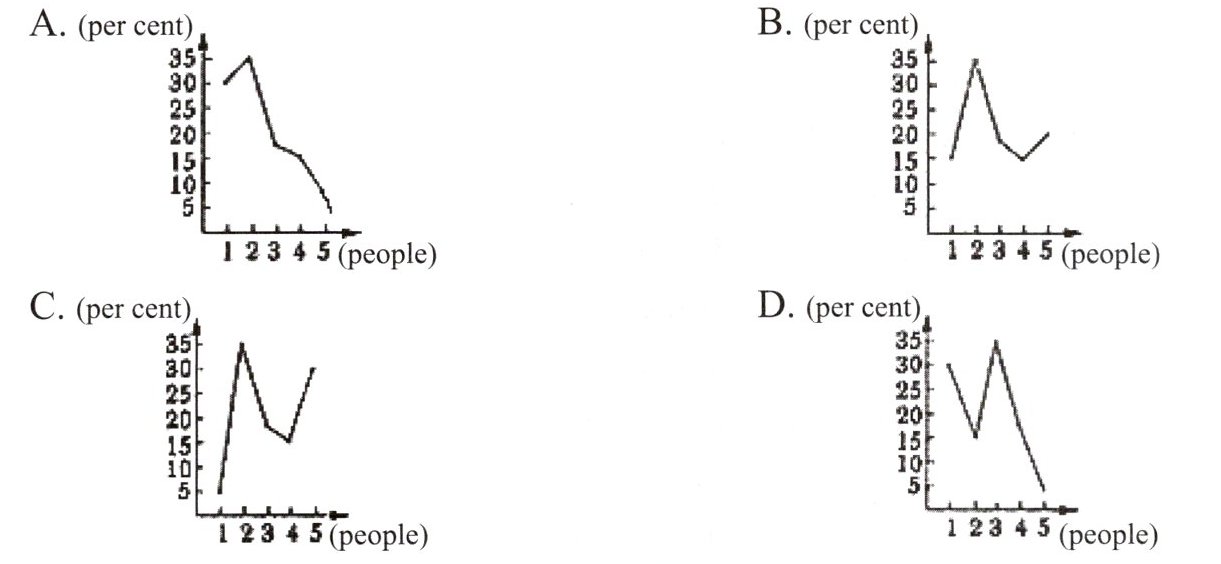
Most people in Britain live in small family groups.More than a quarter of houses in Britain have got only one person in them.Some of these are old people but some are people of 20 to 30 who choose to live alone. 35% of houses have two people in them, and another 17% have three people. 15% have four people in them, and the other homes have five or more.
The families in Britain are small. It is unusual for parents to have more than two children. When children are about 18 or 19, they leave their parents’ home, and they often go to a different city. Sometimes they visit their parents only two or three times a year.
( ) 51. What does the passage mainly tell us?
A. Young people in Britain.
B. Old people in Britain.
C. Families in Britain.
D. The population in Britain.
( ) 52. According to the passage, which of the diagrams (图表) is probably right?
A
Most people in Britain live in small family groups.More than a quarter of houses in Britain have got only one person in them.Some of these are old people but some are people of 20 to 30 who choose to live alone. 35% of houses have two people in them, and another 17% have three people. 15% have four people in them, and the other homes have five or more.
The families in Britain are small. It is unusual for parents to have more than two children. When children are about 18 or 19, they leave their parents’ home, and they often go to a different city. Sometimes they visit their parents only two or three times a year.
( ) 51. What does the passage mainly tell us?
A. Young people in Britain.
B. Old people in Britain.
C. Families in Britain.
D. The population in Britain.
( ) 52. According to the passage, which of the diagrams (图表) is probably right?
答案
B
Elena jogged with her dad in some empty lots (一块地) at the edge of town. These out-of-the-way lots were good places to jog, but they were full of rocks and rubbish.
One day, Elena saw a sign on the lots. It said “New City Park”. Elena was excited. Maybe the park would have a jogging trail (小道)!
Elena told her parents about the sign. “I read about the park in the newspaper,” said Elena’s father. “The city wants volunteers to help clean the area. Then the city will build a soccer field and a playground.”
“Will they build a jogging trail?” Elena asked.
“No. The paper didn’t mention a jogging trail.”
“Well, perhaps if I help clean up the lots, they’ll put in a jogging trail,” said Elena.
On Saturday Elena went to the lots. Many adults were working there. Some were picking up rubbish. Some were moving rocks.
“I want to volunteer,” Elena told a man. “What can I do?”
“This is not a job for children,” said the man. “You’d better go home.”
Elena looked around. She could carry rubbish and move rocks too. A lady was pulling a bag of rubbish. Elena saw a box of rubbish bags. She took an empty bag.
“Here’s a new bag,” said Elena.
“Thanks,” said the lady. “Keep those new bags coming.”
Elena dragged (拖) rubbish bags. She told everyone she was glad to help build the park. She explained that she hoped the park would have a jogging trail.
Elena went to the area every week. Soon everyone knew her and she told everyone how wonderful a jogging trail would be.
Soon the volunteers cleared the lots. The workers could start building. The mayor (市长) gave a speech. He showed a drawing of the new park and talked about the soccer field and the baseball diamond. There would be picnic tables, a playground and the park would even have basketball courts. But there was no sign of a jogging trail.
The mayor thanked the volunteers. Then he asked if they had any suggestions. The volunteers said they wanted to build a jogging trail around the park.
They told the mayor how helpful Elena had been and how she wanted a jogging trail. The mayor said, “A jogging trail won’t be hard to build. Let’s do it!”
Everyone clapped and cheered. Elena cheered loudest of all.
( ) 53. How did Elena know the city needed volunteers to help clean the lots?
A. Her father told her about it.
B. She read it in the newspaper.
C. She learnt it from a sign.
D. She was told by other volunteers.
( ) 54. Why did Elena want to help clean the lots?
A. Because she wanted to play in the playground.
B. Because she wanted her name in the newspaper.
C. Because she wanted to work with other volunteers.
D. Because she wanted the city to build a jogging trail.
( ) 55. Why did the volunteers tell the mayor they wanted to build a jogging trail?
A. Because they needed a jogging trail to jog around.
B. Because they wanted to make Elena’s dream come true.
C. Because they thought it was a good place for jogging.
D. Because they hoped the mayor could jog with them every day.
Elena jogged with her dad in some empty lots (一块地) at the edge of town. These out-of-the-way lots were good places to jog, but they were full of rocks and rubbish.
One day, Elena saw a sign on the lots. It said “New City Park”. Elena was excited. Maybe the park would have a jogging trail (小道)!
Elena told her parents about the sign. “I read about the park in the newspaper,” said Elena’s father. “The city wants volunteers to help clean the area. Then the city will build a soccer field and a playground.”
“Will they build a jogging trail?” Elena asked.
“No. The paper didn’t mention a jogging trail.”
“Well, perhaps if I help clean up the lots, they’ll put in a jogging trail,” said Elena.
On Saturday Elena went to the lots. Many adults were working there. Some were picking up rubbish. Some were moving rocks.
“I want to volunteer,” Elena told a man. “What can I do?”
“This is not a job for children,” said the man. “You’d better go home.”
Elena looked around. She could carry rubbish and move rocks too. A lady was pulling a bag of rubbish. Elena saw a box of rubbish bags. She took an empty bag.
“Here’s a new bag,” said Elena.
“Thanks,” said the lady. “Keep those new bags coming.”
Elena dragged (拖) rubbish bags. She told everyone she was glad to help build the park. She explained that she hoped the park would have a jogging trail.
Elena went to the area every week. Soon everyone knew her and she told everyone how wonderful a jogging trail would be.
Soon the volunteers cleared the lots. The workers could start building. The mayor (市长) gave a speech. He showed a drawing of the new park and talked about the soccer field and the baseball diamond. There would be picnic tables, a playground and the park would even have basketball courts. But there was no sign of a jogging trail.
The mayor thanked the volunteers. Then he asked if they had any suggestions. The volunteers said they wanted to build a jogging trail around the park.
They told the mayor how helpful Elena had been and how she wanted a jogging trail. The mayor said, “A jogging trail won’t be hard to build. Let’s do it!”
Everyone clapped and cheered. Elena cheered loudest of all.
( ) 53. How did Elena know the city needed volunteers to help clean the lots?
A. Her father told her about it.
B. She read it in the newspaper.
C. She learnt it from a sign.
D. She was told by other volunteers.
( ) 54. Why did Elena want to help clean the lots?
A. Because she wanted to play in the playground.
B. Because she wanted her name in the newspaper.
C. Because she wanted to work with other volunteers.
D. Because she wanted the city to build a jogging trail.
( ) 55. Why did the volunteers tell the mayor they wanted to build a jogging trail?
A. Because they needed a jogging trail to jog around.
B. Because they wanted to make Elena’s dream come true.
C. Because they thought it was a good place for jogging.
D. Because they hoped the mayor could jog with them every day.
答案
C
When John was growing up, other kids felt sorry for him, as his parents always had him do some housework or do some part - time jobs. But when John reached adulthood, he was better off than his childhood friends. He had a better career, a better marriage and was healthier. Most of all, he was happier.
These are the findings of a 40 - year study. Researchers followed the lives of 456 teenage boys from Boston. The study showed that those who worked when they were young enjoyed happier and more successful lives than those who did not. “Boys who worked in the home or community gained competence (能力) and came to feel they were useful members of society,” said George Vaillant, the psychologist (心理学家) who made the discovery. “And because they felt good about themselves, others felt good about them too.”
Vaillant’s study followed these males all these years. Interviews were repeated at ages 25, 31 and 47. Under Vaillant, the researchers compared the men’s mental - health scores with their boyhood - activity scores. Points were awarded for part - time jobs, housework, effort at school, and abilities to deal with problems.
The link between what the men once did as young boys and how they turned out as adults was very sharp. Those who did the most boyhood activities were twice as likely to have warm relations with other people, five times as likely to be well paid and 16 times less likely to have been unemployed. The researchers also found that IQ (智商) and family social and economic class (社会和经济阶层) made no real difference in how the boys turned out.
Working—at any age—is important. Childhood activities help a child develop responsibility, independence, confidence and competence—the basis (基础) of emotional health. They also help him understand that people must work with others towards common goals. The most competent adults are those who know how to do this. Yet work isn’t everything. As Tolstory once said, “One can live magnificently in this world if one knows how to work and how to love, to work for the person one loves and to love one’s work.”
( ) 56. Which of the following is true about John?
A. He liked doing part - time jobs.
B. He enjoyed his career and marriage.
C. He received little love from his family.
D. He had few friends when he was a child.
( ) 57. According to Vaillant, why could John be better off than his childhood friends?
A. Because he did part - time jobs after work.
B. Because he felt proud of himself when working.
C. Because his working experience in his childhood was of help.
D. Because he was happier than his friends when they were young.
( ) 58. How many years did the research last?
A. 40 years.
B. 25 years.
C. 31 years.
D. 47 years.
( ) 59. How did Vaillant and his team get the findings of the research?
A. By checking the men’s mental health.
B. By comparing different sets of scores.
C. By recording the boy’s effort at school.
D. By testing the men’s problem solving ability.
( ) 60. The purpose of the passage is to tell us that __________.
A. IQ plays an important role in people’s development
B. social and economic class decides how our career goes
C. only working at a young age is important to our adult life
D. the ability of working with others towards goals is very important
When John was growing up, other kids felt sorry for him, as his parents always had him do some housework or do some part - time jobs. But when John reached adulthood, he was better off than his childhood friends. He had a better career, a better marriage and was healthier. Most of all, he was happier.
These are the findings of a 40 - year study. Researchers followed the lives of 456 teenage boys from Boston. The study showed that those who worked when they were young enjoyed happier and more successful lives than those who did not. “Boys who worked in the home or community gained competence (能力) and came to feel they were useful members of society,” said George Vaillant, the psychologist (心理学家) who made the discovery. “And because they felt good about themselves, others felt good about them too.”
Vaillant’s study followed these males all these years. Interviews were repeated at ages 25, 31 and 47. Under Vaillant, the researchers compared the men’s mental - health scores with their boyhood - activity scores. Points were awarded for part - time jobs, housework, effort at school, and abilities to deal with problems.
The link between what the men once did as young boys and how they turned out as adults was very sharp. Those who did the most boyhood activities were twice as likely to have warm relations with other people, five times as likely to be well paid and 16 times less likely to have been unemployed. The researchers also found that IQ (智商) and family social and economic class (社会和经济阶层) made no real difference in how the boys turned out.
Working—at any age—is important. Childhood activities help a child develop responsibility, independence, confidence and competence—the basis (基础) of emotional health. They also help him understand that people must work with others towards common goals. The most competent adults are those who know how to do this. Yet work isn’t everything. As Tolstory once said, “One can live magnificently in this world if one knows how to work and how to love, to work for the person one loves and to love one’s work.”
( ) 56. Which of the following is true about John?
A. He liked doing part - time jobs.
B. He enjoyed his career and marriage.
C. He received little love from his family.
D. He had few friends when he was a child.
( ) 57. According to Vaillant, why could John be better off than his childhood friends?
A. Because he did part - time jobs after work.
B. Because he felt proud of himself when working.
C. Because his working experience in his childhood was of help.
D. Because he was happier than his friends when they were young.
( ) 58. How many years did the research last?
A. 40 years.
B. 25 years.
C. 31 years.
D. 47 years.
( ) 59. How did Vaillant and his team get the findings of the research?
A. By checking the men’s mental health.
B. By comparing different sets of scores.
C. By recording the boy’s effort at school.
D. By testing the men’s problem solving ability.
( ) 60. The purpose of the passage is to tell us that __________.
A. IQ plays an important role in people’s development
B. social and economic class decides how our career goes
C. only working at a young age is important to our adult life
D. the ability of working with others towards goals is very important
答案
D
What will man be like in the future—in 5,000 or even 50,000 years from now? We can only make a guess, of course. But we can be sure that he will be different from what he is today because man is slowly changing all the time.
Let us take an example. Man, even 500 years ago, was shorter than he is today. Now, on average (平均), man is about three inches taller. 500 years is a relatively (相对地) short period of time, so we may suppose that man will continue to grow taller.
Again, in the modern world we use our brains a lot. Even so, we still make use of only about 20% of the brain’s capacity (容量). As time goes on, however, we will have to use our brains more and more, and finally we will need larger ones! It is likely to bring about a physical change, too. The head, especially the forehead (前额), will grow larger.
Nowadays our eyes are being used too much. In fact, we use them so much that very often they become weaker and we have to wear glasses. But over a very long period of time, it is possible that man’s eyes will grow stronger.
On the other hand, we make less use of our arms and legs. These, as a result, are likely to grow weaker. At the same time, however, our fingers will grow more sensitive (敏感的) because they are used a lot in modern life.
But what about hair? This will probably disappear from the body altogether as time goes on because it does not serve a useful purpose any longer. In the future, then, both men and women are likely to be hairless!
Perhaps all these give the idea that future man will not be a very attractive person to look at. This may be true. All the same (尽管如此), future man will still have a lot in common with us. He will still be a human being, with thoughts and feelings similar to our own.
( ) 61. The article mainly tells us that __________.
A. man’s life will be different in the future
B. future man will look different from us
C. man is growing taller in the future
D. man is changing quickly all the time
( ) 62. Which of the following proves that man is changing?
A. Man sees better than before.
B. Man’s hair has been getting thinner.
C. Man’s arms and legs have been getting weaker.
D. Man has been growing taller over the past 500 years.
( ) 63. How much the brain’s capacity of a person has NOT been used now?
A. About 20%.
B. About 80%.
C. About 30%.
D. About 50%.
( ) 64. Which of the following statements is true about man in the future?
A. He has smaller eyes and wears better glasses.
B. His fingers grow weaker because he doesn’t need to use them.
C. He is hairless because hair is no longer useful.
D. He thinks and feels in a different way.
( ) 65. We can learn from the article that __________.
A. man will become more attractive in the future
B. some parts of man’s body will become weaker because they are less used
C. people are sure about future man’s appearance
D. future life is challenging
What will man be like in the future—in 5,000 or even 50,000 years from now? We can only make a guess, of course. But we can be sure that he will be different from what he is today because man is slowly changing all the time.
Let us take an example. Man, even 500 years ago, was shorter than he is today. Now, on average (平均), man is about three inches taller. 500 years is a relatively (相对地) short period of time, so we may suppose that man will continue to grow taller.
Again, in the modern world we use our brains a lot. Even so, we still make use of only about 20% of the brain’s capacity (容量). As time goes on, however, we will have to use our brains more and more, and finally we will need larger ones! It is likely to bring about a physical change, too. The head, especially the forehead (前额), will grow larger.
Nowadays our eyes are being used too much. In fact, we use them so much that very often they become weaker and we have to wear glasses. But over a very long period of time, it is possible that man’s eyes will grow stronger.
On the other hand, we make less use of our arms and legs. These, as a result, are likely to grow weaker. At the same time, however, our fingers will grow more sensitive (敏感的) because they are used a lot in modern life.
But what about hair? This will probably disappear from the body altogether as time goes on because it does not serve a useful purpose any longer. In the future, then, both men and women are likely to be hairless!
Perhaps all these give the idea that future man will not be a very attractive person to look at. This may be true. All the same (尽管如此), future man will still have a lot in common with us. He will still be a human being, with thoughts and feelings similar to our own.
( ) 61. The article mainly tells us that __________.
A. man’s life will be different in the future
B. future man will look different from us
C. man is growing taller in the future
D. man is changing quickly all the time
( ) 62. Which of the following proves that man is changing?
A. Man sees better than before.
B. Man’s hair has been getting thinner.
C. Man’s arms and legs have been getting weaker.
D. Man has been growing taller over the past 500 years.
( ) 63. How much the brain’s capacity of a person has NOT been used now?
A. About 20%.
B. About 80%.
C. About 30%.
D. About 50%.
( ) 64. Which of the following statements is true about man in the future?
A. He has smaller eyes and wears better glasses.
B. His fingers grow weaker because he doesn’t need to use them.
C. He is hairless because hair is no longer useful.
D. He thinks and feels in a different way.
( ) 65. We can learn from the article that __________.
A. man will become more attractive in the future
B. some parts of man’s body will become weaker because they are less used
C. people are sure about future man’s appearance
D. future life is challenging
答案
