

 登录
登录
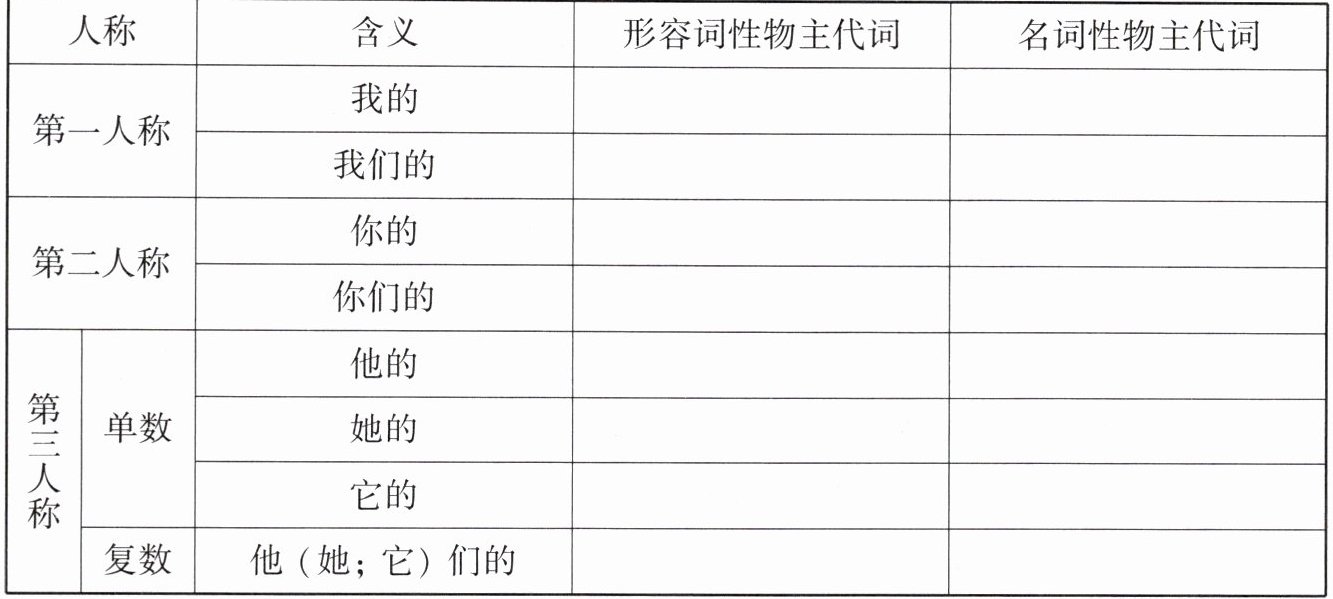
Ⅲ. A) Read the grammar of Possessive Pronouns on pages 91 - 92 in the appendix of the textbook. Then fill in the chart. 读课本 91 - 92 页关于物主代词的语法,填表。
答案
|人称|含义|形容词性物主代词|名词性物主代词|
| ---- | ---- | ---- | ---- |
|第一人称|我的|my|mine|
|第一人称|我们的|our|ours|
|第二人称|你的|your|yours|
|第二人称|你们的|your|yours|
|第三人称单数|他的|his|his|
|第三人称单数|她的|her|hers|
|第三人称单数|它的|its|its|
|第三人称复数|他(她;它)们的|their|theirs|
| ---- | ---- | ---- | ---- |
|第一人称|我的|my|mine|
|第一人称|我们的|our|ours|
|第二人称|你的|your|yours|
|第二人称|你们的|your|yours|
|第三人称单数|他的|his|his|
|第三人称单数|她的|her|hers|
|第三人称单数|它的|its|its|
|第三人称复数|他(她;它)们的|their|theirs|
解析
根据课本附录91-92页物主代词语法内容,第一人称“我的”形容词性物主代词是my,名词性物主代词是mine;“我们的”形容词性物主代词是our,名词性物主代词是ours。第二人称“你的”形容词性物主代词是your,名词性物主代词是yours;“你们的”形容词性物主代词是your,名词性物主代词是yours。第三人称单数“他的”形容词性物主代词是his,名词性物主代词是his;“她的”形容词性物主代词是her,名词性物主代词是hers;“它的”形容词性物主代词是its,名词性物主代词是its。第三人称复数“他(她;它)们的”形容词性物主代词是their,名词性物主代词是theirs。
B) Complete the sentences with proper words. 用合适的单词填空,完成下列句子。
1. —Is this exercise mat yours? —Yes, it's . Thanks!
2. This badminton racket is Han Lin's. has “HL” on it.
3. —Emma, is this volleyball Ella's? —No, is at home.
4. Those badminton rackets belong to Peter and Helen. They're .
5. Ella, these new bikes are . Dad bought them for us yesterday.
1. —Is this exercise mat yours? —Yes, it's . Thanks!
2. This badminton racket is Han Lin's. has “HL” on it.
3. —Emma, is this volleyball Ella's? —No, is at home.
4. Those badminton rackets belong to Peter and Helen. They're .
5. Ella, these new bikes are . Dad bought them for us yesterday.
答案
1. mine 2. It 3. hers 4. theirs 5. ours
解析
1. 问句询问“这个瑜伽垫是你的吗?”,回答“是的,它是我的。”,此处用名词性物主代词mine,相当于my exercise mat。
2. 前句说“这个羽毛球拍是韩林的。”,后句指代“这个羽毛球拍”,用it。
3. 问句询问“这个排球是艾拉的吗?”,回答“不,她的在家里。”,此处用名词性物主代词hers,相当于her volleyball。
4. 前句说“那些羽毛球拍属于彼得和海伦。”,后句表示“它们是他们的。”,用名词性物主代词theirs,相当于their badminton rackets。
5. 后句提到“爸爸昨天给我们买的。”,所以此处表示“这些新自行车是我们的。”,用名词性物主代词ours,相当于our bikes。
2. 前句说“这个羽毛球拍是韩林的。”,后句指代“这个羽毛球拍”,用it。
3. 问句询问“这个排球是艾拉的吗?”,回答“不,她的在家里。”,此处用名词性物主代词hers,相当于her volleyball。
4. 前句说“那些羽毛球拍属于彼得和海伦。”,后句表示“它们是他们的。”,用名词性物主代词theirs,相当于their badminton rackets。
5. 后句提到“爸爸昨天给我们买的。”,所以此处表示“这些新自行车是我们的。”,用名词性物主代词ours,相当于our bikes。
Ⅰ. Read Section A, underline the following language chunks. After that, translate and use them to complete the sentences. 阅读 Section A,并将下列语块在课本上画出来,翻译这些语块,然后选用这些语块完成下列句子。
1. keep fit 2. do sport
3. baseball glove 4. exercise mat
5. jump rope 6. ping - pong bat
7. running shoes 8. tennis racket
9. how often 10. hardly ever
11. once a year 12. be good at
13. play baseball 14. once or twice at weekends
15. play tennis 16. play sport
17. Not at all. 18. look well - used
19. Practice makes perfect. 20. play... with sb
21. play doubles 22. go jogging
23. do exercise 24. go swimming
25. a few 26. badminton racket
27. excuse me 28. over there
29. belong to 30. get up early
31. at the start 32. hear birds singing
33. We can see a new moon of February.
34. —I'm not good at playing ping - pong.
—. You can practise every day.
35. —, is this your baseball? —Yes, that's mine. Thanks.
—. do you usually play baseball?
—Once or twice a week.
36. In the morning I usually and jog in the park. The air is clean, and I can in the trees. I feel great!
1. keep fit 2. do sport
3. baseball glove 4. exercise mat
5. jump rope 6. ping - pong bat
7. running shoes 8. tennis racket
9. how often 10. hardly ever
11. once a year 12. be good at
13. play baseball 14. once or twice at weekends
15. play tennis 16. play sport
17. Not at all. 18. look well - used
19. Practice makes perfect. 20. play... with sb
21. play doubles 22. go jogging
23. do exercise 24. go swimming
25. a few 26. badminton racket
27. excuse me 28. over there
29. belong to 30. get up early
31. at the start 32. hear birds singing
33. We can see a new moon of February.
34. —I'm not good at playing ping - pong.
—. You can practise every day.
35. —, is this your baseball? —Yes, that's mine. Thanks.
—. do you usually play baseball?
—Once or twice a week.
36. In the morning I usually and jog in the park. The air is clean, and I can in the trees. I feel great!
答案
语块翻译
1. 保持健康
2. 做运动
3. 棒球手套
4. 运动垫
5. 跳绳
6. 乒乓球拍
7. 跑鞋
8. 网球拍
9. 多久一次
10. 几乎从不
11. 一年一次
12. 擅长
13. 打棒球
14. 在周末一两次
15. 打网球
16. 做运动
17. 一点也不;不客气
18. 看起来用得很多;看起来很旧
19. 熟能生巧
20. 和某人一起玩……
21. 打双打
22. 去慢跑
23. 做锻炼
24. 去游泳
25. 几个;一些
26. 羽毛球拍
27. 打扰一下;劳驾
28. 在那边
29. 属于
30. 早起
31. 开始;起初
32. 听到鸟儿唱歌
句子填空
33. at the start
34. Practice makes perfect
35. Excuse me; Not at all; How often
36. get up early; hear birds singing
1. 保持健康
2. 做运动
3. 棒球手套
4. 运动垫
5. 跳绳
6. 乒乓球拍
7. 跑鞋
8. 网球拍
9. 多久一次
10. 几乎从不
11. 一年一次
12. 擅长
13. 打棒球
14. 在周末一两次
15. 打网球
16. 做运动
17. 一点也不;不客气
18. 看起来用得很多;看起来很旧
19. 熟能生巧
20. 和某人一起玩……
21. 打双打
22. 去慢跑
23. 做锻炼
24. 去游泳
25. 几个;一些
26. 羽毛球拍
27. 打扰一下;劳驾
28. 在那边
29. 属于
30. 早起
31. 开始;起初
32. 听到鸟儿唱歌
句子填空
33. at the start
34. Practice makes perfect
35. Excuse me; Not at all; How often
36. get up early; hear birds singing
解析
先翻译各语块,再根据语境选择合适语块填空。
33. 句意为“我们能在二月初看到新月”,“在开始时”用“at the start”。
34. 对方说不擅长乒乓球,回答应鼓励练习,“熟能生巧”用“Practice makes perfect.”。
35. 询问物品归属前用“Excuse me”;对方感谢,回答“Not at all.”;问频率用“How often”。
36. 早上通常“早起”然后慢跑,用“get up early”;听到鸟唱歌用“hear birds singing”。
33. 句意为“我们能在二月初看到新月”,“在开始时”用“at the start”。
34. 对方说不擅长乒乓球,回答应鼓励练习,“熟能生巧”用“Practice makes perfect.”。
35. 询问物品归属前用“Excuse me”;对方感谢,回答“Not at all.”;问频率用“How often”。
36. 早上通常“早起”然后慢跑,用“get up early”;听到鸟唱歌用“hear birds singing”。
