

 登录
登录
三、阅读理解(16 分)
A
2024 marks the 50th anniversary of the Rubik's Cube, invented in 1974 by Hungarian professor Ernő Rubik. Initially called the "Magic Cube", Rubik designed it as a teaching tool to help architecture (建筑) students grasp 3D movement. Surprisingly, solving his first wooden prototype took him a month! Over 450 million cubes have been sold worldwide, making it the world's most popular puzzle toy in history—ahead of even the Slinky.
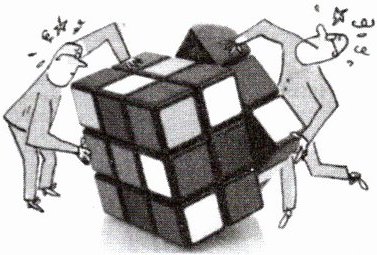
A standard cube has six colored sides. When scrambled, it has 43,000,000³ possible combinations (43 followed by 18 zeros!). Yet mathematicians proved that any cube can be solved in 20 moves or fewer, a number called "God's number". To find this answer, Google used computers running non—stop for 35 years! Modern speedcubers solve it faster—the current world record is 3.13 seconds, set by Max Park in 2023.
Cubes come in all shapes and sizes. The tiniest, made by Super Impulse, is just 3/4 inch wide—smaller than a dice. On the opposite end, Dubai's giant cube is nearly 10 feet tall and weighs over 660 pounds. Special editions include a 2.5 million jeweled cube with gold and gemstones (still solvable!) and tactile cubes with raised symbols for blind users.
The cube became a global craze after arriving in the U.S. in 1980. In 1981, 13—year—old Patrick Bossert wrote a solution book that sold 750,000 copies, making him the youngest New York Times bestselling author. The cube also stars in pop culture—it appears in movies like *Spider—Man: Into the Spider—Verse* and TV shows like *The Big Bang Theory*. Some fans even joke about injuries (损伤) like "Rubik's wrist" from solving too much!
Beyond fun, the cube has educational value. Since 2008, U.S. schools have used it in STEM classes to teach spatial reasoning. Ernő Rubik, now 80, continues to promote its educational role through programs like Rubik's Academy. Though he later created puzzles like the spherical Rubik's 360, his original cube remains a symbol of creativity and logic.
From classrooms to world championships, the Rubik's Cube challenges minds across generations. As Rubik himself says, "It's not just a toy—it's a tool to explore the beauty of problem—solving."
()1. What does "God's number" refer to in the text?
A. The luckiest number.
B. The fewest moves to solve any cube.
C. Total cubes ever sold.
D. Seconds for the fastest solve.
()2. Why does the text mention Dubai's giant cube?
A. To compare cube materials.
B. To explain speedcubing rules.
C. To show different cube sizes.
D. To discuss the math research.
()3. Which evidence best supports the cube's role in education?
A. Used in STEM classes.
B. Appears in movies.
C. Sold in many countries.
D. Caused injuries.
()4. What is the author's main message about the cube's future?
A. It will become outdated.
B. Schools should limit it.
C. It remains influential.
D. Only experts can solve it.
A
2024 marks the 50th anniversary of the Rubik's Cube, invented in 1974 by Hungarian professor Ernő Rubik. Initially called the "Magic Cube", Rubik designed it as a teaching tool to help architecture (建筑) students grasp 3D movement. Surprisingly, solving his first wooden prototype took him a month! Over 450 million cubes have been sold worldwide, making it the world's most popular puzzle toy in history—ahead of even the Slinky.
A standard cube has six colored sides. When scrambled, it has 43,000,000³ possible combinations (43 followed by 18 zeros!). Yet mathematicians proved that any cube can be solved in 20 moves or fewer, a number called "God's number". To find this answer, Google used computers running non—stop for 35 years! Modern speedcubers solve it faster—the current world record is 3.13 seconds, set by Max Park in 2023.
Cubes come in all shapes and sizes. The tiniest, made by Super Impulse, is just 3/4 inch wide—smaller than a dice. On the opposite end, Dubai's giant cube is nearly 10 feet tall and weighs over 660 pounds. Special editions include a 2.5 million jeweled cube with gold and gemstones (still solvable!) and tactile cubes with raised symbols for blind users.
The cube became a global craze after arriving in the U.S. in 1980. In 1981, 13—year—old Patrick Bossert wrote a solution book that sold 750,000 copies, making him the youngest New York Times bestselling author. The cube also stars in pop culture—it appears in movies like *Spider—Man: Into the Spider—Verse* and TV shows like *The Big Bang Theory*. Some fans even joke about injuries (损伤) like "Rubik's wrist" from solving too much!
Beyond fun, the cube has educational value. Since 2008, U.S. schools have used it in STEM classes to teach spatial reasoning. Ernő Rubik, now 80, continues to promote its educational role through programs like Rubik's Academy. Though he later created puzzles like the spherical Rubik's 360, his original cube remains a symbol of creativity and logic.
From classrooms to world championships, the Rubik's Cube challenges minds across generations. As Rubik himself says, "It's not just a toy—it's a tool to explore the beauty of problem—solving."
()1. What does "God's number" refer to in the text?
A. The luckiest number.
B. The fewest moves to solve any cube.
C. Total cubes ever sold.
D. Seconds for the fastest solve.
()2. Why does the text mention Dubai's giant cube?
A. To compare cube materials.
B. To explain speedcubing rules.
C. To show different cube sizes.
D. To discuss the math research.
()3. Which evidence best supports the cube's role in education?
A. Used in STEM classes.
B. Appears in movies.
C. Sold in many countries.
D. Caused injuries.
()4. What is the author's main message about the cube's future?
A. It will become outdated.
B. Schools should limit it.
C. It remains influential.
D. Only experts can solve it.
答案
1. B
2. C
3. A
4. C
2. C
3. A
4. C
