

 登录
登录
一、选出画线部分发音不同的一项。
(
A B C
(
A B C
(
A B C
(
A B C
(
C
)1. This is Lucy's father. He is thirty years old.A B C
(
B
)2. My mother tells me to brush my teeth and care more about them.A B C
(
A
)3. John thinks Jack should clean their table together.A B C
(
C
)4. Thanks to Judy's help, I make a birthday gift for my brother.A B C
答案
一、1. C 2. B 3. A 4. C
解析
【分析】
这道题考查字母组合th的两种发音:清辅音/θ/和浊辅音/ð/。解题思路是先明确th的发音规律:一般在表示亲属关系的名词(如father、mother)、代词(如them、their)等词汇中,th发浊辅音/ð/;在数词(如thirty)、名词(如teeth)、动词第三人称单数(如thinks)等词汇中,th发清辅音/θ/。接下来逐个分析每个小题中三个画线部分的发音,对比后找出发音不同的选项。
【解析】
1. 第1题:
A. father中th发音为/ð/;
C. thirty中th发音为/θ/;
因此发音不同的是C选项。
2. 第2题:
A. mother中th发音为/ð/;
B. teeth中th发音为/θ/;
C. them中th发音为/ð/;
因此发音不同的是B选项。
3. 第3题:
A. thinks中th发音为/θ/;
B. their中th发音为/ð/;
C. together中th发音为/ð/;
因此发音不同的是A选项。
4. 第4题:
A. Thanks中th发音为/θ/;
B. birthday中th发音为/θ/;
C. brother中th发音为/ð/;
因此发音不同的是C选项。
【答案】
一、1. C 2. B 3. A 4. C
【知识点】
字母组合th的发音
【点评】
本题聚焦字母组合th的清浊辅音发音差异,需要学生熟悉th在不同类型词汇中的发音规则,通过对比发音选出不同项,能有效检验学生对辅音字母组合发音的掌握程度,帮助学生巩固语音知识。
【难度系数】
0.6
这道题考查字母组合th的两种发音:清辅音/θ/和浊辅音/ð/。解题思路是先明确th的发音规律:一般在表示亲属关系的名词(如father、mother)、代词(如them、their)等词汇中,th发浊辅音/ð/;在数词(如thirty)、名词(如teeth)、动词第三人称单数(如thinks)等词汇中,th发清辅音/θ/。接下来逐个分析每个小题中三个画线部分的发音,对比后找出发音不同的选项。
【解析】
1. 第1题:
A. father中th发音为/ð/;
C. thirty中th发音为/θ/;
因此发音不同的是C选项。
2. 第2题:
A. mother中th发音为/ð/;
B. teeth中th发音为/θ/;
C. them中th发音为/ð/;
因此发音不同的是B选项。
3. 第3题:
A. thinks中th发音为/θ/;
B. their中th发音为/ð/;
C. together中th发音为/ð/;
因此发音不同的是A选项。
4. 第4题:
A. Thanks中th发音为/θ/;
B. birthday中th发音为/θ/;
C. brother中th发音为/ð/;
因此发音不同的是C选项。
【答案】
一、1. C 2. B 3. A 4. C
【知识点】
字母组合th的发音
【点评】
本题聚焦字母组合th的清浊辅音发音差异,需要学生熟悉th在不同类型词汇中的发音规则,通过对比发音选出不同项,能有效检验学生对辅音字母组合发音的掌握程度,帮助学生巩固语音知识。
【难度系数】
0.6
二、从方框中选择合适的词语,并用其适当形式填空。(有一项多余)
visit old people dragon boat race look at the moon rice dumpling
Mother's Day favourite rice cakes make jiaozi
1. —What are they doing? —They
2. —What should we do at the Double Ninth Festival?
—We should
3. —What do people usually do at the Dragon Boat Festival?
—They usually have
4. —What is your grandpa good at?
—He is good at
5. It's
visit old people dragon boat race look at the moon rice dumpling
Mother's Day favourite rice cakes make jiaozi
1. —What are they doing? —They
are looking at the moon
and eating moon cakes.2. —What should we do at the Double Ninth Festival?
—We should
visit old people
and have a big lunch with them.3. —What do people usually do at the Dragon Boat Festival?
—They usually have
dragon boat races
and eat rice dumplings
.4. —What is your grandpa good at?
—He is good at
making jiaozi
. We often eat different kinds of jiaozi.5. It's
Mother's Day
. I cook my mum's favourite
food—a rose cake.答案
二、1. are looking at the moon
2. visit old people
3. dragon boat races,rice dumplings
4. making jiaozi
5. Mother's Day,favourite
2. visit old people
3. dragon boat races,rice dumplings
4. making jiaozi
5. Mother's Day,favourite
解析
【分析】
1. 第一题:问句用现在进行时提问,答句需保持时态一致,且答句提到“eating moon cakes(吃月饼)”,对应中秋传统活动“look at the moon(赏月)”,因此要填其现在进行时形式。
2. 第二题:“Double Ninth Festival(重阳节)”的核心传统活动是看望老人,方框中“visit old people”符合该节日习俗,且should后接动词原形,直接使用即可。
3. 第三题:“Dragon Boat Festival(端午节)”的传统活动为赛龙舟、吃粽子,此处表示泛指这类活动和食物,名词需用复数形式。
4. 第四题:“be good at”是固定搭配,后接动词的ing形式,结合答句中“jiaozi(饺子)”的提示,对应短语“make jiaozi”,需变换为动名词形式。
5. 第五题:根据后句“cook my mum's...food(给妈妈做……食物)”的语境,可确定节日为“Mother's Day(母亲节)”;“favourite”表示“最喜欢的”,用来修饰“food”符合语义。
【解析】
1. 结合现在进行时态要求和“吃月饼”的中秋语境,填入are looking at the moon。
2. 依据重阳节习俗和should的用法,填入visit old people。
3. 按照端午节传统活动,且表示泛指需用名词复数,分别填入dragon boat races和rice dumplings。
4. 遵循“be good at doing sth.”的固定搭配,结合饺子的提示,填入making jiaozi。
5. 根据给妈妈做食物的语境确定节日,再用“favourite”修饰食物,分别填入Mother's Day和favourite。
【答案】
1. are looking at the moon
2. visit old people
3. dragon boat races,rice dumplings
4. making jiaozi
5. Mother's Day,favourite
【知识点】
1. 传统节日习俗
2. 现在进行时用法
3. 固定搭配运用
【点评】
本题结合中国传统节日的文化常识与英语语法知识点,考查了现在进行时、固定搭配、名词复数等内容,需要学生既熟悉节日典型活动,又能灵活运用语法规则变换短语形式。
【难度系数】
0.6
1. 第一题:问句用现在进行时提问,答句需保持时态一致,且答句提到“eating moon cakes(吃月饼)”,对应中秋传统活动“look at the moon(赏月)”,因此要填其现在进行时形式。
2. 第二题:“Double Ninth Festival(重阳节)”的核心传统活动是看望老人,方框中“visit old people”符合该节日习俗,且should后接动词原形,直接使用即可。
3. 第三题:“Dragon Boat Festival(端午节)”的传统活动为赛龙舟、吃粽子,此处表示泛指这类活动和食物,名词需用复数形式。
4. 第四题:“be good at”是固定搭配,后接动词的ing形式,结合答句中“jiaozi(饺子)”的提示,对应短语“make jiaozi”,需变换为动名词形式。
5. 第五题:根据后句“cook my mum's...food(给妈妈做……食物)”的语境,可确定节日为“Mother's Day(母亲节)”;“favourite”表示“最喜欢的”,用来修饰“food”符合语义。
【解析】
1. 结合现在进行时态要求和“吃月饼”的中秋语境,填入are looking at the moon。
2. 依据重阳节习俗和should的用法,填入visit old people。
3. 按照端午节传统活动,且表示泛指需用名词复数,分别填入dragon boat races和rice dumplings。
4. 遵循“be good at doing sth.”的固定搭配,结合饺子的提示,填入making jiaozi。
5. 根据给妈妈做食物的语境确定节日,再用“favourite”修饰食物,分别填入Mother's Day和favourite。
【答案】
1. are looking at the moon
2. visit old people
3. dragon boat races,rice dumplings
4. making jiaozi
5. Mother's Day,favourite
【知识点】
1. 传统节日习俗
2. 现在进行时用法
3. 固定搭配运用
【点评】
本题结合中国传统节日的文化常识与英语语法知识点,考查了现在进行时、固定搭配、名词复数等内容,需要学生既熟悉节日典型活动,又能灵活运用语法规则变换短语形式。
【难度系数】
0.6
三、根据图片或上下文提示,补全短文。
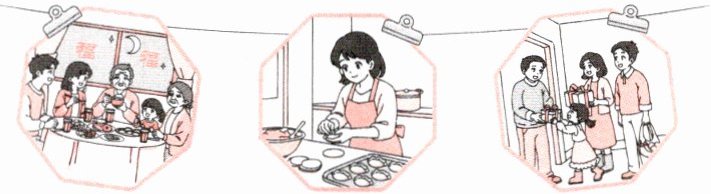
There 1.
also 2.
festival, people always get 5.
mother 7.
my parents and I go and 9.
10.
There 1.
are
a lot of Chinese festivals. My favourite festival is the Spring Festival. Wealso 2.
call
it Chinese New Year. It's usually in 3. January
or February. 4. At
thisfestival, people always get 5.
together
with their families and have a big 6. dinner
. Mymother 7.
makes
jiaozi for us every year. I like 8. eating
jiaozi very much. Sometimesmy parents and I go and 9.
visit
some relatives(亲戚) and friends. We buy some10.
presents
for them. We always have a lot of 11. fun
.答案
三、1. are 2. call 3. January 4. At
5. together 6. dinner 7. makes
8. eating 9. visit 10. presents
11. fun
5. together 6. dinner 7. makes
8. eating 9. visit 10. presents
11. fun
解析
【分析】
首先通读短文,了解短文围绕春节展开介绍。然后结合图片(家庭聚餐、制作饺子、拜访亲友送礼物)和上下文语境、语法规则、固定搭配来逐个确定答案:
1. 第一空是there be句型,后面名词是复数形式“a lot of Chinese festivals”,所以be动词用are;
2. 第二空根据语境“我们也把它叫做中国新年”,用动词call;
3. 第三空结合春节的时间常识,通常在一月或二月,填January;
4. 第四空表示“在这个节日”,节日前用介词At;
5. 第五空根据图片家庭团聚的场景,固定短语get together表示“团聚”;
6. 第六空结合聚餐场景,have a big dinner是“吃大餐”的固定表达;
7. 第七空主语是My mother(第三人称单数),一般现在时中“做饺子”用makes;
8. 第八空like后接动名词,“喜欢吃饺子”用eating;
9. 第九空结合图片拜访亲友的场景,“拜访”用visit;
10. 第十空根据图片送礼物的场景,“礼物”用presents;
11. 第十一空固定短语have a lot of fun表示“玩得开心”。
【解析】
1. 第1空:there be句型遵循“就近原则”,后面的名词“a lot of Chinese festivals”是复数,所以填are;
2. 第2空:根据语境“我们也称呼它为中国新年”,call有“称呼,把……叫做”的意思,填call;
3. 第3空:根据春节的时间常识,春节通常在一月(January)或二月,填January;
4. 第4空:表示“在某个节日”,常用介词At,填At;
5. 第5空:固定短语get together意为“团聚,聚在一起”,符合家庭团聚的语境,填together;
6. 第6空:have a big dinner是固定表达,意为“吃一顿大餐”,对应图片里的聚餐场景,填dinner;
7. 第7空:主语“My mother”是第三人称单数,一般现在时中谓语动词用第三人称单数形式,make的第三人称单数是makes,填makes;
8. 第8空:like后接动名词形式,表示“喜欢做某事”,eat的动名词是eating,填eating;
9. 第9空:根据图片拜访亲友的场景,visit意为“拜访,看望”,填visit;
10. 第10空:结合图片送礼物的场景,present意为“礼物”,这里用复数形式presents;
11. 第11空:固定短语have a lot of fun意为“玩得很开心”,符合语境,填fun。
【答案】
1. are 2. call 3. January 4. At
5. together 6. dinner 7. makes
8. eating 9. visit 10. presents
11. fun
【知识点】
there be句型、固定短语搭配、一般现在时
【点评】
本题围绕中国传统节日春节展开,结合图片提示和语境,考查了基础语法、固定短语以及节日相关的英语表达,贴近生活实际,既能巩固语言知识,又能加深对传统节日的了解,提升学生的语用能力。
【难度系数】
0.8
首先通读短文,了解短文围绕春节展开介绍。然后结合图片(家庭聚餐、制作饺子、拜访亲友送礼物)和上下文语境、语法规则、固定搭配来逐个确定答案:
1. 第一空是there be句型,后面名词是复数形式“a lot of Chinese festivals”,所以be动词用are;
2. 第二空根据语境“我们也把它叫做中国新年”,用动词call;
3. 第三空结合春节的时间常识,通常在一月或二月,填January;
4. 第四空表示“在这个节日”,节日前用介词At;
5. 第五空根据图片家庭团聚的场景,固定短语get together表示“团聚”;
6. 第六空结合聚餐场景,have a big dinner是“吃大餐”的固定表达;
7. 第七空主语是My mother(第三人称单数),一般现在时中“做饺子”用makes;
8. 第八空like后接动名词,“喜欢吃饺子”用eating;
9. 第九空结合图片拜访亲友的场景,“拜访”用visit;
10. 第十空根据图片送礼物的场景,“礼物”用presents;
11. 第十一空固定短语have a lot of fun表示“玩得开心”。
【解析】
1. 第1空:there be句型遵循“就近原则”,后面的名词“a lot of Chinese festivals”是复数,所以填are;
2. 第2空:根据语境“我们也称呼它为中国新年”,call有“称呼,把……叫做”的意思,填call;
3. 第3空:根据春节的时间常识,春节通常在一月(January)或二月,填January;
4. 第4空:表示“在某个节日”,常用介词At,填At;
5. 第5空:固定短语get together意为“团聚,聚在一起”,符合家庭团聚的语境,填together;
6. 第6空:have a big dinner是固定表达,意为“吃一顿大餐”,对应图片里的聚餐场景,填dinner;
7. 第7空:主语“My mother”是第三人称单数,一般现在时中谓语动词用第三人称单数形式,make的第三人称单数是makes,填makes;
8. 第8空:like后接动名词形式,表示“喜欢做某事”,eat的动名词是eating,填eating;
9. 第9空:根据图片拜访亲友的场景,visit意为“拜访,看望”,填visit;
10. 第10空:结合图片送礼物的场景,present意为“礼物”,这里用复数形式presents;
11. 第11空:固定短语have a lot of fun意为“玩得很开心”,符合语境,填fun。
【答案】
1. are 2. call 3. January 4. At
5. together 6. dinner 7. makes
8. eating 9. visit 10. presents
11. fun
【知识点】
there be句型、固定短语搭配、一般现在时
【点评】
本题围绕中国传统节日春节展开,结合图片提示和语境,考查了基础语法、固定短语以及节日相关的英语表达,贴近生活实际,既能巩固语言知识,又能加深对传统节日的了解,提升学生的语用能力。
【难度系数】
0.8
四、提素养 人文底蕴 阅读短文,选择正确的选项。
The Laba Festival is on the eighth(第八) day of the last month in the Chinese lunar
calendar and it has a history of more than 1,200 years.
In ancient China, "La" referred to the sacrificial ceremony(祭祀仪式) held at the
end of the lunar year. People first say "La" in the Qin Dynasty(朝代). In the Han
Dynasty, the eighth day of the last lunar month is called "the Laba Festival". From the
Song Dynasty, people start making Laba porridge(粥) on that day. In many places of
northern China, people make Laba garlic.
(核算收支) of the year. Garlic, called "suàn" in Chinese, sounds the same as
the word "calculate". On that day, people will send a letter to people who bor-
row money from them. The letter says it is time to pay back the money. They may give Laba
garlic to kindly remind the borrowers to pay back the money too.
The Laba Festival is full of traditional Chinese culture. The customs(习俗) may be
different, but people have the same wish for a better life.
(
A. the Qin Dynasty B. the Song Dynasty C. the Han Dynasty
(
A. 介意 B. 提醒 C. 警告
(
A. Why do people make Laba garlic B. How do people make Laba garlic
C. Why do people like Laba porridge
(
A. The way to make Laba food. B. The customs of the Laba Festival.
C. The history of the Laba Festival.
(
A. Science Life. B. Art Today. C. Culture World.
The Laba Festival is on the eighth(第八) day of the last month in the Chinese lunar
calendar and it has a history of more than 1,200 years.
In ancient China, "La" referred to the sacrificial ceremony(祭祀仪式) held at the
end of the lunar year. People first say "La" in the Qin Dynasty(朝代). In the Han
Dynasty, the eighth day of the last lunar month is called "the Laba Festival". From the
Song Dynasty, people start making Laba porridge(粥) on that day. In many places of
northern China, people make Laba garlic.
Why do people make Laba garlic
? At the Laba Festival, people calculate the income and payment(核算收支) of the year. Garlic, called "suàn" in Chinese, sounds the same as
the word "calculate". On that day, people will send a letter to people who bor-
row money from them. The letter says it is time to pay back the money. They may give Laba
garlic to kindly remind the borrowers to pay back the money too.
The Laba Festival is full of traditional Chinese culture. The customs(习俗) may be
different, but people have the same wish for a better life.
(
C
)1. "Laba" becomes a festival in C
.A. the Qin Dynasty B. the Song Dynasty C. the Han Dynasty
(
B
)2. The underlined word "remind" means "B
" in Chinese.A. 介意 B. 提醒 C. 警告
(
A
)3. Which of the following can be put in "A
"?A. Why do people make Laba garlic B. How do people make Laba garlic
C. Why do people like Laba porridge
(
A
)4. Which is not mentioned(未提及) in this passage?A. The way to make Laba food. B. The customs of the Laba Festival.
C. The history of the Laba Festival.
(
C
)5. In which part of a magazine can we read this passage?A. Science Life. B. Art Today. C. Culture World.
答案
四、1. C 2. B 3. A 4. A 5. C
解析
【分析】
1. 第1题:解题思路是定位题目关键词“becomes a festival”,在文中寻找对应的朝代信息,找到第二段中“In the Han Dynasty, the eighth day of the last lunar month is called 'the Laba Festival'.”的句子,即可确定答案。
2. 第2题:解题思路是结合上下文语境猜测词义,根据后文“the borrowers to pay back the money”可知,给腊八蒜是为了让借钱的人记起还钱,由此推断“remind”的含义。
3. 第3题:解题思路是分析后文内容,后文讲述了人们制作腊八蒜的原因,因此空处应是针对制作腊八蒜的原因提出的问题,对应选项。
4. 第4题:解题思路是逐一核对选项内容,文中提及了腊八节的历史和习俗,但未提到制作腊八食物的方法,从而确定未提及的内容。
5. 第5题:解题思路是判断文章主题,文章围绕腊八节这一中国传统节日展开,属于文化类内容,据此判断杂志板块。
【解析】
1. 根据文章第二段“In the Han Dynasty, the eighth day of the last lunar month is called 'the Laba Festival'.”可知,腊八在汉代成为节日,故选C。
2. 根据“They may give Laba garlic to kindly remind the borrowers to pay back the money too.”可知,人们用腊八蒜来提醒借钱的人还钱,因此“remind”意为“提醒”,故选B。
3. 后文内容介绍了人们制作腊八蒜的原因,因此空处应是“Why do people make Laba garlic”,故选A。
4. 文章介绍了腊八节的历史(第一段、第二段)和习俗(制作腊八粥、腊八蒜,核算收支等),但未提及制作腊八食物的方法,故选A。
5. 文章介绍的是腊八节这一中国传统文化内容,因此可以在“Culture World”板块读到,故选C。
【答案】
四、1. C 2. B 3. A 4. A 5. C
【知识点】
细节理解题、词义猜测题、主旨推断题
【点评】
本文介绍了腊八节的历史、习俗及相关文化内涵,题目侧重考查学生对文章细节信息的提取能力、词义的语境推测能力和主旨内容的判断能力,解题时需结合文章内容精准定位信息,结合语境分析推断。
【难度系数】
0.7
1. 第1题:解题思路是定位题目关键词“becomes a festival”,在文中寻找对应的朝代信息,找到第二段中“In the Han Dynasty, the eighth day of the last lunar month is called 'the Laba Festival'.”的句子,即可确定答案。
2. 第2题:解题思路是结合上下文语境猜测词义,根据后文“the borrowers to pay back the money”可知,给腊八蒜是为了让借钱的人记起还钱,由此推断“remind”的含义。
3. 第3题:解题思路是分析后文内容,后文讲述了人们制作腊八蒜的原因,因此空处应是针对制作腊八蒜的原因提出的问题,对应选项。
4. 第4题:解题思路是逐一核对选项内容,文中提及了腊八节的历史和习俗,但未提到制作腊八食物的方法,从而确定未提及的内容。
5. 第5题:解题思路是判断文章主题,文章围绕腊八节这一中国传统节日展开,属于文化类内容,据此判断杂志板块。
【解析】
1. 根据文章第二段“In the Han Dynasty, the eighth day of the last lunar month is called 'the Laba Festival'.”可知,腊八在汉代成为节日,故选C。
2. 根据“They may give Laba garlic to kindly remind the borrowers to pay back the money too.”可知,人们用腊八蒜来提醒借钱的人还钱,因此“remind”意为“提醒”,故选B。
3. 后文内容介绍了人们制作腊八蒜的原因,因此空处应是“Why do people make Laba garlic”,故选A。
4. 文章介绍了腊八节的历史(第一段、第二段)和习俗(制作腊八粥、腊八蒜,核算收支等),但未提及制作腊八食物的方法,故选A。
5. 文章介绍的是腊八节这一中国传统文化内容,因此可以在“Culture World”板块读到,故选C。
【答案】
四、1. C 2. B 3. A 4. A 5. C
【知识点】
细节理解题、词义猜测题、主旨推断题
【点评】
本文介绍了腊八节的历史、习俗及相关文化内涵,题目侧重考查学生对文章细节信息的提取能力、词义的语境推测能力和主旨内容的判断能力,解题时需结合文章内容精准定位信息,结合语境分析推断。
【难度系数】
0.7
