

 登录
登录
Ⅲ. 任务型读写。
Stonehenge is a famous circle of large stones in Britain. Scientists are not sure what it was used for, but they believe that it is one of the greatest mysteries(神秘事物) in history.
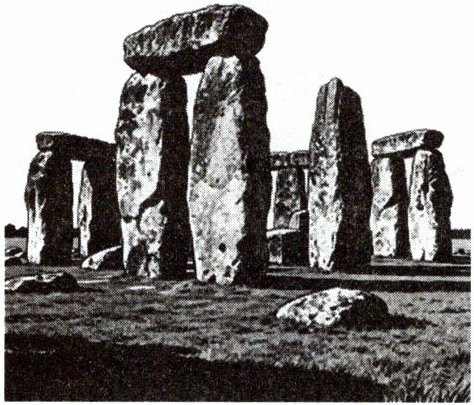
Every year, more than 750,000 visitors go there in order to see the sunrise on the longest day of the year. For many years, people believed that it was a temple (寺庙) where ancient leaders tried to talk with the gods (神). However, a historian named Paul Stoker thinks that might not be true, because Stonehenge was built long before those leaders arrived.
Another popular idea is that Stonehenge might be a kind of calendar(日历). Research shows that on midsummer's morning, the sun shines directly into the center of the stones.
Some people also wonder whether the stones had a medical purpose. One visitor said, "As you walk there, you can feel energy(能量) move up your body." Therefore, they think the stones can keep people healthy.
No one is sure if Stonehenge was a burial(埋葬的) place, or whether it was built to celebrate a victory. But most experts agree that the stones were placed for a special purpose.
Stonehenge was built over a very long time. Scientists are not sure how people moved such heavy stones. In 2001, some volunteers tried to build another Stonehenge, but they couldn't. Paul Stoker says, "We don't know who built Stonehenge, but we do know that they must have been hard-working and great planners."
任务一:根据短文内容完成下表,每空不超过3个单词。
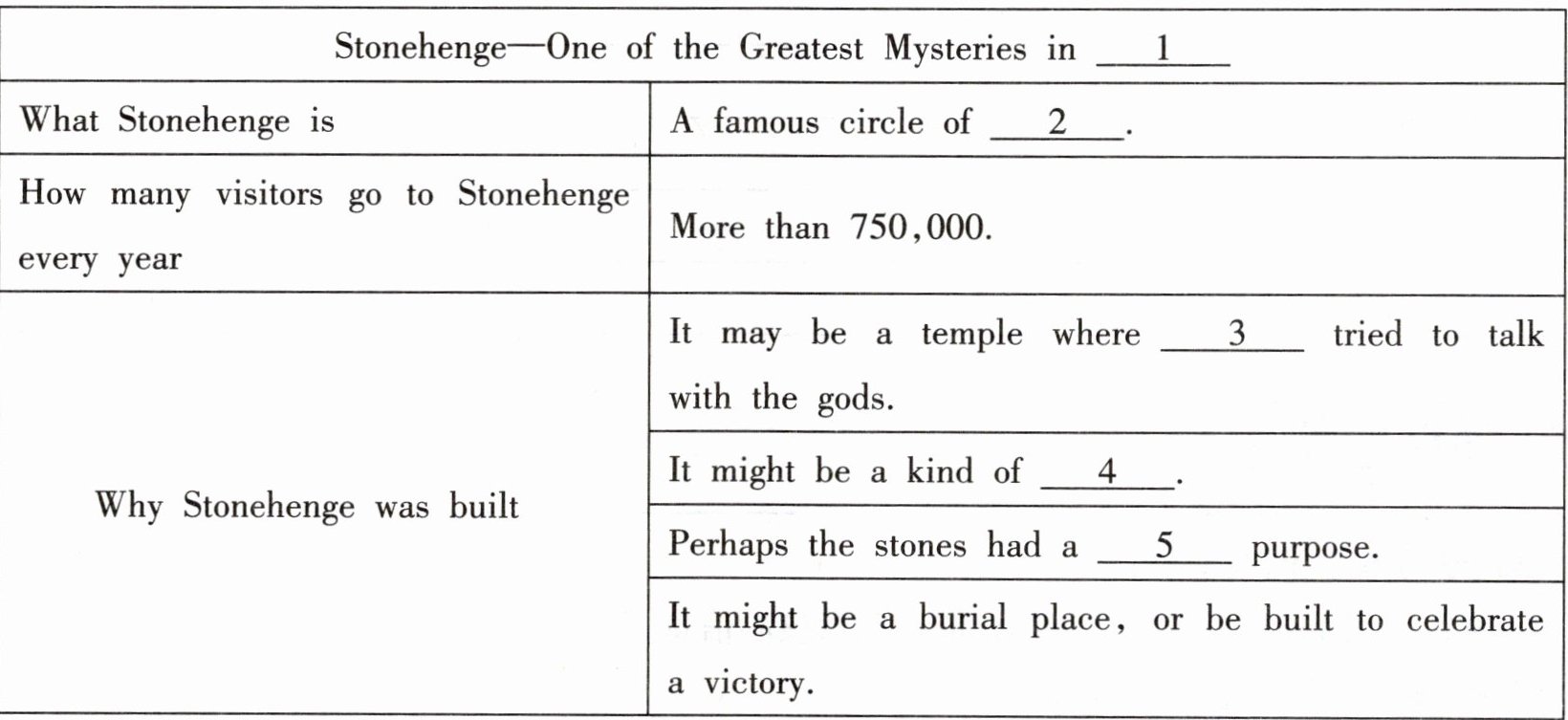
1.
任务二:
Why do human beings never give up exploring the secrets of the world, even the ones that may never be unlocked?
Stonehenge is a famous circle of large stones in Britain. Scientists are not sure what it was used for, but they believe that it is one of the greatest mysteries(神秘事物) in history.
Every year, more than 750,000 visitors go there in order to see the sunrise on the longest day of the year. For many years, people believed that it was a temple (寺庙) where ancient leaders tried to talk with the gods (神). However, a historian named Paul Stoker thinks that might not be true, because Stonehenge was built long before those leaders arrived.
Another popular idea is that Stonehenge might be a kind of calendar(日历). Research shows that on midsummer's morning, the sun shines directly into the center of the stones.
Some people also wonder whether the stones had a medical purpose. One visitor said, "As you walk there, you can feel energy(能量) move up your body." Therefore, they think the stones can keep people healthy.
No one is sure if Stonehenge was a burial(埋葬的) place, or whether it was built to celebrate a victory. But most experts agree that the stones were placed for a special purpose.
Stonehenge was built over a very long time. Scientists are not sure how people moved such heavy stones. In 2001, some volunteers tried to build another Stonehenge, but they couldn't. Paul Stoker says, "We don't know who built Stonehenge, but we do know that they must have been hard-working and great planners."
任务一:根据短文内容完成下表,每空不超过3个单词。
1.
history
2. large stones
3. ancient leaders
4. calendar
5. medical
任务二:
Why do human beings never give up exploring the secrets of the world, even the ones that may never be unlocked?
Human beings never give up exploring because curiosity drives us to understand the world around us. Exploring helps us get new knowledge and make progress. Even unsolved secrets encourage us to keep trying and unlock more secrets of the world.
答案
任务一:1. history 2. large stones 3. ancient leaders 4. calendar 5. medical
任务二:(答案不唯一)Human beings never give up exploring because curiosity drives us
to understand the world around us. Exploring helps us get new knowledge and make progress.
Even unsolved secrets encourage us to keep trying and unlock more secrets of the world.
任务二:(答案不唯一)Human beings never give up exploring because curiosity drives us
to understand the world around us. Exploring helps us get new knowledge and make progress.
Even unsolved secrets encourage us to keep trying and unlock more secrets of the world.
解析
【分析】
任务一:需从短文中精准提取对应信息完成表格,解题时先通读短文,再根据相关描述逐句定位原文内容:先找到巨石阵是历史上的神秘事物,提取对应关键词;接着明确巨石阵的构成;然后找到早期人们对它用途的猜想——古代领袖与神对话的场所;再获取另一种主流猜想是日历;最后定位到有人认为它有医疗用途,确保每空词汇不超过3个单词。
任务二:这是开放性问题,解题时围绕“人类为何不放弃探索未解之谜”展开思考,可从好奇心驱使、获取新知识、推动进步、未解之谜的激励作用等角度组织语言,保证表达通顺合理。
【解析】
任务一:
1. 根据第一段“it is one of the greatest mysteries(神秘事物) in history”,提取关键词history;
2. 根据第一段“Stonehenge is a famous circle of large stones in Britain”,提取关键词large stones;
3. 根据第二段“people believed that it was a temple (寺庙) where ancient leaders tried to talk with the gods (神)”,提取关键词ancient leaders;
4. 根据第三段“Another popular idea is that Stonehenge might be a kind of calendar(日历)”,提取关键词calendar;
5. 根据第四段“Some people also wonder whether the stones had a medical purpose”,提取关键词medical。
任务二:
围绕探索的意义作答,核心思路为:好奇心驱使人类了解世界,探索能帮助我们获取新知识、取得进步,即使未解的秘密也会激励我们不断尝试,解锁更多世界的奥秘,据此组织通顺的英语句子即可。
【答案】
任务一:1. history 2. large stones 3. ancient leaders 4. calendar 5. medical
任务二:(答案不唯一)Human beings never give up exploring because curiosity drives us
to understand the world around us. Exploring helps us get new knowledge and make progress.
Even unsolved secrets encourage us to keep trying and unlock more secrets of the world.
【知识点】
细节信息提取、开放性观点表达、英语读写综合
【点评】
本题结合任务型读写的两种常见题型,既考查学生对英语短文细节信息的定位与提取能力,又考查学生的开放性思维和英语语言组织能力。任务一需要学生精准阅读原文,抓取核心词汇;任务二需要学生结合生活认知和探索意义,用通顺的英语表达观点,对学生的综合语言能力有一定要求。
【难度系数】
0.6
任务一:需从短文中精准提取对应信息完成表格,解题时先通读短文,再根据相关描述逐句定位原文内容:先找到巨石阵是历史上的神秘事物,提取对应关键词;接着明确巨石阵的构成;然后找到早期人们对它用途的猜想——古代领袖与神对话的场所;再获取另一种主流猜想是日历;最后定位到有人认为它有医疗用途,确保每空词汇不超过3个单词。
任务二:这是开放性问题,解题时围绕“人类为何不放弃探索未解之谜”展开思考,可从好奇心驱使、获取新知识、推动进步、未解之谜的激励作用等角度组织语言,保证表达通顺合理。
【解析】
任务一:
1. 根据第一段“it is one of the greatest mysteries(神秘事物) in history”,提取关键词history;
2. 根据第一段“Stonehenge is a famous circle of large stones in Britain”,提取关键词large stones;
3. 根据第二段“people believed that it was a temple (寺庙) where ancient leaders tried to talk with the gods (神)”,提取关键词ancient leaders;
4. 根据第三段“Another popular idea is that Stonehenge might be a kind of calendar(日历)”,提取关键词calendar;
5. 根据第四段“Some people also wonder whether the stones had a medical purpose”,提取关键词medical。
任务二:
围绕探索的意义作答,核心思路为:好奇心驱使人类了解世界,探索能帮助我们获取新知识、取得进步,即使未解的秘密也会激励我们不断尝试,解锁更多世界的奥秘,据此组织通顺的英语句子即可。
【答案】
任务一:1. history 2. large stones 3. ancient leaders 4. calendar 5. medical
任务二:(答案不唯一)Human beings never give up exploring because curiosity drives us
to understand the world around us. Exploring helps us get new knowledge and make progress.
Even unsolved secrets encourage us to keep trying and unlock more secrets of the world.
【知识点】
细节信息提取、开放性观点表达、英语读写综合
【点评】
本题结合任务型读写的两种常见题型,既考查学生对英语短文细节信息的定位与提取能力,又考查学生的开放性思维和英语语言组织能力。任务一需要学生精准阅读原文,抓取核心词汇;任务二需要学生结合生活认知和探索意义,用通顺的英语表达观点,对学生的综合语言能力有一定要求。
【难度系数】
0.6
