

 登录
登录
五、(2025·苏州)阅读下面短文,从短文后的选项中选出可以填入空白处的最佳选项。选项中有两项为多余选项。
Have you ever looked closely at the paper money from different countries? You will see more than numbers and colours. You will discover pictures of rivers, mountains, buildings and famous people. 1.
Let's start with China. 2.
4.
These days, many people use phones or cards as a way to pay. 5.
So next time you hold your paper money, take a second look.
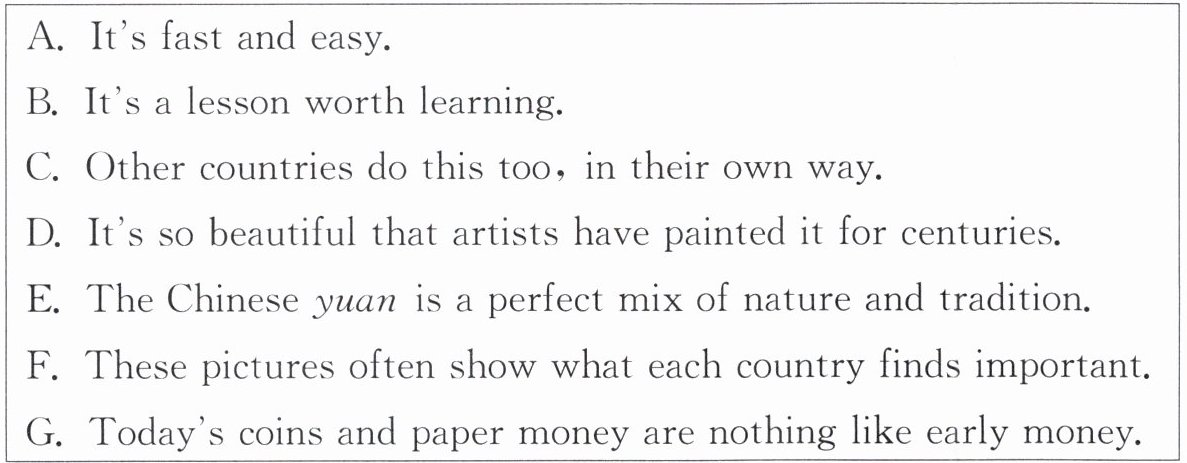
Have you ever looked closely at the paper money from different countries? You will see more than numbers and colours. You will discover pictures of rivers, mountains, buildings and famous people. 1.
F
They are like small lessons in culture, history and nature. Paper money isn't just for spending—it's also for learning.Let's start with China. 2.
E
On the 20 yuan note(纸币), there is the Lijiang River in Guilin, with green mountains rising from calm waters. 3. D
On the 5 yuan note, you'll find Mount Tai, one of the most famous mountains in China. A large number of poems were written in praise of it.4.
C
Switzerland's notes include mountains, rivers, and even wind patterns! Canada's notes have snowy landscapes and maple(枫树)leaves.These days, many people use phones or cards as a way to pay. 5.
A
But paper money still has its value—not only in money, but in meaning. You can hold it, look at it, and learn from it. It can be a tiny museum in your pocket.So next time you hold your paper money, take a second look.
答案
1~5. FEDCA
六、阅读表达。〔人与自我——做人与做事〕
阅读下面短文,用英语回答短文后的问题。
I was cycling and saw a person about 250 metres ahead of me. I could tell that he was cycling a little slower than me. I decided to catch up with him. I had about a kilometre to go on the road before turning off. I started cycling faster and faster. With every block, I got just a little bit closer to him. After a few minutes I was only about 100 metres behind him, so I speeded up again and tried my best. Finally, I caught up with him and passed him. I felt so good. I “beat him”, but he didn't even know we were racing. After I passed him, I found that I missed my turning—six blocks past it, and I had to turn around and go all the way back. That is what usually happens in life when we race against others, trying to beat them or show we are more successful! We spend our time and energy running after them and we miss out on our own paths. The problem with unhealthy competition is that it's a never - ending cycle. There will always be somebody in front of you in one way or another. What you should do is just run your own races.
1. What did the writer decide to do when he saw a person ahead of him?
2. Why did the writer have to turn around?
3. What do you learn from the passage?
阅读下面短文,用英语回答短文后的问题。
I was cycling and saw a person about 250 metres ahead of me. I could tell that he was cycling a little slower than me. I decided to catch up with him. I had about a kilometre to go on the road before turning off. I started cycling faster and faster. With every block, I got just a little bit closer to him. After a few minutes I was only about 100 metres behind him, so I speeded up again and tried my best. Finally, I caught up with him and passed him. I felt so good. I “beat him”, but he didn't even know we were racing. After I passed him, I found that I missed my turning—six blocks past it, and I had to turn around and go all the way back. That is what usually happens in life when we race against others, trying to beat them or show we are more successful! We spend our time and energy running after them and we miss out on our own paths. The problem with unhealthy competition is that it's a never - ending cycle. There will always be somebody in front of you in one way or another. What you should do is just run your own races.
1. What did the writer decide to do when he saw a person ahead of him?
To catch up with him/the person.
2. Why did the writer have to turn around?
Because he missed his turning./Because of missing his turning.
3. What do you learn from the passage?
We should run our own races.(言之有理即可)
答案
1. To catch up with him/the person. 2. Because he missed his turning./Because of missing his turning. 3. We should run our own races.(言之有理即可)
