

 登录
登录
18. 如图①,在$Rt\triangle ABC$中,$\angle C = 90^{\circ}$,$BC = 9\ \text{cm}$,$AC = 12\ \text{cm}$,$AB = 15\ \text{cm}$,现有一动点$P$,从点$A$出发,沿着三角形的边$AC \to CB \to BA$运动,回到点$A$停止,速度为$3\ \text{cm/s}$,设运动时间为$t\ \text{s}$.
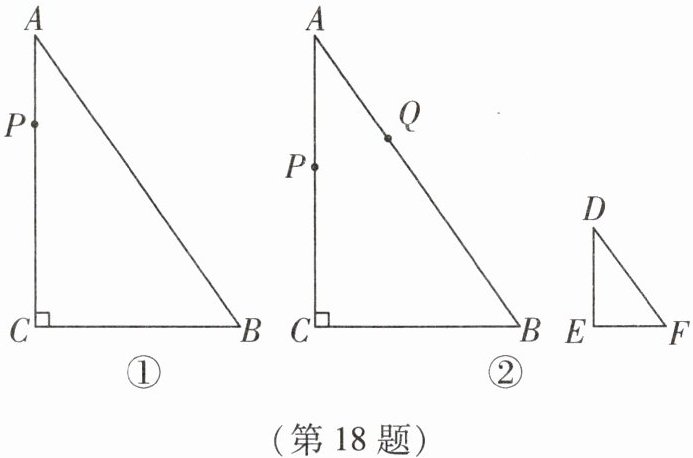
(1)如图①,当$t = $______时,$\triangle APC的面积等于\triangle ABC$面积的一半;
(2)如图②,在$\triangle DEF$中,$\angle E = 90^{\circ}$,$DE = 4\ \text{cm}$,$DF = 5\ \text{cm}$,$\angle D = \angle A$. 在$\triangle ABC$的边上,若另外有一个动点$Q$,与点$P同时从点A$出发,沿着边$AB \to BC \to CA$运动,回到点$A$停止. 在两点运动过程中的某一时刻,恰好$\triangle APQ \cong \triangle DEF$,求点$Q$的运动速度.
(1)如图①,当$t = $______时,$\triangle APC的面积等于\triangle ABC$面积的一半;
(2)如图②,在$\triangle DEF$中,$\angle E = 90^{\circ}$,$DE = 4\ \text{cm}$,$DF = 5\ \text{cm}$,$\angle D = \angle A$. 在$\triangle ABC$的边上,若另外有一个动点$Q$,与点$P同时从点A$出发,沿着边$AB \to BC \to CA$运动,回到点$A$停止. 在两点运动过程中的某一时刻,恰好$\triangle APQ \cong \triangle DEF$,求点$Q$的运动速度.
答案
(1) $\frac{11}{2}$或$\frac{19}{2}$
(2) $\triangle APQ \cong \triangle DEF$,即,对应顶点为 A 与 D,P 与 E,Q 与 F;
i. 当点 P 在 AC 上,如图①所示.
此时,$AP = 4$ cm,$AQ = 5$ cm,
∴点 Q 移动的速度为 $5 ÷ (4 ÷ 3) =\frac{15}{4}$ (cm/s).
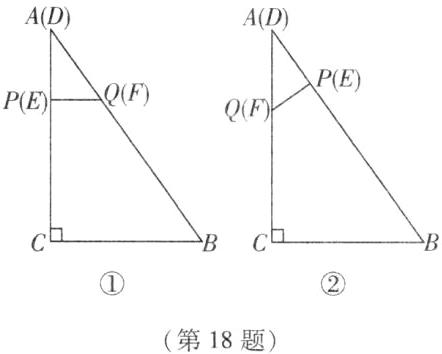
ii. 当点 P 在 AB 上,如图②所示.
此时,$AP = 4$ cm,$AQ = 5$ cm,
即点 P 移动的距离为 $9 + 12 + 15 - 4 = 32$ (cm),点 Q 移动的距离为 $9 + 12 + 15 - 5 = 31$ (cm),
∴点 Q 移动的速度为 $31 ÷ (32 ÷ 3) =\frac{93}{32}$ (cm/s).
综上所述,两点运动过程中的某一时刻,恰好 $\triangle APQ \cong \triangle DEF$,点 Q 的运动速度为 $\frac{15}{4}$ cm/s 或 $\frac{93}{32}$ cm/s.
