

 登录
名师点拨
一般现在时 Grammar
1. 用法
| 用法 | 举例 |
| --- | --- |
| 表示经常性或习惯性的动作 | I get up at 6:00 every day. 我每天早上6点起床。 |
| 表示现在的特征或状态 | The boy is very kind to others. 这个男孩对其他人很友好。 |
2. 基本句型
| 动词 | 句类 | 句式 | 举例 |
| --- | --- | --- | --- |
| be动词 | 肯定句 | 主语 + am / is / are + 其他. | I am a junior high student. 我是一名初中生。
He is careful with his studies. 他对学习很认真。
We are at home. 我们在家。 |
| be动词 | 否定句 | 主语 + am / is / are not(isn't / aren't)+其他. | I am not a junior high student. 我不是一名初中生。
He isn't careful with his studies. 他对学习不认真。
We aren't at home. 我们不在家。 |
| be动词 | 一般疑问句及其答语 | Am / Is / Are + 主语 + 其他?
肯定回答:Yes, 主语 + am / is / are.
否定回答:No, 主语 + am not / isn't / aren't. | —Are you a junior high student? 你是一名初中生吗?
—Yes, I am. / No, I am not. 是的,我是。/ 不,我不是。
—Is he careful with his studies? 他对学习认真吗?
—Yes, he is. / No, he isn't. 是的,他对学习认真。/ 不,他对学习不认真。
—Are you at home? 你们在家吗?
—Yes, we are. / No, we aren't. 是的,我们在家。/ 不,我们不在家。 |
| be动词 | 特殊疑问句 | 特殊疑问词 + am / is / are + 主语 + 其他? | Who am I? 我是谁?
What is he careful with? 他对什么认真?
Where are you? 你们在哪? |
| 行为动词 | 肯定句 | 主语 + 动词原形 / 动词的第三人称单数形式 +其他. | I clean my room on Saturdays. 我在周六打扫我的房间。
She goes to school at 7:30 am every day. 她每天早上7点30分去上学。 |
| 行为动词 | 否定句 | 主语 + do / does not(don't / doesn't)+动词原形 +其他. | I don't clean my room on Saturdays. 我不在周六打扫我的房间。
She doesn't go to school at 7:30 am every day. 她不是每天早上7点30分去上学。 |
续表
| 动词 | 句类 | 句式 | 举例 |
| --- | --- | --- | --- |
| 行为动词 | 一般疑问句及其答语 | Do / Does + 主语 + 动词原形 +其他?
肯定回答:Yes, 主语 + do / does.
否定回答:No, 主语 + don't / doesn't. | —Do you clean your room on Saturdays? 你在周六打扫你的房间吗?
—Yes, I do. / No, I don't. 是的,我在周六打扫我的房间。/ 不,我不在周六打扫我的房间。
—Does she go to school at 7:30 am every day? 她每天早上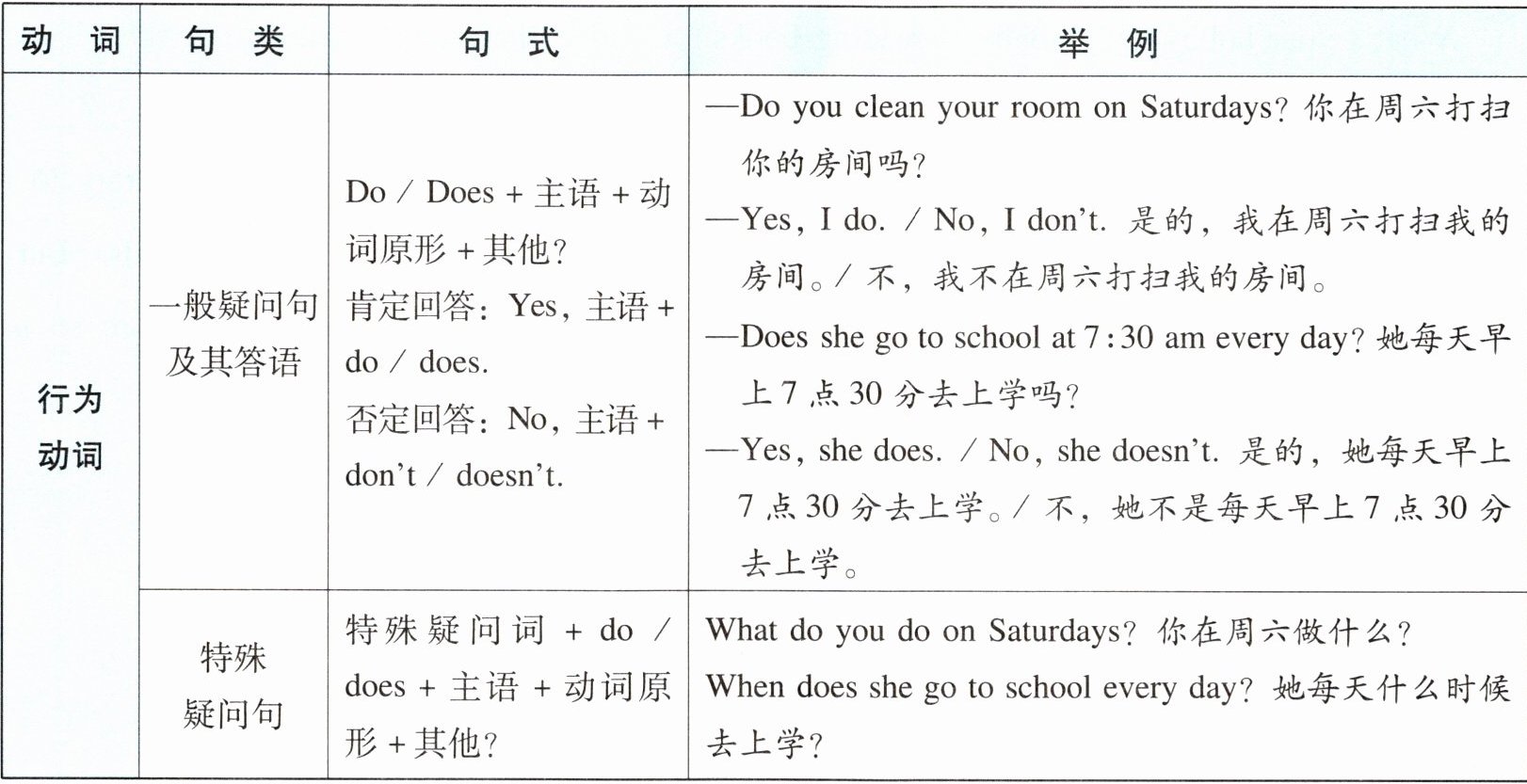 点30分去上学吗?
—Yes, she does. / No, she doesn't. 是的,她每天早上7点30分去上学。/ 不,她不是每天早上7点30分去上学。 |
| 行为动词 | 特殊疑问句 | 特殊疑问词 + do / does + 主语 + 动词原形 +其他? | What do you do on Saturdays? 你在周六做什么?
When does she go to school every day? 她每天什么时候去上学? |
专练
1. 用所给单词的适当形式填空。
(1)My grandpa
(2)Lucy and Lisa
(3)The students in Class Three often
2. 根据要求完成句子,每空一词。
(1)Jim has lunch at home every day.(改为否定句)
Jim
(2)The boy likes playing sports.(改为一般疑问句并作否定回答)
—
—
(3)She reads books at home on Sundays.(就画线部分提问)
一般现在时 Grammar
1. 用法
| 用法 | 举例 |
| --- | --- |
| 表示经常性或习惯性的动作 | I get up at 6:00
every day. 我每天早上6点起床。 || 表示现在的特征或状态 | The boy is very kind to others. 这个男孩对其他人很友好。 |
2. 基本句型
| 动词 | 句类 | 句式 | 举例 |
| --- | --- | --- | --- |
| be动词 | 肯定句 | 主语 + am / is / are + 其他. | I am a junior high student. 我是一名初中生。
He is careful with his studies. 他对学习很认真。
We are at home. 我们在家。 |
| be动词 | 否定句 | 主语 + am / is / are not(isn't / aren't)+其他. | I am not a junior high student. 我不是一名初中生。
He isn't careful with his studies. 他对学习不认真。
We aren't at home. 我们不在家。 |
| be动词 | 一般疑问句及其答语 | Am / Is / Are + 主语 + 其他?
肯定回答:Yes, 主语 + am / is / are.
否定回答:No, 主语 + am not / isn't / aren't. | —Are you a junior high student? 你是一名初中生吗?
—Yes, I am. / No, I am not. 是的,我是。/ 不,我不是。
—Is he careful with his studies? 他对学习认真吗?
—Yes, he is. / No, he isn't. 是的,他对学习认真。/ 不,他对学习不认真。
—Are you at home? 你们在家吗?
—Yes, we are. / No, we aren't. 是的,我们在家。/ 不,我们不在家。 |
| be动词 | 特殊疑问句 | 特殊疑问词 + am / is / are + 主语 + 其他? | Who am I? 我是谁?
What is he careful with? 他对什么认真?
Where are you? 你们在哪? |
| 行为动词 | 肯定句 | 主语 + 动词原形 / 动词的第三人称单数形式 +其他. | I clean my room on Saturdays. 我在周六打扫我的房间。
She goes to school at 7:30 am every day. 她每天早上7点30分去上学。 |
| 行为动词 | 否定句 | 主语 + do / does not(don't / doesn't)+动词原形 +其他. | I don't clean my room on Saturdays. 我不在周六打扫我的房间。
She doesn't go to school at 7:30 am every day. 她不是每天早上7点30分去上学。 |
续表
| 动词 | 句类 | 句式 | 举例 |
| --- | --- | --- | --- |
| 行为动词 | 一般疑问句及其答语 | Do / Does + 主语 + 动词原形 +其他?
肯定回答:Yes, 主语 + do / does.
否定回答:No, 主语 + don't / doesn't. | —Do you clean your room on Saturdays? 你在周六打扫你的房间吗?
—Yes, I do. / No, I don't. 是的,我在周六打扫我的房间。/ 不,我不在周六打扫我的房间。
—Does she go to school at 7:30 am every day? 她每天早上
点30分去上学吗?—Yes, she does. / No, she doesn't. 是的,她每天早上7点30分去上学。/ 不,她不是每天早上7点30分去上学。 |
| 行为动词 | 特殊疑问句 | 特殊疑问词 + do / does + 主语 + 动词原形 +其他? | What do you do on Saturdays? 你在周六做什么?
When does she go to school every day? 她每天什么时候去上学? |
专练
1. 用所给单词的适当形式填空。
(1)My grandpa
watches
(watch)TV every evening.(2)Lucy and Lisa
are
(be)good at singing.(3)The students in Class Three often
play
(play)basketball in the playground.2. 根据要求完成句子,每空一词。
(1)Jim has lunch at home every day.(改为否定句)
Jim
doesn't
have
lunch at home every day.(2)The boy likes playing sports.(改为一般疑问句并作否定回答)
—
Does
the boy like
playing sports?—
No
, he
doesn't
.(3)She reads books at home on Sundays.(就画线部分提问)
Where
does
she read
books on Sundays?答案
1. (1) watches (2) are (3) play
2. (1) doesn't have
(2) Does; like; No; he doesn't
(3) Where does; read
2. (1) doesn't have
(2) Does; like; No; he doesn't
(3) Where does; read
解析
【分析】本题考查一般现在时的基础用法,解题思路如下:1. 用所给单词适当填空时,先判断主语的人称和数,再结合一般现在时的动词变化规则(第三人称单数动词加-s/-es,be动词随主语单复数变化)确定单词形式;2. 句型转换时,区分be动词和行为动词的句型规则:be动词的否定句直接加not,一般疑问句提前be动词;行为动词的否定句借助don't/doesn't,一般疑问句借助Do/Does且动词用原形,特殊疑问句根据画线内容选对应疑问词,搭配正确助动词。
【解析】
1. 用所给单词适当形式填空:
(1) 主语My grandpa是第三人称单数,一般现在时中行为动词需用第三人称单数形式,watch的第三人称单数为watches,故填watches;
(2) 主语Lucy and Lisa是复数,be动词需用are,故填are;
(3) 主语The students是复数,一般现在时中行为动词用原形,故填play;
2. 句型转换:
(1) 原句中has是行为动词have的第三人称单数形式,改为否定句需借助助动词doesn't,后接动词原形have,故填doesn't have;
(2) 原句中likes是行为动词like的第三人称单数形式,改为一般疑问句需借助助动词Does,动词用原形like;否定回答为No, he doesn't,故依次填Does、like、No、he、doesn't;
(3) 画线部分at home是地点,用疑问词Where提问;主语she是第三人称单数,助动词用does,后接动词原形read,故依次填Where、does、read;
【答案】
1. (1) watches (2) are (3) play
2. (1) doesn't have (2) Does; like; No; he doesn't (3) Where does; read
【知识点】一般现在时、be动词句型、行为动词句型
【点评】本题围绕一般现在时核心基础考点命题,涵盖动词形式变化、be动词与行为动词的各类句型转换,是初中英语语法的重点基础内容,适合巩固相关知识点。
【难度系数】0.7
