

 登录
登录
一、完形填空
Learning to take notes in class is important. Note-taking is a(n)
You need to prepare a
In your free time, you can try to
1. A. secret B. skill C. order
2. A. notebook B. computer C. textbook
3. A. pick up B. get up C. look up
4. A. interesting B. boring C. nervous
5. A. Though B. Because C. If
6. A. at first B. in the end C. at last
7. A. break B. hear C. follow
8. A. repeat B. help C. find
9. A. remind B. memorise C. remember
10. A. increase B. improve C. raise
Learning to take notes in class is important. Note-taking is a(n)
B
1 that can help you do well in all your schoolwork.You need to prepare a
A
2 for each subject so that you can C
3 what you've learned in it to prepare for tests. This will help you feel less C
4 during tests. If your teacher writes notes on the blackboard, that's great. You can copy them or write down the important points of all in class. C
5 your teacher doesn't like to write anything down on the blackboard, you will have to write down some key words A
6. Don't expect to write everything down during class. If you can't C
7 what the teacher is saying, don't be afraid to ask your teacher to A
8 what you miss. Of course, you may ask him or her after class.In your free time, you can try to
B
9 the notes you have taken. It can be good for your learning. Your notes are good study records and taking notes is one of the best ways to B
10 your grades.1. A. secret B. skill C. order
2. A. notebook B. computer C. textbook
3. A. pick up B. get up C. look up
4. A. interesting B. boring C. nervous
5. A. Though B. Because C. If
6. A. at first B. in the end C. at last
7. A. break B. hear C. follow
8. A. repeat B. help C. find
9. A. remind B. memorise C. remember
10. A. increase B. improve C. raise
答案
1.B 2.A 3.C 4.C 5.C 6.A 7.C 8.A 9.B 10.B
二、阅读理解
History can be a difficult subject for many students. It's important to remember. However, history is just a collection of stories in fact. Learning history can help us better understand the present and make us wiser. If you have trouble in matching the story and its time, maybe you can memorise them by making a timeline(时间轴). Here are some suggestions to help you make a timeline.
Firstly, make a list of important dates. Find key dates from your textbooks and class notes. Combine(整合)this information as a list to make sure your dates are in time order.
Secondly, organise your timeline. Draw a straight line from one end of your page to the other. Then, fill in your dates in order from the oldest to the latest. Draw a box under each date and fill it with the key information you need to remember. Make sure it includes information about important people, events and places.
Thirdly, move forward in time. Continue filling in your dates in your timeline along with descriptions of what happened and why it is important. Make notes of connections among events by drawing arrows(箭头). Use different colours to make the timeline visually(视觉上地)friendly. This can also help you quickly find important names or other key information that appear in your
timeline more than once.
Fourthly, test yourself. Once you have finished your timeline, put it away and try to recreate it from your memory. This will tell you what you really know. If you don't get everything right for the first time, go back to brush up on the parts that you missed.
Once you recreate everything from the beginning, you will know that you have your history information memorised.
1. How many suggestions does the writer give the readers?
A. Three.
B. Four.
C. Five.
D. Six.
2. Which of the following best explains the meaning of “organise your timeline”?
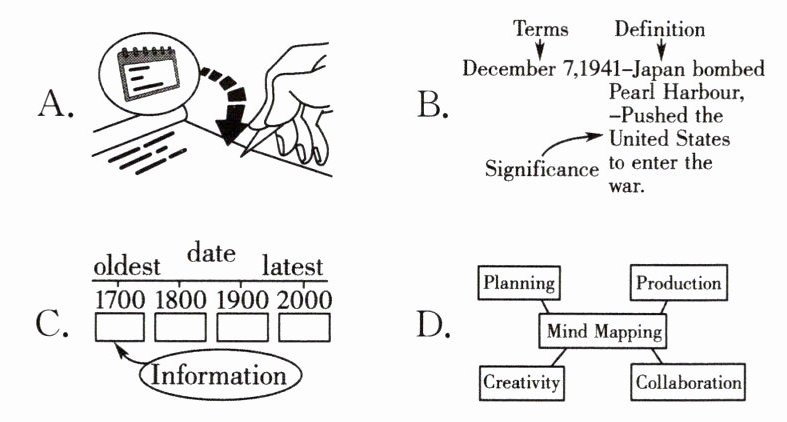
3. What does the underlined word “This” refer to in Paragraph 4?
A. Writing descriptions.
B. Drawing arrows.
C. Using different colours.
D. Finding important names.
4. What does the underlined phrase “brush up on” mean in Paragraph 5?
A. Review.
B. Create.
C. Forget.
D. Avoid.
5. What's the purpose of the passage?
A. To introduce a class discussion.
B. To explain why history is difficult to learn.
C. To share the advantage of learning history.
D. To give some advice on history learning.
History can be a difficult subject for many students. It's important to remember. However, history is just a collection of stories in fact. Learning history can help us better understand the present and make us wiser. If you have trouble in matching the story and its time, maybe you can memorise them by making a timeline(时间轴). Here are some suggestions to help you make a timeline.
Firstly, make a list of important dates. Find key dates from your textbooks and class notes. Combine(整合)this information as a list to make sure your dates are in time order.
Secondly, organise your timeline. Draw a straight line from one end of your page to the other. Then, fill in your dates in order from the oldest to the latest. Draw a box under each date and fill it with the key information you need to remember. Make sure it includes information about important people, events and places.
Thirdly, move forward in time. Continue filling in your dates in your timeline along with descriptions of what happened and why it is important. Make notes of connections among events by drawing arrows(箭头). Use different colours to make the timeline visually(视觉上地)friendly. This can also help you quickly find important names or other key information that appear in your
timeline more than once.
Fourthly, test yourself. Once you have finished your timeline, put it away and try to recreate it from your memory. This will tell you what you really know. If you don't get everything right for the first time, go back to brush up on the parts that you missed.
Once you recreate everything from the beginning, you will know that you have your history information memorised.
1. How many suggestions does the writer give the readers?
A. Three.
B. Four.
C. Five.
D. Six.
2. Which of the following best explains the meaning of “organise your timeline”?
3. What does the underlined word “This” refer to in Paragraph 4?
A. Writing descriptions.
B. Drawing arrows.
C. Using different colours.
D. Finding important names.
4. What does the underlined phrase “brush up on” mean in Paragraph 5?
A. Review.
B. Create.
C. Forget.
D. Avoid.
5. What's the purpose of the passage?
A. To introduce a class discussion.
B. To explain why history is difficult to learn.
C. To share the advantage of learning history.
D. To give some advice on history learning.
答案
1.B【解析】细节理解题。通读全文可知,作者给读者提供了四条建议。故选B。
2.C【解析】推理判断题。根据第三段“Secondly,organise your timeline.(其次,组织你的时间轴)”可知,C图符合题意。故选C。
3.C 4.A 5.D
2.C【解析】推理判断题。根据第三段“Secondly,organise your timeline.(其次,组织你的时间轴)”可知,C图符合题意。故选C。
3.C 4.A 5.D
