

 登录
登录
D Read and order(连词成句,注意大小写并加标点)
A: I’m hungry, Mum. (1)
B: Yes. (2)
A: Great! (3)
B: OK. The soup is ready. Try it.
A: It’s delicious, Mum. You’re a great cook!
A: I’m hungry, Mum. (1)
Are you cooking dinner?
(cooking, are, you, dinner)B: Yes. (2)
I'm cooking tomato and egg soup.
(tomato and egg, I’m, cooking, soup)A: Great! (3)
Let me set the table.
(let, set the table, me)B: OK. The soup is ready. Try it.
A: It’s delicious, Mum. You’re a great cook!
答案
1. Are you cooking dinner? 2. I'm cooking tomato and egg soup. 3. Let me set the table.
解析
【分析】
我们可以结合对话场景和英语句式结构来解题:
1. 第一空:A表达饥饿后,需询问妈妈是否在做晚饭。给出词汇包含be动词are,属于现在进行时的一般疑问句,结构为“Be动词+主语+现在分词+宾语?”,将are放句首(大写),依次衔接主语you、现在分词cooking、宾语dinner,句末加问号即可。
2. 第二空:妈妈回应Yes后,要说明正在制作的食物。这是现在进行时的陈述句,结构为“主语+be+现在分词+宾语.”,主语是I’m,接着是现在分词cooking,宾语是固定搭配tomato and egg soup,句末加句号。
3. 第三空:A表达喜悦后,要提出帮忙摆桌子的请求。这是Let型祈使句,结构为“Let+宾语+动词原形短语.”,将Let放句首(大写),衔接宾语me和动词短语set the table,句末加句号。
【解析】
1. 确定为现在进行时一般疑问句,按“Are(Be动词)+you(主语)+cooking(现在分词)+dinner(宾语)”组合,首字母大写,句末加问号,得到:Are you cooking dinner?
2. 确定为现在进行时陈述句,按“I'm(主语)+cooking(现在分词)+tomato and egg soup(宾语)”组合,句末加句号,得到:I'm cooking tomato and egg soup.
3. 确定为Let型祈使句,按“Let+me(宾语)+set the table(动词原形短语)”组合,首字母大写,句末加句号,得到:Let me set the table.
【答案】
1. Are you cooking dinner?
2. I'm cooking tomato and egg soup.
3. Let me set the table.
【知识点】
1. 现在进行时句式
2. Let型祈使句
3. 连词成句技巧
【点评】
本题结合日常用餐对话场景,考查现在进行时的不同句式以及Let型祈使句的运用,要求学生熟悉各类句式结构,同时注意句子的大小写和标点规范,能有效巩固基础时态与句型,提升英语场景运用能力。
【难度系数】
0.8
我们可以结合对话场景和英语句式结构来解题:
1. 第一空:A表达饥饿后,需询问妈妈是否在做晚饭。给出词汇包含be动词are,属于现在进行时的一般疑问句,结构为“Be动词+主语+现在分词+宾语?”,将are放句首(大写),依次衔接主语you、现在分词cooking、宾语dinner,句末加问号即可。
2. 第二空:妈妈回应Yes后,要说明正在制作的食物。这是现在进行时的陈述句,结构为“主语+be+现在分词+宾语.”,主语是I’m,接着是现在分词cooking,宾语是固定搭配tomato and egg soup,句末加句号。
3. 第三空:A表达喜悦后,要提出帮忙摆桌子的请求。这是Let型祈使句,结构为“Let+宾语+动词原形短语.”,将Let放句首(大写),衔接宾语me和动词短语set the table,句末加句号。
【解析】
1. 确定为现在进行时一般疑问句,按“Are(Be动词)+you(主语)+cooking(现在分词)+dinner(宾语)”组合,首字母大写,句末加问号,得到:Are you cooking dinner?
2. 确定为现在进行时陈述句,按“I'm(主语)+cooking(现在分词)+tomato and egg soup(宾语)”组合,句末加句号,得到:I'm cooking tomato and egg soup.
3. 确定为Let型祈使句,按“Let+me(宾语)+set the table(动词原形短语)”组合,首字母大写,句末加句号,得到:Let me set the table.
【答案】
1. Are you cooking dinner?
2. I'm cooking tomato and egg soup.
3. Let me set the table.
【知识点】
1. 现在进行时句式
2. Let型祈使句
3. 连词成句技巧
【点评】
本题结合日常用餐对话场景,考查现在进行时的不同句式以及Let型祈使句的运用,要求学生熟悉各类句式结构,同时注意句子的大小写和标点规范,能有效巩固基础时态与句型,提升英语场景运用能力。
【难度系数】
0.8
E Read and choose(读短文,选出正确答案)选做题
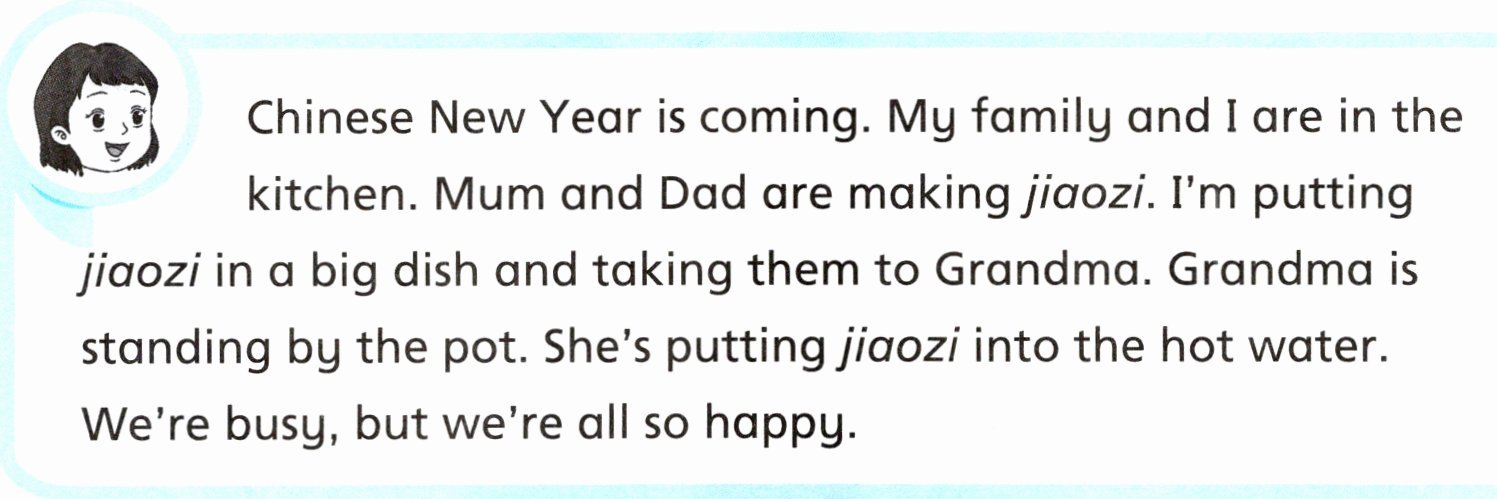
Chinese New Year is coming. My family and I are in the kitchen. Mum and Dad are making jiaozi. I’m putting jiaozi in a big dish and taking them to Grandma. Grandma is standing by the pot. She’s putting jiaozi into the hot water. We’re busy, but we’re all so happy.
(

A.
B.
C.
(
A. In the park.
B. In the kitchen.
C. In a restaurant.
(
A. She is eating jiaozi.
B. She is making jiaozi.
C. She is taking jiaozi to Grandma.
(
A. Mum.
B. Grandma.
C. Dad.
(
A. Busy but happy.
B. Happy but tired.
C. Happy but hungry.
Chinese New Year is coming. My family and I are in the kitchen. Mum and Dad are making jiaozi. I’m putting jiaozi in a big dish and taking them to Grandma. Grandma is standing by the pot. She’s putting jiaozi into the hot water. We’re busy, but we’re all so happy.
(
B
) 1. Which picture is about Chinese New Year?A.
B.
C.
(
B
) 2. Where are the family?A. In the park.
B. In the kitchen.
C. In a restaurant.
(
C
) 3. What is Yang Ling doing?A. She is eating jiaozi.
B. She is making jiaozi.
C. She is taking jiaozi to Grandma.
(
B
) 4. Who is cooking jiaozi?A. Mum.
B. Grandma.
C. Dad.
(
A
) 5. How do Yang Ling’s family feel?A. Busy but happy.
B. Happy but tired.
C. Happy but hungry.
答案
1. B 2. B 3. C 4. B 5. A
解析
【分析】
这是一篇围绕春节家庭包饺子场景的英语阅读理解题,解题思路如下:
1. 第1题:需结合春节典型文化元素(如包饺子、春联等)判断对应图片,选出符合春节场景的选项。
2. 第2-5题均为细节理解题,解题核心是带着问题回归原文,定位相关语句,提取对应信息来确定答案,比如找家人所在地点、人物动作、煮饺子的主体以及家人的感受,都能在原文中找到直接匹配的描述。
【解析】
1. 第1题:春节标志性元素包含包饺子等传统活动,选项B的图片符合春节场景,故选B。
2. 第2题:根据原文“My family and I are in the kitchen.”可知,家人在厨房,故选B。
3. 第3题:根据原文“I’m putting jiaozi in a big dish and taking them to Grandma.”可知,Yang Ling正把饺子端给奶奶,故选C。
4. 第4题:根据原文“Grandma is standing by the pot. She’s putting jiaozi into the hot water.”可知,奶奶正在煮饺子,故选B。
5. 第5题:根据原文“We’re busy, but we’re all so happy.”可知,家人忙碌但开心,故选A。
【答案】
1. B 2. B 3. C 4. B 5. A
【知识点】
阅读理解细节定位、中国春节习俗、现在进行时
【点评】
本文围绕春节家庭包饺子的温馨场景展开,题目以细节理解题为主,结合春节文化常识考查,内容贴近生活,难度适中,解题时需仔细阅读原文,精准定位关键信息即可作答。
【难度系数】
0.8
这是一篇围绕春节家庭包饺子场景的英语阅读理解题,解题思路如下:
1. 第1题:需结合春节典型文化元素(如包饺子、春联等)判断对应图片,选出符合春节场景的选项。
2. 第2-5题均为细节理解题,解题核心是带着问题回归原文,定位相关语句,提取对应信息来确定答案,比如找家人所在地点、人物动作、煮饺子的主体以及家人的感受,都能在原文中找到直接匹配的描述。
【解析】
1. 第1题:春节标志性元素包含包饺子等传统活动,选项B的图片符合春节场景,故选B。
2. 第2题:根据原文“My family and I are in the kitchen.”可知,家人在厨房,故选B。
3. 第3题:根据原文“I’m putting jiaozi in a big dish and taking them to Grandma.”可知,Yang Ling正把饺子端给奶奶,故选C。
4. 第4题:根据原文“Grandma is standing by the pot. She’s putting jiaozi into the hot water.”可知,奶奶正在煮饺子,故选B。
5. 第5题:根据原文“We’re busy, but we’re all so happy.”可知,家人忙碌但开心,故选A。
【答案】
1. B 2. B 3. C 4. B 5. A
【知识点】
阅读理解细节定位、中国春节习俗、现在进行时
【点评】
本文围绕春节家庭包饺子的温馨场景展开,题目以细节理解题为主,结合春节文化常识考查,内容贴近生活,难度适中,解题时需仔细阅读原文,精准定位关键信息即可作答。
【难度系数】
0.8
