

 登录
登录
中考趋势 Ⅳ.情境翻译
1. 你有多少零花钱?你多久存一次?
2. 在春节的时候,我们有时会从祖父母或亲戚那里得到一些红包。
3. 所以我们应该学习如何明智地使用我们的压岁钱。
4. 我们可以在每年年初做一个预算。
5. 我们可以用一些钱来帮助有需要的人。
6. 存钱以备不时之需也很重要。
1. 你有多少零花钱?你多久存一次?
2. 在春节的时候,我们有时会从祖父母或亲戚那里得到一些红包。
3. 所以我们应该学习如何明智地使用我们的压岁钱。
4. 我们可以在每年年初做一个预算。
5. 我们可以用一些钱来帮助有需要的人。
6. 存钱以备不时之需也很重要。
答案
1. How much pocket money do you have? How often do you save it?
2. Sometimes, we get red packets from grandparents or relatives at the Spring Festival.
3. So we should learn how to use our lucky money wisely.
4. We can make a budget at the beginning of each year.
5. We can use some money to help people in need.
6. It's also important to save for a rainy day.
2. Sometimes, we get red packets from grandparents or relatives at the Spring Festival.
3. So we should learn how to use our lucky money wisely.
4. We can make a budget at the beginning of each year.
5. We can use some money to help people in need.
6. It's also important to save for a rainy day.
解析
【分析】本题为中考英语情境翻译题,需结合中文句子的语义、句式,依据英语的表达习惯和常用固定短语进行翻译。翻译时要注意特殊疑问句的语序、频率疑问词的使用,以及“零花钱”“红包”“压岁钱”等日常词汇的正确对应,还有固定搭配的准确运用。
【解析】1. 第一句是两个特殊疑问句,“多少零花钱”对应How much pocket money,“多久存一次”用How often提问频率,宾语it指代前文的pocket money,故译为How much pocket money do you have? How often do you save it?;2. “在春节”为at the Spring Festival,“红包”是red packets,“亲戚”是relatives,“从……得到”用get...from,故译为Sometimes, we get red packets from grandparents or relatives at the Spring Festival.;3. “学习如何做某事”是learn how to do sth,“压岁钱”对应lucky money,“明智地”用副词wisely修饰动词use,故译为So we should learn how to use our lucky money wisely.;4. “做预算”是make a budget,“每年年初”为at the beginning of each year,故译为We can make a budget at the beginning of each year.;5. “用某物帮助某人”是use sth to help sb,“有需要的人”是people in need,故译为We can use some money to help people in need.;6. 用It作形式主语的句式It's important to do sth,“存钱以备不时之需”是固定搭配save for a rainy day,故译为It's also important to save for a rainy day.
【答案】1. How much pocket money do you have? How often do you save it?
2. Sometimes, we get red packets from grandparents or relatives at the Spring Festival.
3. So we should learn how to use our lucky money wisely.
4. We can make a budget at the beginning of each year.
5. We can use some money to help people in need.
6. It's also important to save for a rainy day.
【知识点】英语情境翻译、常用固定搭配
【点评】本题考查日常交际类的英语翻译,贴近生活实际,是中考英语的常见题型,重点考查学生对基础词汇和句式的掌握情况。
【难度系数】0.6
【解析】1. 第一句是两个特殊疑问句,“多少零花钱”对应How much pocket money,“多久存一次”用How often提问频率,宾语it指代前文的pocket money,故译为How much pocket money do you have? How often do you save it?;2. “在春节”为at the Spring Festival,“红包”是red packets,“亲戚”是relatives,“从……得到”用get...from,故译为Sometimes, we get red packets from grandparents or relatives at the Spring Festival.;3. “学习如何做某事”是learn how to do sth,“压岁钱”对应lucky money,“明智地”用副词wisely修饰动词use,故译为So we should learn how to use our lucky money wisely.;4. “做预算”是make a budget,“每年年初”为at the beginning of each year,故译为We can make a budget at the beginning of each year.;5. “用某物帮助某人”是use sth to help sb,“有需要的人”是people in need,故译为We can use some money to help people in need.;6. 用It作形式主语的句式It's important to do sth,“存钱以备不时之需”是固定搭配save for a rainy day,故译为It's also important to save for a rainy day.
【答案】1. How much pocket money do you have? How often do you save it?
2. Sometimes, we get red packets from grandparents or relatives at the Spring Festival.
3. So we should learn how to use our lucky money wisely.
4. We can make a budget at the beginning of each year.
5. We can use some money to help people in need.
6. It's also important to save for a rainy day.
【知识点】英语情境翻译、常用固定搭配
【点评】本题考查日常交际类的英语翻译,贴近生活实际,是中考英语的常见题型,重点考查学生对基础词汇和句式的掌握情况。
【难度系数】0.6
Ⅴ. 阅读理解
If you want to buy new clothes, what will you do? You may go online and soon find one. Online prices are lower and you can have it the next day. We can see that buying online is easier than buying in shops. But for some people, going shopping is more than just shopping. Some shops use technology(科技)to give people a better shopping experience(体验).
Imagine(想象)this: you go into a shop and the assistant(助手)asks, “Can I help you?” In front of you is a robot! This robot wants to help you shop. For example, if you want a pair of trousers, the robot may help you find it and give it to you. They're always nice to people and don't get tired.
You like two dresses, but you don't know which one looks better on you. You need your friend's help. But now smart mirrors(智能镜子)in the dressing room can show you which size or colour is better for you. And you can try on different kinds of clothes with your finger tapping(轻触)on the screen.
You finally pay for your goods, but you have heavy bags. You need drone delivery(无人机配送)to bring them home. Drone delivery is a new idea, and we're very excited about it.
1. What does the writer think of shopping online?
A. Fun. B. Boring.
C. Easy. D. Dangerous.
2. What is the advantage(优点)of the robot assistant in Paragraph 2?
A. Speak different languages.
B. Help try on clothes.
C. Get tired easily.
D. Find the clothes you want.
3. 新考法 图示理解 Which picture is NOT mentioned(提到)in the text?
A.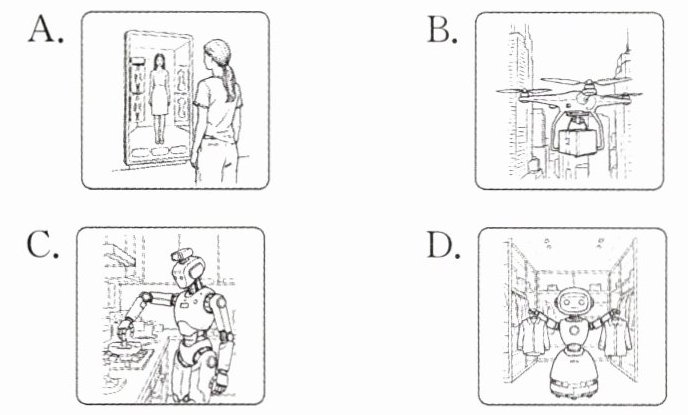
4. 新考法 篇章结构 What's the structure of the text?
A.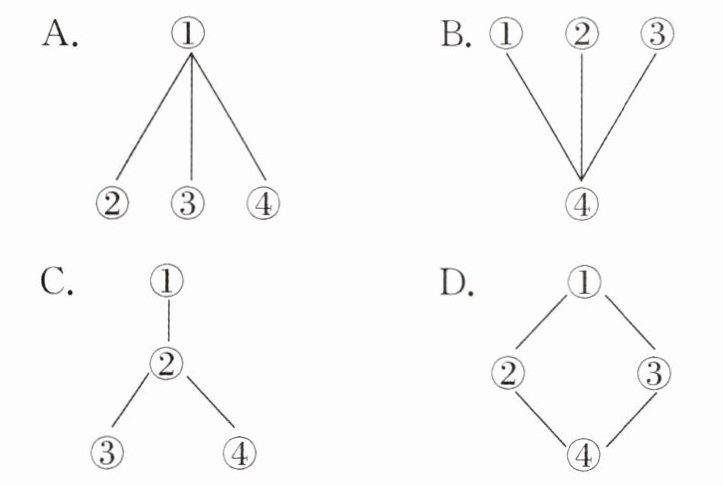
5. What's the best title for the text?
A. The Speed of Online Shopping
B. Technology for Better Offline Shopping
C. Differences between Online and Offline Shopping
D. The Future of Drone Delivery
If you want to buy new clothes, what will you do? You may go online and soon find one. Online prices are lower and you can have it the next day. We can see that buying online is easier than buying in shops. But for some people, going shopping is more than just shopping. Some shops use technology(科技)to give people a better shopping experience(体验).
Imagine(想象)this: you go into a shop and the assistant(助手)asks, “Can I help you?” In front of you is a robot! This robot wants to help you shop. For example, if you want a pair of trousers, the robot may help you find it and give it to you. They're always nice to people and don't get tired.
You like two dresses, but you don't know which one looks better on you. You need your friend's help. But now smart mirrors(智能镜子)in the dressing room can show you which size or colour is better for you. And you can try on different kinds of clothes with your finger tapping(轻触)on the screen.
You finally pay for your goods, but you have heavy bags. You need drone delivery(无人机配送)to bring them home. Drone delivery is a new idea, and we're very excited about it.
1. What does the writer think of shopping online?
A. Fun. B. Boring.
C. Easy. D. Dangerous.
2. What is the advantage(优点)of the robot assistant in Paragraph 2?
A. Speak different languages.
B. Help try on clothes.
C. Get tired easily.
D. Find the clothes you want.
3. 新考法 图示理解 Which picture is NOT mentioned(提到)in the text?
A.
4. 新考法 篇章结构 What's the structure of the text?
A.
5. What's the best title for the text?
A. The Speed of Online Shopping
B. Technology for Better Offline Shopping
C. Differences between Online and Offline Shopping
D. The Future of Drone Delivery
答案
1.C 2.D 3.C 4.A 5.B
【语篇解读】本文主要探讨了科技如何改善线下购物体验。文章首先对比了线上购物的便捷性,引出线下购物也能通过科技手段提升体验。接着,通过机器人助手、智能镜子和无人机配送三个具体例子,详细阐述了科技在购物过程(寻找商品、试穿、配送)中的应用,展现了未来线下购物的新趋势。
1. C 解析:根据文章第一段中"We can see that buying online is easier than buying in shops."可知,作者明确表达了网上购物是"容易的"。
2. D 解析:根据第二段中"For example, if you want a pair of trousers, the robot may help you find it and give it to you."可知,机器人的优点是可以帮你找到想要的衣服。
3. C 解析:A图展示的是smart mirrors,文中第三段有提及;B图展示的是drone delivery,文中第四段有提及;D图展示的是robot assistant,文中第二段有提及;C图展示的是厨房烹饪机器人,文中未提及此场景。
4. A 解析:第一段:提出主题,即科技能给人们带来更好的线下购物体验。第二段、第三段、第四段:分别介绍了三种科技应用(机器人助手、智能镜子、无人机配送)来支持主题。文章结构为"总—分"结构,即第一段总述,后三段分别举例说明。
5. B 解析:文章先对比了网购,再重点介绍了实体店中机器人助手、智能镜子、无人机配送等科技手段如何提升购物体验,核心主题是"科技让线下购物更美好"。
【语篇解读】本文主要探讨了科技如何改善线下购物体验。文章首先对比了线上购物的便捷性,引出线下购物也能通过科技手段提升体验。接着,通过机器人助手、智能镜子和无人机配送三个具体例子,详细阐述了科技在购物过程(寻找商品、试穿、配送)中的应用,展现了未来线下购物的新趋势。
1. C 解析:根据文章第一段中"We can see that buying online is easier than buying in shops."可知,作者明确表达了网上购物是"容易的"。
2. D 解析:根据第二段中"For example, if you want a pair of trousers, the robot may help you find it and give it to you."可知,机器人的优点是可以帮你找到想要的衣服。
3. C 解析:A图展示的是smart mirrors,文中第三段有提及;B图展示的是drone delivery,文中第四段有提及;D图展示的是robot assistant,文中第二段有提及;C图展示的是厨房烹饪机器人,文中未提及此场景。
4. A 解析:第一段:提出主题,即科技能给人们带来更好的线下购物体验。第二段、第三段、第四段:分别介绍了三种科技应用(机器人助手、智能镜子、无人机配送)来支持主题。文章结构为"总—分"结构,即第一段总述,后三段分别举例说明。
5. B 解析:文章先对比了网购,再重点介绍了实体店中机器人助手、智能镜子、无人机配送等科技手段如何提升购物体验,核心主题是"科技让线下购物更美好"。
解析
【分析】解答本题需先通读全文把握核心内容,再针对每道题的题干关键词回原文定位,结合原文信息逐一比对选项得出答案。具体思路:1. 第1题定位“shopping online”,查找作者对网购的评价;2. 第2题定位“robot assistant”,明确机器人的优点;3. 第3题梳理文中提及的科技相关图示,排除未涉及的内容;4. 第4题分析段落间逻辑关系,确定篇章结构;5. 第5题提炼文章核心主旨,选择贴合的标题。
【解析】
1. 细节理解题:根据第一段“We can see that buying online is easier than buying in shops.”可知,作者认为网购是容易的,对应选项C。
2. 细节理解题:根据第二段“For example, if you want a pair of trousers, the robot may help you find it and give it to you.”可知,机器人助手的优点是能帮助找到想要的衣服,对应选项D。
3. 图示理解题:文中提及的科技相关图示有机器人助手(第二段)、智能镜子(第三段)、无人机配送(第四段),未涉及厨房烹饪机器人相关图示,对应选项C。
4. 篇章结构题:第一段总述“科技能给人们带来更好的线下购物体验”,第二、三、四段分别举例介绍三种科技应用,为“总—分”结构,对应选项A。
5. 主旨大意题:文章先对比网购,重点介绍线下购物中运用科技提升体验的案例,核心主题是科技让线下购物更美好,对应选项B。
【答案】1.C 2.D 3.C 4.A 5.B
【知识点】细节理解题、主旨大意题、篇章结构题
【点评】本题为阅读理解题,涵盖细节理解、图示理解、篇章结构、主旨大意等题型,新考法的图示理解和篇章结构题需结合原文内容分析,整体考查学生的信息定位、逻辑分析及主旨提炼能力,难度适中。
【难度系数】0.6
【解析】
1. 细节理解题:根据第一段“We can see that buying online is easier than buying in shops.”可知,作者认为网购是容易的,对应选项C。
2. 细节理解题:根据第二段“For example, if you want a pair of trousers, the robot may help you find it and give it to you.”可知,机器人助手的优点是能帮助找到想要的衣服,对应选项D。
3. 图示理解题:文中提及的科技相关图示有机器人助手(第二段)、智能镜子(第三段)、无人机配送(第四段),未涉及厨房烹饪机器人相关图示,对应选项C。
4. 篇章结构题:第一段总述“科技能给人们带来更好的线下购物体验”,第二、三、四段分别举例介绍三种科技应用,为“总—分”结构,对应选项A。
5. 主旨大意题:文章先对比网购,重点介绍线下购物中运用科技提升体验的案例,核心主题是科技让线下购物更美好,对应选项B。
【答案】1.C 2.D 3.C 4.A 5.B
【知识点】细节理解题、主旨大意题、篇章结构题
【点评】本题为阅读理解题,涵盖细节理解、图示理解、篇章结构、主旨大意等题型,新考法的图示理解和篇章结构题需结合原文内容分析,整体考查学生的信息定位、逻辑分析及主旨提炼能力,难度适中。
【难度系数】0.6
