

 登录
登录
一 新考法【扬州广陵】根据图片顺序,将下列句子用数字重新排序,组成一个完整的故事。

(
(
(
(
(
(
3
)The sun is high in the sky at noon. The dog's shadow(影子) is short.(
2
)Today is Tuesday. The sun rises in the morning. Micky has his breakfast.(
1
)Micky is a dog. He likes taking a walk outside.(
5
)The moon is high in the sky. Micky goes to bed. He has a beautiful dream.(
4
)The sun goes down in the afternoon. His shadow is behind him. And it is long.答案
3 2 1 5 4
解析
【分析】首先通读所有句子,明确这是关于小狗Micky一天生活的故事。解题思路是按照故事的时间逻辑排序:先介绍主角,再按早上→中午→下午→晚上的时间顺序排列,结合图片的时间场景对应句子,确定每句的顺序。
【解析】1. 通读5个句子,确定主题为小狗Micky的一天;2. 找到介绍主角的句子:“Micky is a dog. He likes taking a walk outside.”,这是故事的开头,排第1;3. 按时间顺序依次排列:早上(“Today is Tuesday. The sun rises in the morning. Micky has his breakfast.”)排第2;中午(“The sun is high in the sky at noon. The dog's shadow is short.”)排第3;下午(“The sun goes down in the afternoon. His shadow is behind him. And it is long.”)排第4;晚上(“The moon is high in the sky. Micky goes to bed. He has a beautiful dream.”)排第5;4. 最终排序结果为3 2 1 5 4。
【答案】3 2 1 5 4
【知识点】英语句子排序、故事时间顺序
【点评】本题考查对故事叙事逻辑和时间顺序的理解,结合图片场景辅助梳理时间线,是基础英语排序题,注重逻辑思维的培养。
【难度系数】0.3
【解析】1. 通读5个句子,确定主题为小狗Micky的一天;2. 找到介绍主角的句子:“Micky is a dog. He likes taking a walk outside.”,这是故事的开头,排第1;3. 按时间顺序依次排列:早上(“Today is Tuesday. The sun rises in the morning. Micky has his breakfast.”)排第2;中午(“The sun is high in the sky at noon. The dog's shadow is short.”)排第3;下午(“The sun goes down in the afternoon. His shadow is behind him. And it is long.”)排第4;晚上(“The moon is high in the sky. Micky goes to bed. He has a beautiful dream.”)排第5;4. 最终排序结果为3 2 1 5 4。
【答案】3 2 1 5 4
【知识点】英语句子排序、故事时间顺序
【点评】本题考查对故事叙事逻辑和时间顺序的理解,结合图片场景辅助梳理时间线,是基础英语排序题,注重逻辑思维的培养。
【难度系数】0.3
二 新素材【无锡江阴】阅读天气预报,完成对话。
A: Look at this week's weather forecast. What season is it?
B: It's
A: What day is it today?
B: It's
A: What's the
B: It's cloudy.
A: Can we walk outside on Sunday?
B:
A: What can we take on
B: We can take
A: What can we do on Wednesday?
B: We can
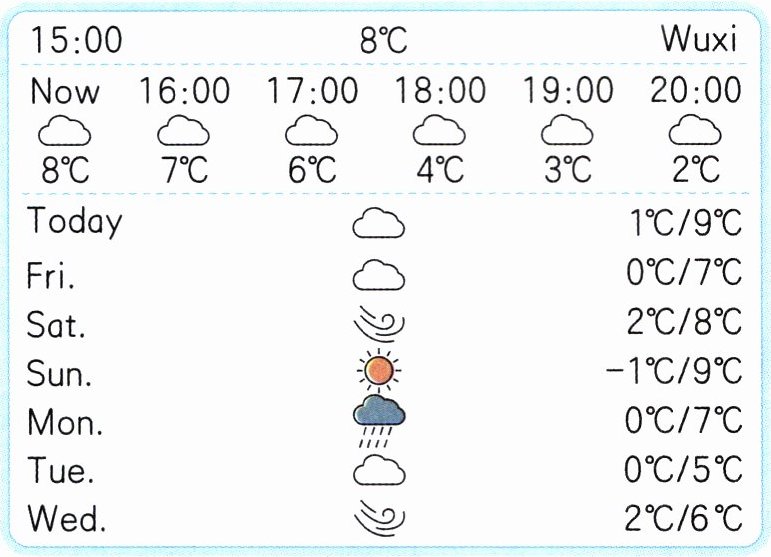
A: Look at this week's weather forecast. What season is it?
B: It's
winter
.A: What day is it today?
B: It's
Thursday
.A: What's the
weather
like
today?B: It's cloudy.
A: Can we walk outside on Sunday?
B:
Yes
, we can
.A: What can we take on
Monday
?B: We can take
an
umbrella.A: What can we do on Wednesday?
B: We can
play basketball
/have picnics/fly kites(答案不唯一)
.答案
winter; Thursday; weather like; Yes; can; Monday; an; play basketball/have picnics/fly kites(答案不唯一)
解析
【分析】
首先观察天气预报的气温范围(-1℃~9℃),气温较低,判断季节为冬季;再根据给出的星期序列(Today、Fri.、Sat.……),Today对应周五前一天即周四;接着根据答语“cloudy”,确定问句是询问天气的固定表达;周日为晴天,适合外出,故用肯定回答;下雨的是周一,需带伞;周三为刮风天气,可进行户外活动。
【解析】
1. 季节判断:天气预报中气温较低,符合冬季特征,故填winter;
2. 星期确定:给出的星期顺序中,Today之后是Fri.(周五),因此Today是周四,填Thursday;
3. 询问天气的固定句型:What's the weather like? 是询问天气的常用表达,对应答语“cloudy”,故填weather like;
4. 周日天气为晴天,适合外出,所以回答Yes, we can;
5. 需带伞的是下雨的周一,故填Monday;
6. umbrella以元音音素开头,前面用不定冠词an;
7. 周三为刮风天气,可进行户外活动,如play basketball等(答案不唯一)。
【答案】
winter; Thursday; weather like; Yes; can; Monday; an; play basketball
【知识点】
季节判断、天气表达、星期识别
【点评】
本题结合天气预报图表信息,考查日常对话中季节、星期、天气及活动的相关表达,需准确提取图表内容完成填空,难度适中。
【难度系数】
0.5
首先观察天气预报的气温范围(-1℃~9℃),气温较低,判断季节为冬季;再根据给出的星期序列(Today、Fri.、Sat.……),Today对应周五前一天即周四;接着根据答语“cloudy”,确定问句是询问天气的固定表达;周日为晴天,适合外出,故用肯定回答;下雨的是周一,需带伞;周三为刮风天气,可进行户外活动。
【解析】
1. 季节判断:天气预报中气温较低,符合冬季特征,故填winter;
2. 星期确定:给出的星期顺序中,Today之后是Fri.(周五),因此Today是周四,填Thursday;
3. 询问天气的固定句型:What's the weather like? 是询问天气的常用表达,对应答语“cloudy”,故填weather like;
4. 周日天气为晴天,适合外出,所以回答Yes, we can;
5. 需带伞的是下雨的周一,故填Monday;
6. umbrella以元音音素开头,前面用不定冠词an;
7. 周三为刮风天气,可进行户外活动,如play basketball等(答案不唯一)。
【答案】
winter; Thursday; weather like; Yes; can; Monday; an; play basketball
【知识点】
季节判断、天气表达、星期识别
【点评】
本题结合天气预报图表信息,考查日常对话中季节、星期、天气及活动的相关表达,需准确提取图表内容完成填空,难度适中。
【难度系数】
0.5
三 连词成句,补全对话。
$A: Look out of the window. 1. \underline{\qquad\qquad\qquad\qquad\qquad\qquad\qquad\qquad\qquad\qquad} [the, like, what's, today, weather (?)]$
B: It's sunny. Let's go outside and play.
$A: Good idea! 2. \underline{\qquad\qquad\qquad\qquad\qquad\qquad\qquad\qquad\qquad\qquad} [what, do, can, but, we (?)]$
B: We can fly a kite.
$A: Oh no! It's rainy now. 3. \underline{\qquad\qquad\qquad\qquad\qquad\qquad\qquad\qquad\qquad\qquad} [can't, we, outside, play (. )]$
$B: Don't worry. 4. \underline{\qquad\qquad\qquad\qquad\qquad\qquad\qquad\qquad\qquad\qquad} [read, my, books, home, we, at, can (. )]$
$A: Great! I like reading. 5. \underline{\qquad\qquad\qquad\qquad\qquad\qquad\qquad\qquad\qquad\qquad} [eat, some, and, we, can, also, fruit (. )]$
$A: Look out of the window. 1. \underline{\qquad\qquad\qquad\qquad\qquad\qquad\qquad\qquad\qquad\qquad} [the, like, what's, today, weather (?)]$
B: It's sunny. Let's go outside and play.
$A: Good idea! 2. \underline{\qquad\qquad\qquad\qquad\qquad\qquad\qquad\qquad\qquad\qquad} [what, do, can, but, we (?)]$
B: We can fly a kite.
$A: Oh no! It's rainy now. 3. \underline{\qquad\qquad\qquad\qquad\qquad\qquad\qquad\qquad\qquad\qquad} [can't, we, outside, play (. )]$
$B: Don't worry. 4. \underline{\qquad\qquad\qquad\qquad\qquad\qquad\qquad\qquad\qquad\qquad} [read, my, books, home, we, at, can (. )]$
$A: Great! I like reading. 5. \underline{\qquad\qquad\qquad\qquad\qquad\qquad\qquad\qquad\qquad\qquad} [eat, some, and, we, can, also, fruit (. )]$
答案
1. What's the weather like today? 2. But what can we do? 3. We can't play outside. 4. We can read books at my home. 5. And we can also eat some fruit.
解析
【分析】
连词成句时,先根据标点判断句子类型(疑问句/陈述句);若为疑问句,需确定疑问词、be动词/情态动词的位置(疑问句中be动词/情态动词置于主语前);若为陈述句,先找主语,再按“主语+谓语(情态动词/be动词)+其他成分”的语序排列,同时注意固定搭配(如what's the weather like)、介词短语(如at my home)的正确位置,最后调整单词顺序组成通顺正确的句子。
【解析】
1. 该句为特殊疑问句,标点为问号,疑问词为what's,固定搭配“the weather like”,时间状语为today,按特殊疑问句语序组合得:What's the weather like today?
2. 该句为特殊疑问句,标点为问号,含转折词but,疑问词为what,情态动词为can,主语为we,按“but+疑问词+情态动词+主语+动词原形”的结构组合得:But what can we do?
3. 该句为陈述句,标点为句号,主语为we,情态动词否定式为can't,动词为play,地点状语为outside,按“主语+情态动词否定式+动词原形+地点”的结构组合得:We can't play outside.
4. 该句为陈述句,标点为句号,主语为we,情态动词为can,动词为read,宾语为books,地点状语为at my home,按“主语+情态动词+动词原形+宾语+地点”的结构组合得:We can read books at my home.
5. 该句为陈述句,用and连接,主语为we,情态动词为can also,动词为eat,宾语为some fruit,按“and+主语+情态动词+副词+动词原形+宾语”的结构组合得:And we can also eat some fruit.
【答案】
1. What's the weather like today? 2. But what can we do? 3. We can't play outside. 4. We can read books at my home. 5. And we can also eat some fruit.
【知识点】
英语连词成句,英语基本句型
【点评】
本题为基础英语连词成句题,考察常用句型、情态动词用法及固定搭配,是英语学习的基础题型,帮助学生巩固句子结构知识。
【难度系数】
0.8
连词成句时,先根据标点判断句子类型(疑问句/陈述句);若为疑问句,需确定疑问词、be动词/情态动词的位置(疑问句中be动词/情态动词置于主语前);若为陈述句,先找主语,再按“主语+谓语(情态动词/be动词)+其他成分”的语序排列,同时注意固定搭配(如what's the weather like)、介词短语(如at my home)的正确位置,最后调整单词顺序组成通顺正确的句子。
【解析】
1. 该句为特殊疑问句,标点为问号,疑问词为what's,固定搭配“the weather like”,时间状语为today,按特殊疑问句语序组合得:What's the weather like today?
2. 该句为特殊疑问句,标点为问号,含转折词but,疑问词为what,情态动词为can,主语为we,按“but+疑问词+情态动词+主语+动词原形”的结构组合得:But what can we do?
3. 该句为陈述句,标点为句号,主语为we,情态动词否定式为can't,动词为play,地点状语为outside,按“主语+情态动词否定式+动词原形+地点”的结构组合得:We can't play outside.
4. 该句为陈述句,标点为句号,主语为we,情态动词为can,动词为read,宾语为books,地点状语为at my home,按“主语+情态动词+动词原形+宾语+地点”的结构组合得:We can read books at my home.
5. 该句为陈述句,用and连接,主语为we,情态动词为can also,动词为eat,宾语为some fruit,按“and+主语+情态动词+副词+动词原形+宾语”的结构组合得:And we can also eat some fruit.
【答案】
1. What's the weather like today? 2. But what can we do? 3. We can't play outside. 4. We can read books at my home. 5. And we can also eat some fruit.
【知识点】
英语连词成句,英语基本句型
【点评】
本题为基础英语连词成句题,考察常用句型、情态动词用法及固定搭配,是英语学习的基础题型,帮助学生巩固句子结构知识。
【难度系数】
0.8
