

 登录
登录
二、阅读理解
A 新模态 复合型文本
KEY→P3
范畴:人与自然 主题:灾害防范 体裁:应用文 难度:★★★ 建议用时:6分钟 评价:
On the morning of April 3, 2024, a 7.3-magnitude earthquake hit the sea area near Hualien, Taiwan. As of April 6, the quake had killed 13 people and injured more than 1,140 people. There had been more than 10 aftershocks(余震) of magnitude 5 or above in Hualien, as of April 23.
What to do during an earthquake
Inside: Don't stand in a doorway. You are safer under a table. Remember these three actions: drop, cover, and hold on.
Outside: Move away from buildings, trees, and power lines.
In a crowded place: Drop down onto your hands and knees, cover your head and neck, and hold on to something stable.
In a stadium or a theatre: Stay in your seat. Protect your head and neck with your arms.
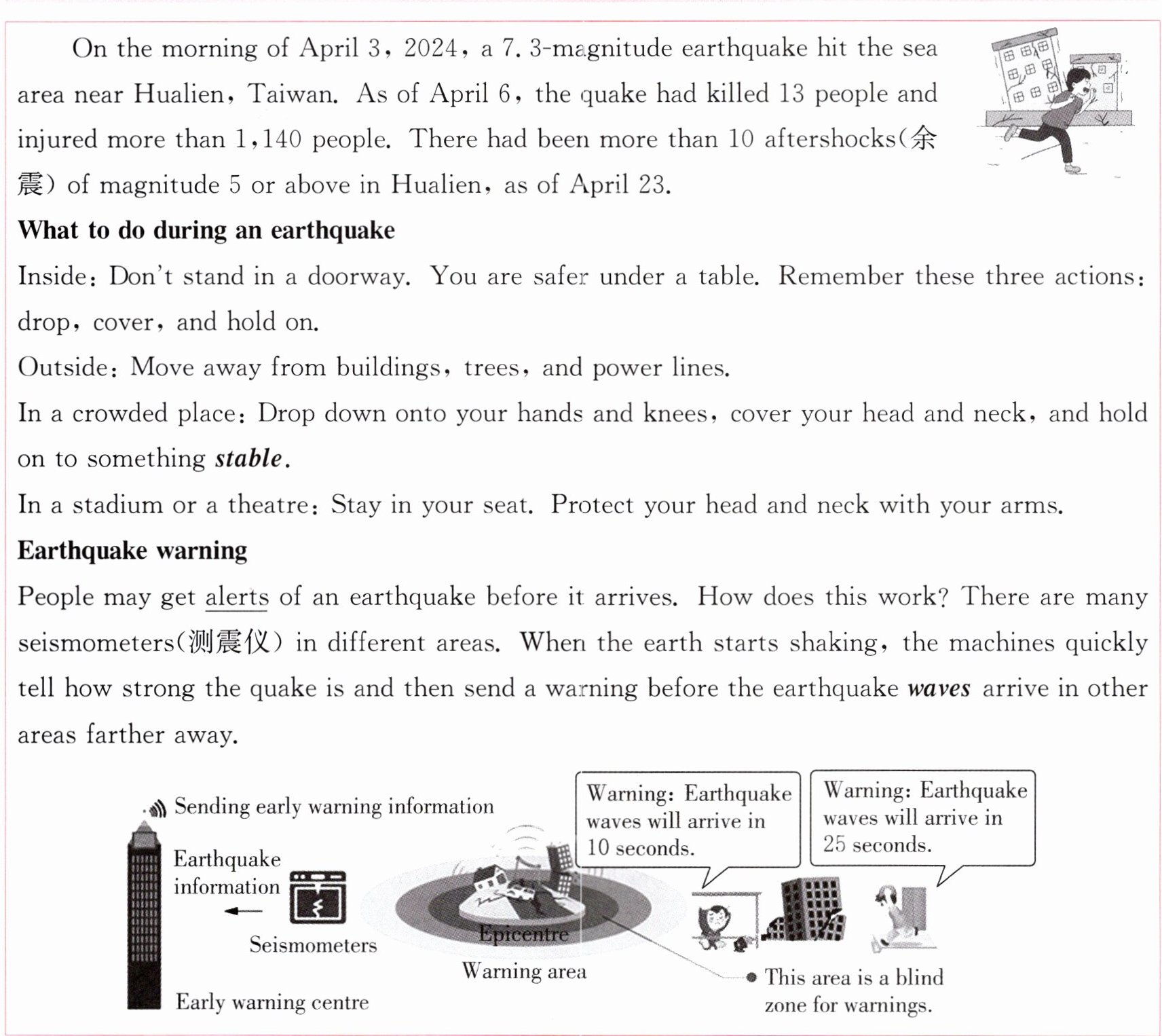
Earthquake warning
People may get alerts of an earthquake before it arrives. How does this work? There are many seismometers(测震仪) in different areas. When the earth starts shaking, the machines quickly tell how strong the quake is and then send a warning before the earthquake waves arrive in other areas farther away.
Sending early warning information
Earthquake information
Seismometers
Early warning centre
Epicentre
Warning area
Warning: Earthquake waves will arrive in 10 seconds.
Warning: Earthquake waves will arrive in 25 seconds.
● This area is a blind zone for warnings.
(
A. The result of the earthquake in Taiwan.
B. The causes of the earthquake in Taiwan.
C. The aftershocks in Taiwan.
D. The earthquake warning in Taiwan.
(

A
B
C
D
(
A. messages B. notes C. actions D. warnings
(
A. No matter where you are, protect yourself during an earthquake.
B. Seismometers can tell people how strong the quake is.
C. Every area can get warnings from the epicentre.
D. Earthquake waves first arrive at the nearest place.
(
A. Sports. B. Health. C. Life. D. Business.
A 新模态 复合型文本
KEY→P3
范畴:人与自然 主题:灾害防范 体裁:应用文 难度:★★★ 建议用时:6分钟 评价:
5
/5On the morning of April 3, 2024, a 7.3-magnitude earthquake hit the sea area near Hualien, Taiwan. As of April 6, the quake had killed 13 people and injured more than 1,140 people. There had been more than 10 aftershocks(余震) of magnitude 5 or above in Hualien, as of April 23.
What to do during an earthquake
Inside: Don't stand in a doorway. You are safer under a table. Remember these three actions: drop, cover, and hold on.
Outside: Move away from buildings, trees, and power lines.
In a crowded place: Drop down onto your hands and knees, cover your head and neck, and hold on to something stable.
In a stadium or a theatre: Stay in your seat. Protect your head and neck with your arms.
Earthquake warning
People may get alerts of an earthquake before it arrives. How does this work? There are many seismometers(测震仪) in different areas. When the earth starts shaking, the machines quickly tell how strong the quake is and then send a warning before the earthquake waves arrive in other areas farther away.
Sending early warning information
Earthquake information
Seismometers
Early warning centre
Epicentre
Warning area
Warning: Earthquake waves will arrive in 10 seconds.
Warning: Earthquake waves will arrive in 25 seconds.
● This area is a blind zone for warnings.
(
A
)1. What is the first paragraph mainly about?A. The result of the earthquake in Taiwan.
B. The causes of the earthquake in Taiwan.
C. The aftershocks in Taiwan.
D. The earthquake warning in Taiwan.
(
B
)2. 新考法·图片理解 What should you do when an earthquake happens?A
B
C
D
(
D
)3. The underlined word “alerts” here means “” in English.A. messages B. notes C. actions D. warnings
(
C
)4. Which of the following is NOT true according to the passage?A. No matter where you are, protect yourself during an earthquake.
B. Seismometers can tell people how strong the quake is.
C. Every area can get warnings from the epicentre.
D. Earthquake waves first arrive at the nearest place.
(
C
)5. 新考法·出处推断 In which part of a newspaper can you probably read this passage?A. Sports. B. Health. C. Life. D. Business.
答案
阅读理解A
本文主要讲了台湾的一次地震及发生地震时我们应采取的措施,并解释了地震预警系统的工作原理。
1. A 段落大意题。第一段主要讲了发生在台湾的地震所造成的严重后果。
2. B 图片理解题。由“Drop down onto your hands and knees, cover your head and neck, and hold on to something stable.”可知,地震发生时,我们应该蹲下,护住头和脖子并抓住牢固的东西。
3. D 词义猜测题。人们可能会在地震到来之前收到地震警报。
4. C 推理判断题。由图中的“This area is a blind zone for warnings.”可知,有些区域是地震预警的盲区。
5. C 出处推断题。本文主要讲了台湾的一次地震及发生地震时我们应该怎么做,属于“生命”范畴。
本文主要讲了台湾的一次地震及发生地震时我们应采取的措施,并解释了地震预警系统的工作原理。
1. A 段落大意题。第一段主要讲了发生在台湾的地震所造成的严重后果。
2. B 图片理解题。由“Drop down onto your hands and knees, cover your head and neck, and hold on to something stable.”可知,地震发生时,我们应该蹲下,护住头和脖子并抓住牢固的东西。
3. D 词义猜测题。人们可能会在地震到来之前收到地震警报。
4. C 推理判断题。由图中的“This area is a blind zone for warnings.”可知,有些区域是地震预警的盲区。
5. C 出处推断题。本文主要讲了台湾的一次地震及发生地震时我们应该怎么做,属于“生命”范畴。
解析
【分析】
本文是关于台湾地震及地震应对、预警的应用文,需结合各题考点定位原文信息:1题考查第一段主旨,需概括段落核心内容;2题图片理解对应拥挤场所的地震应对;3题词义猜测结合上下文预警相关表述;4题推理判断需对比原文与选项;5题出处推断结合文章主题所属范畴。
【解析】
1. 段落大意题:第一段介绍2024年4月台湾花莲附近海域7.3级地震的伤亡及余震情况,即地震的结果,故选A。
2. 图片理解题:根据文中“In a crowded place: Drop down onto your hands and knees, cover your head and neck, and hold on to something stable.”可知,地震发生在拥挤场所时应采取的措施,对应选项B。
3. 词义猜测题:结合后文“Earthquake warning”及“send a warning”可知,此处“alerts”意为“警报”,对应选项D(warnings)。
4. 推理判断题:根据文中插图说明“This area is a blind zone for warnings.”可知,存在预警盲区,并非所有区域都能收到预警,故C项错误;A项(地震时各处需保护)、B项(测震仪可测地震强度)、D项(震波先到最近处)均符合文意,故选C。
5. 出处推断题:本文围绕地震灾害防范及应对措施展开,属于生活范畴,应出自报纸的生活板块,故选C。
【答案】
1.A 2.B 3.D 4.C 5.C
【知识点】
阅读理解(段落大意)、词义猜测、推理判断
【点评】
本文是关于地震灾害防范的应用文,考查学生对段落主旨、词义猜测、推理判断等阅读技能的运用,结合实际生活场景,难度适中,注重信息定位与理解能力的考查。
【难度系数】
0.6
本文是关于台湾地震及地震应对、预警的应用文,需结合各题考点定位原文信息:1题考查第一段主旨,需概括段落核心内容;2题图片理解对应拥挤场所的地震应对;3题词义猜测结合上下文预警相关表述;4题推理判断需对比原文与选项;5题出处推断结合文章主题所属范畴。
【解析】
1. 段落大意题:第一段介绍2024年4月台湾花莲附近海域7.3级地震的伤亡及余震情况,即地震的结果,故选A。
2. 图片理解题:根据文中“In a crowded place: Drop down onto your hands and knees, cover your head and neck, and hold on to something stable.”可知,地震发生在拥挤场所时应采取的措施,对应选项B。
3. 词义猜测题:结合后文“Earthquake warning”及“send a warning”可知,此处“alerts”意为“警报”,对应选项D(warnings)。
4. 推理判断题:根据文中插图说明“This area is a blind zone for warnings.”可知,存在预警盲区,并非所有区域都能收到预警,故C项错误;A项(地震时各处需保护)、B项(测震仪可测地震强度)、D项(震波先到最近处)均符合文意,故选C。
5. 出处推断题:本文围绕地震灾害防范及应对措施展开,属于生活范畴,应出自报纸的生活板块,故选C。
【答案】
1.A 2.B 3.D 4.C 5.C
【知识点】
阅读理解(段落大意)、词义猜测、推理判断
【点评】
本文是关于地震灾害防范的应用文,考查学生对段落主旨、词义猜测、推理判断等阅读技能的运用,结合实际生活场景,难度适中,注重信息定位与理解能力的考查。
【难度系数】
0.6
