

 登录
A
(2026·武汉模拟) What time is it? That's a very good question! From morning until night, clocks help us to plan our day. They tell us when things begin and end.
Before clocks, our ancestors used a special tool called a sundial to tell time. They placed a stick upright on a flat plate. As the Sun moved across the sky, the stick's shadow moved around the plate. In the morning, the shadow was long and pointed to one side. At noon, it was short and pointed straight ahead. In the late afternoon, it grew long again on the other side. The sundial helped them know when to work, when to eat, and when to rest.
Today, we know that the Sun doesn't move around the Earth. The Earth turns on an imaginary line called an axis(轴). As the Earth turns, the Sun seems to be moving across the sky. The time the Earth takes to make one complete turn is one day.
The Earth is divided into 24 time zones. Each time zone is one hour apart from the next time zone. For example, when it is 10:00 a.m. where you live, it is 10:00 p.m. on the opposite side of the world. In two hours, it will be noon where you live, but on the other side of the world, it will be 12:00 at night!
Thanks to clocks and calendars, we can tell time very easily. However, it is the movement of the Earth that really allows us to measure time.
1. 新考法 图示理解 What does a sundial look like?
A.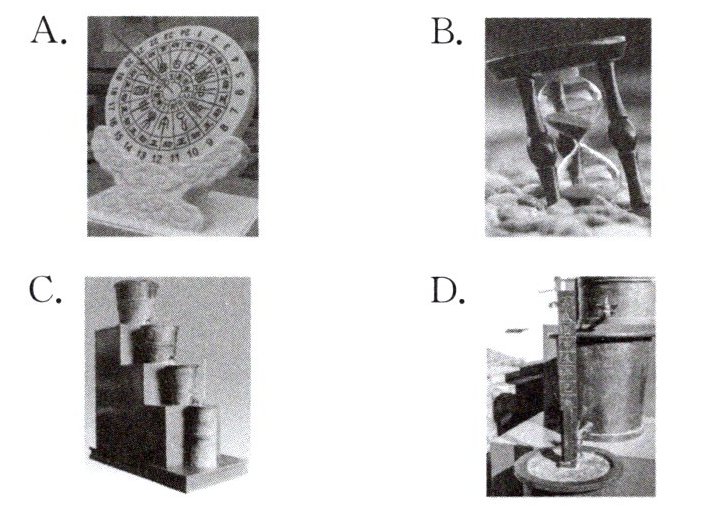
2. What did people in the past believe about time?
A. The Sun moves around the Earth.
B. The Earth turns on a hidden line.
C. The Earth is the centre of the universe.
D. The Earth travels around the Sun.
3. 新考法 补全文章 Which of the following can be put in ★?
A. The Earth moves fast in space.
B. The Sun gives us light and heat.
C. The Earth takes one day to complete its turn.
D. Other movements of the Earth help us know time too.
4. What can be known about time zones according to Paragraph 5?
A. Neighbouring time zones are half an hour apart.
B. Places in the same time zone have the same clock time.
C. When it is 8:00 a.m. in Beijing, it is also 8:00 a.m. in Paris.
D. The time difference between two opposite time zones is 24 hours.
5. What is the passage mainly about?
A. The history of clocks and calendars.
B. How the Earth's movements tell time.
C. Different time zones around the world.
D. Why the Sun seems to move in the sky.
(2026·武汉模拟) What time is it? That's a very good question! From morning until night, clocks help us to plan our day. They tell us when things begin and end.
Before clocks, our ancestors used a special tool called a sundial to tell time. They placed a stick upright on a flat plate. As the Sun moved across the sky, the stick's shadow moved around the plate. In the morning, the shadow was long and pointed to one side. At noon, it was short and pointed straight ahead. In the late afternoon, it grew long again on the other side. The sundial helped them know when to work, when to eat, and when to rest.
Today, we know that the Sun doesn't move around the Earth. The Earth turns on an imaginary line called an axis(轴). As the Earth turns, the Sun seems to be moving across the sky. The time the Earth takes to make one complete turn is one day.
D
★ . The Earth travels around the Sun. And it needs lots of time to finish one trip. The time it takes is called a year because its orbit(轨道) around the Sun is very huge and long. To be very specific, it takes the Earth 365 days, 6 hours, 9 minutes, and 10 seconds to go around the Sun.The Earth is divided into 24 time zones. Each time zone is one hour apart from the next time zone. For example, when it is 10:00 a.m. where you live, it is 10:00 p.m. on the opposite side of the world. In two hours, it will be noon where you live, but on the other side of the world, it will be 12:00 at night!
Thanks to clocks and calendars, we can tell time very easily. However, it is the movement of the Earth that really allows us to measure time.
1. 新考法 图示理解 What does a sundial look like?
A.
2. What did people in the past believe about time?
A. The Sun moves around the Earth.
B. The Earth turns on a hidden line.
C. The Earth is the centre of the universe.
D. The Earth travels around the Sun.
3. 新考法 补全文章 Which of the following can be put in ★?
A. The Earth moves fast in space.
B. The Sun gives us light and heat.
C. The Earth takes one day to complete its turn.
D. Other movements of the Earth help us know time too.
4. What can be known about time zones according to Paragraph 5?
A. Neighbouring time zones are half an hour apart.
B. Places in the same time zone have the same clock time.
C. When it is 8:00 a.m. in Beijing, it is also 8:00 a.m. in Paris.
D. The time difference between two opposite time zones is 24 hours.
5. What is the passage mainly about?
A. The history of clocks and calendars.
B. How the Earth's movements tell time.
C. Different time zones around the world.
D. Why the Sun seems to move in the sky.
答案
1. A 2. A 3. D 4. B 5. B
【文章大意】本文是一篇科普说明文。文章先介绍古代人们依靠日晷计时;接着讲解地球自转让人们产生太阳在空中移动的视觉感受,地球自转一圈就是一天;然后介绍地球公转,公转一圈为一年;还介绍全球24个时区相关知识。
1 A 图示理解题。根据第二段“They placed a stick upright on a flat plate ... moved around the plate.”可知,日晷是在平坦的石板上竖立一根杆子,依靠杆子投射的影子判断时间,选择匹配该构造的图片。故选A。
2 A 细节理解题。根据第三段“Today, we know that the Sun doesn't move around the Earth.”可知,如今人类明白太阳并不是绕地球旋转,由此推断古时候人们认为太阳围绕地球运转。B、D项是现代科学认知;C项文中没有相关表述。故选A。
3 D 补全文章题。前文介绍地球自转,后文介绍地球绕太阳公转。D选项“地球的其他运动同样有助于我们了解时间”,承接自转话题,引出后文地球公转。A、B项和段落主旨无关;C项仅复述自转内容,无法引出公转。故选D。
4 B 细节理解题。根据第五段“Each time zone is one hour apart from the next time zone.”可知相邻时区相差一小时,同一时区的地区时钟时间相同。C北京与巴黎位于不同时区,时间不一样;D地球两端时区时差约12小时,并非24小时。故选B。
5 B 主旨大意题。根据文末“However, it is the movement of the Earth that really allows us to measure time.”,整篇文章主要介绍地球的各类运动如何用来计量时间。A钟表和日历发展史只是开篇引入;C时区只是段落局部信息;D只是文中一处细节,不能概括全文。故选B。
