

 登录
登录
五、新形式 立德树人·保护环境 阅读理解
 Are You Responsible for Your Clothes?
Do you often buy new clothes just because they are fashionable? What will you do with your old or unused clothes? Just throw them away? Or put them into the rubbish bin? These clothes go into landfills. This is bad for our world. Here is how you can help!
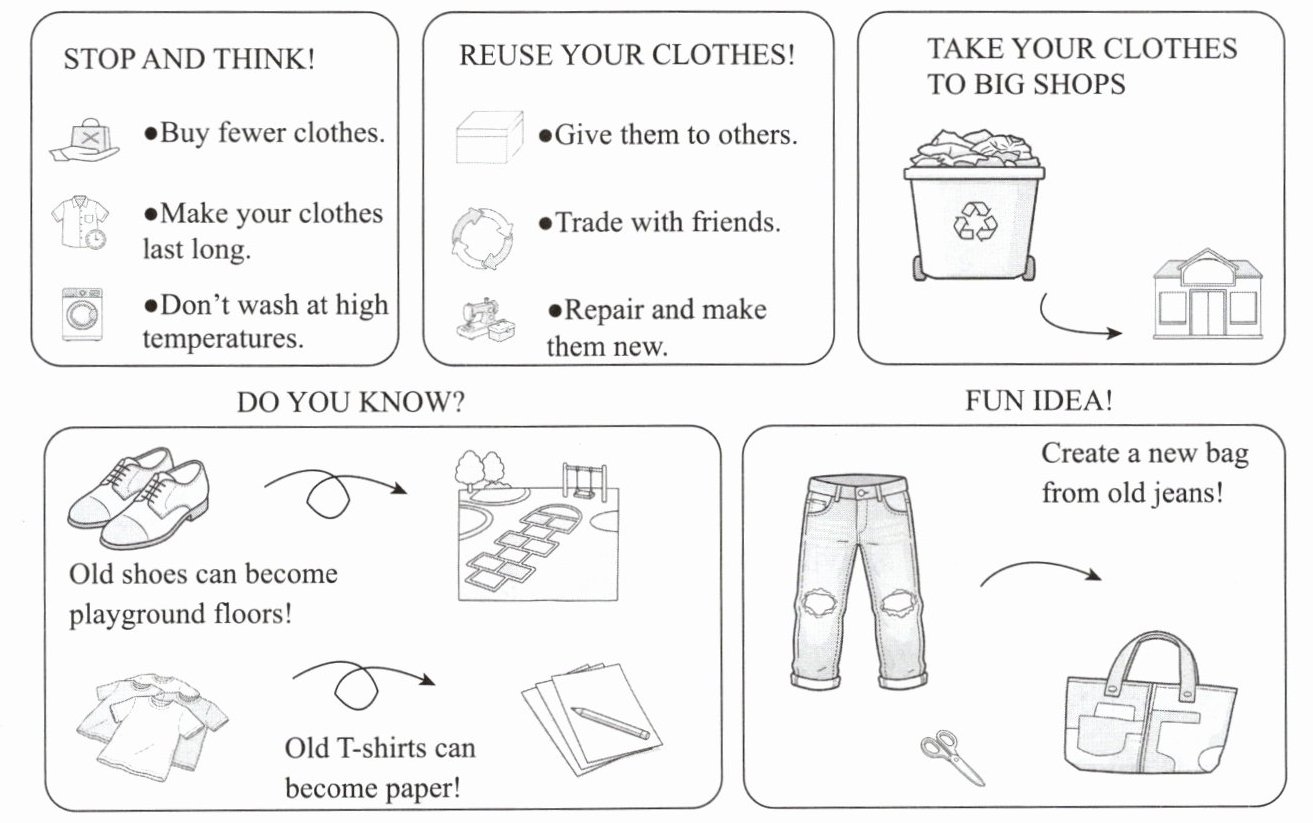
(
①Buy fewer clothes.
②Wash clothes in cool water.
③Repair our old clothes.
④Make paper out of T-shirts.
⑤Give them to those in need.
A. ①②③
B. ②③④
C. ②③⑤
D. ③④⑤
(
A. Big landfills.
B. Some small local shops nearby.
C. Neighbors' houses.
D. Big shops with textile recycling services.
(
A. Making old jeans into bags.
B. Taking old clothes to big shops.
C. Selling unused clothes online.
D. Putting old clothes into dustbins.
(
A. Old shoes.
B. Old T-shirts.
C. Old jeans.
D. Old bags.
(
A. Health.
B. Culture.
C. Environment.
D. Technology.
Are You Responsible for Your Clothes?Do you often buy new clothes just because they are fashionable? What will you do with your old or unused clothes? Just throw them away? Or put them into the rubbish bin? These clothes go into landfills. This is bad for our world. Here is how you can help!
(
D
)21. According to the text, what can we do to reuse or recycle our clothes?①Buy fewer clothes.
②Wash clothes in cool water.
③Repair our old clothes.
④Make paper out of T-shirts.
⑤Give them to those in need.
A. ①②③
B. ②③④
C. ②③⑤
D. ③④⑤
(
D
)22. Where should people take their clothes for textile(纺织品)recycling?A. Big landfills.
B. Some small local shops nearby.
C. Neighbors' houses.
D. Big shops with textile recycling services.
(
A
)23. What creative way to deal with clothes is mentioned in the text?A. Making old jeans into bags.
B. Taking old clothes to big shops.
C. Selling unused clothes online.
D. Putting old clothes into dustbins.
(
B
)24. According to the text, what can be turned into paper?A. Old shoes.
B. Old T-shirts.
C. Old jeans.
D. Old bags.
(
C
)25. 新考向·文章出处 In which part of a magazine can we read the text?A. Health.
B. Culture.
C. Environment.
D. Technology.
答案
21~25: DDABC
解析
【分析】
本题为环保主题的阅读理解题,解题思路是先明确文本围绕旧衣物处理与环保的核心,再针对每个题目定位文本细节,区分不同处理方式的属性,逐一匹配选项,最后判断文章所属板块,完成题目解答。
【解析】
21题:考查旧衣物重复利用/回收的方法。①“买更少衣服”属于减少消费,并非重复利用或回收;②“冷水洗衣”是衣物护理,与回收无关;③“修理旧衣服”、④“用T恤做纸”、⑤“捐赠给有需要的人”均属于重复利用/回收,对应选项D,故选D。
22题:考查纺织品回收的地点。文本提及纺织品回收需找有相关服务的场所,选项中“有纺织品回收服务的大商店”符合,故选D。
23题:考查创造性处理旧衣物的方式。文本提到的创造性方式为将旧牛仔裤制成包,对应选项A,故选A。
24题:考查可制成纸的衣物。文本明确旧T恤可制成纸,故选B。
25题:考查文章出处。文本围绕旧衣物处理对环境的影响展开,属于环保板块,故选C。
【答案】
21~25: DDABC
【知识点】
阅读理解、环保主题阅读、细节信息匹配
【点评】
本题结合环保主题,考查学生英语阅读理解的细节查找、信息筛选及文章出处判断能力,体现立德树人的教育理念,题型贴合初中英语阅读考查方向。
【难度系数】
0.6
本题为环保主题的阅读理解题,解题思路是先明确文本围绕旧衣物处理与环保的核心,再针对每个题目定位文本细节,区分不同处理方式的属性,逐一匹配选项,最后判断文章所属板块,完成题目解答。
【解析】
21题:考查旧衣物重复利用/回收的方法。①“买更少衣服”属于减少消费,并非重复利用或回收;②“冷水洗衣”是衣物护理,与回收无关;③“修理旧衣服”、④“用T恤做纸”、⑤“捐赠给有需要的人”均属于重复利用/回收,对应选项D,故选D。
22题:考查纺织品回收的地点。文本提及纺织品回收需找有相关服务的场所,选项中“有纺织品回收服务的大商店”符合,故选D。
23题:考查创造性处理旧衣物的方式。文本提到的创造性方式为将旧牛仔裤制成包,对应选项A,故选A。
24题:考查可制成纸的衣物。文本明确旧T恤可制成纸,故选B。
25题:考查文章出处。文本围绕旧衣物处理对环境的影响展开,属于环保板块,故选C。
【答案】
21~25: DDABC
【知识点】
阅读理解、环保主题阅读、细节信息匹配
【点评】
本题结合环保主题,考查学生英语阅读理解的细节查找、信息筛选及文章出处判断能力,体现立德树人的教育理念,题型贴合初中英语阅读考查方向。
【难度系数】
0.6
