

 登录
完形填空。
新课标 传统文化 Thousands of years ago, ancient Chinese people created “the 24 solar terms(节气)”. Regarded as “the fifth great invention of China”, it quickly 1 to Japan, Korea and Vietnam in history.
There 2 two solar terms every month, such as Start of Spring and Rain Water in February in 2025.
3 the 24 solar terms, Summer Solstice(夏至) and Winter Solstice are two days of the year with the 4 daytime and nighttime respectively(分别), while Spring Equinox(春分) and Autumn Equinox are days with the most balanced daytime and nighttime. The four solar terms divide a year into four 5.
The 24 solar terms show the 6 in climate, nature, farming and other fields of human life. In China, an idea goes that human beings should respect nature, or we would get 7. In ancient times, the 24 solar terms not only guided farming, gave an early 8 on weather conditions but also directed Chinese folk customs. And some later became 9 festivals. For example, on Winter Solstice, emperors would hold a ceremony(仪式) to worship, praying for good 10 for crops, peace and a bright future for the country.
Nowadays, the 24 solar terms still make a 11 to Chinese in everyday life. People sweep tombs to honor the 12 on Qingming Festival, 13 weight to keep warm at Start of Autumn and eat nutritious food to store energy at Start of Winter. At present, more and more cultural products and 14 about the 24 solar terms also come up, including creative and novel dishes, desserts and designs. And the 24 solar terms also become a good excuse to 15 time to reunite with relatives and friends.
The 24 solar terms reflect the emotional bond, the wisdom and creativity of the Chinese, which have a deep influence on the way people think and act.
(
(
(
(
(
(
(
(
(
(
(
(
(
(
(
新课标 传统文化 Thousands of years ago, ancient Chinese people created “the 24 solar terms(节气)”. Regarded as “the fifth great invention of China”, it quickly 1 to Japan, Korea and Vietnam in history.
There 2 two solar terms every month, such as Start of Spring and Rain Water in February in 2025.
3 the 24 solar terms, Summer Solstice(夏至) and Winter Solstice are two days of the year with the 4 daytime and nighttime respectively(分别), while Spring Equinox(春分) and Autumn Equinox are days with the most balanced daytime and nighttime. The four solar terms divide a year into four 5.
The 24 solar terms show the 6 in climate, nature, farming and other fields of human life. In China, an idea goes that human beings should respect nature, or we would get 7. In ancient times, the 24 solar terms not only guided farming, gave an early 8 on weather conditions but also directed Chinese folk customs. And some later became 9 festivals. For example, on Winter Solstice, emperors would hold a ceremony(仪式) to worship, praying for good 10 for crops, peace and a bright future for the country.
Nowadays, the 24 solar terms still make a 11 to Chinese in everyday life. People sweep tombs to honor the 12 on Qingming Festival, 13 weight to keep warm at Start of Autumn and eat nutritious food to store energy at Start of Winter. At present, more and more cultural products and 14 about the 24 solar terms also come up, including creative and novel dishes, desserts and designs. And the 24 solar terms also become a good excuse to 15 time to reunite with relatives and friends.
The 24 solar terms reflect the emotional bond, the wisdom and creativity of the Chinese, which have a deep influence on the way people think and act.
(
B
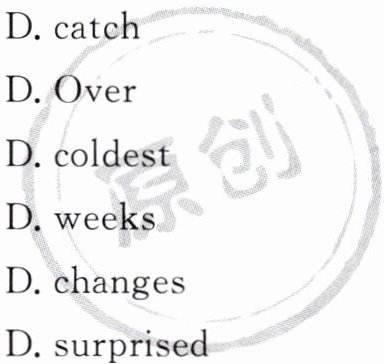
)1. A. introduced B. spread C. set D. hit(
A
)2. A. lie B. act C. break D. catch(
C
)3. A. On B. Between C. Among D. Over(
C
)4. A. shortest B. hottest C. longest D. coldest(
A
)5. A. seasons B. days C. months D. weeks(
D
)6. A. wonders B. competitions C. rules D. changes(
A
)7. A. punished B. hurt C. lost D. surprised(
D
)8. A. reply B. record C. start D. warn(
B
)9. A. personal B. traditional C. criminal D. physical(
C
)10. A. place B. color C. weather D. water(
B
)11. A. wish B. difference C. decision D. living(
C
)12. A. old B. rich C. dead D. poor(
D
)13. A. take off B. look for C. keep from D. put on(
A
)14. A. businesses B. discoveries C. communications D. difficulties(
B
)15. A. buy B. steal C. sell D. save答案
1. B
2. A
3. C
4. C
5. A
6. D
7. A
8. D
9. B
10. C
11. B
12. C
13. D
14. A
15. B
解析
【分析】
这是一篇围绕中国传统文化“二十四节气”的完形填空,需结合语境、词汇辨析及固定搭配逐一解题:
1. 第1题:根据“传播到日本、韩国等国家”的语境,“spread to”表示“传播到”,符合要求;
2. 第2题:“there lie”是固定句型,意为“存在”,对应“每个月有两个节气”的表述;
3. 第3题:“among”用于三者及以上之间,24个节气属于三者以上,符合介词用法;
4. 第4题:夏至是一年中白天最长的节气,对应形容词最高级“longest”;
5. 第5题:四个节气将一年分为四季,“seasons”符合逻辑;
6. 第6题:二十四节气体现气候等领域的变化,“changes”贴合语境;
7. 第7题:结合“尊重自然”的理念,不尊重自然会被“惩罚”,“punished”符合;
8. 第8题:古代节气能提前“警告”天气情况,“warn”符合;
9. 第9题:部分节气后来演变成传统节日,“traditional”符合;
10. 第10题:帝王祭祀祈求好“天气”,“weather”贴合语境;
11. 第11题:“make a difference”是固定搭配,意为“有影响”,符合节气对生活的作用;
12. 第12题:清明节是纪念“死者”的节日,“dead”符合;
13. 第13题:立秋“贴秋膘”对应“put on weight”(增肥);
14. 第14题:文化产品和商业相关,“businesses”符合;
15. 第15题:“steal time”表示“挤时间”,符合和亲友团聚的语境。
【解析】
1. 考查动词辨析:spread意为“传播”,符合节气向其他国家传播的语境,故选B;
2. 考查固定句型:there lie表示“存在”,是固定用法,故选A;
3. 考查介词辨析:among用于三者及以上之间,24个节气是三者以上,故选C;
4. 考查形容词最高级:夏至是一年中白天最长的,longest符合,故选C;
5. 考查名词辨析:四个节气将一年分为四季,seasons符合,故选A;
6. 考查名词辨析:changes意为“变化”,节气体现各领域的变化,故选D;
7. 考查动词辨析:punished意为“被惩罚”,符合不尊重自然的后果,故选A;
8. 考查动词辨析:warn意为“警告”,节气可提前预警天气,故选D;
9. 考查形容词辨析:traditional意为“传统的”,节气演变成传统节日,故选B;
10. 考查名词辨析:weather意为“天气”,祭祀祈求好天气,故选C;
11. 考查固定搭配:make a difference意为“有影响”,节气对现代生活仍有影响,故选B;
12. 考查形容词辨析:the dead意为“死者”,清明节纪念死者,故选C;
13. 考查动词短语辨析:put on weight意为“增肥”,对应立秋习俗,故选D;
14. 考查名词辨析:businesses意为“商业”,文化产品和商业相关,故选A;
15. 考查动词辨析:steal time意为“挤时间”,符合团聚的语境,故选B。
【答案】
1.B 2.A 3.C 4.C 5.A 6.D 7.A 8.D 9.B 10.C 11.B 12.C 13.D 14.A 15.B
【知识点】
动词辨析、介词辨析、固定搭配
【点评】
本题以中国传统文化“二十四节气”为载体,考察词汇辨析、固定搭配及语境理解能力,兼具知识性与文化性,能帮助学生了解传统文化的同时巩固英语知识。
【难度系数】
0.5
