

 登录
登录
A. 阅读短文,补全表格。
Politeness helps us communicate better. When we are little kids, our parents and teachers teach us to say "please" "thank you" "excuse me" and "sorry". They know politeness is important for our development. For an English learner, it's also a good idea to learn polite expressions. Here is some advice for you.
★Use modal verbs(情态动词)
When we use modal verbs, like would, could or may, we can change a direct question into a polite request. For example, when we say "Pass me the salt.", we can say "Could you please pass me the salt?" When we say "Where is the bookstore?", we can say "Could you please show me where the bookstore is?"
★Change the grammar
This way may be strange but it's true. In order to be politer, speakers often change the tense. In English, the simple present tense sounds too direct, so speakers change the present tense into the past tense. For example, when we say "Do you have time tomorrow?", we can say "I wondered if you had time tomorrow."
★Adapt to different situations
Polite language works best when it fits the situation. A useful structure for small talk is tag questions—a short question added to the end of a sentence. Tag questions not only make small talk more natural, but also help keep conversations polite and friendly in different situations.
Polite actions are also important because they can make us feel confident and improve the relationship with others. So let's be polite and be a better person!
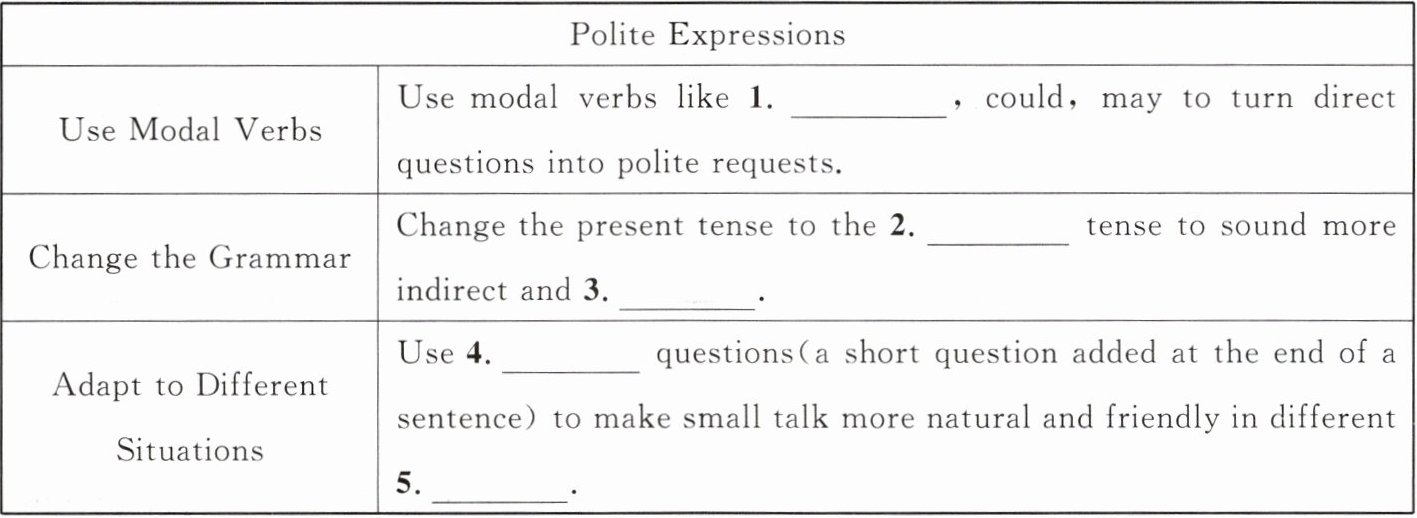
Polite Expressions
| Use Modal Verbs | Use modal verbs like 1. , could, may to turn direct questions into polite requests. |
| --- | --- |
| Change the Grammar | Change the present tense to the 2. tense to sound more indirect and 3. . |
| Adapt to Different Situations | Use 4. questions(a short question added at the end of a sentence) to make small talk more natural and friendly in different 5. . |
Politeness helps us communicate better. When we are little kids, our parents and teachers teach us to say "please" "thank you" "excuse me" and "sorry". They know politeness is important for our development. For an English learner, it's also a good idea to learn polite expressions. Here is some advice for you.
★Use modal verbs(情态动词)
When we use modal verbs, like would, could or may, we can change a direct question into a polite request. For example, when we say "Pass me the salt.", we can say "Could you please pass me the salt?" When we say "Where is the bookstore?", we can say "Could you please show me where the bookstore is?"
★Change the grammar
This way may be strange but it's true. In order to be politer, speakers often change the tense. In English, the simple present tense sounds too direct, so speakers change the present tense into the past tense. For example, when we say "Do you have time tomorrow?", we can say "I wondered if you had time tomorrow."
★Adapt to different situations
Polite language works best when it fits the situation. A useful structure for small talk is tag questions—a short question added to the end of a sentence. Tag questions not only make small talk more natural, but also help keep conversations polite and friendly in different situations.
Polite actions are also important because they can make us feel confident and improve the relationship with others. So let's be polite and be a better person!
Polite Expressions
| Use Modal Verbs | Use modal verbs like 1. , could, may to turn direct questions into polite requests. |
| --- | --- |
| Change the Grammar | Change the present tense to the 2. tense to sound more indirect and 3. . |
| Adapt to Different Situations | Use 4. questions(a short question added at the end of a sentence) to make small talk more natural and friendly in different 5. . |
答案
【解析】:我们可以根据短文对应内容逐空定位答案:
1. 定位到"Use modal verbs"部分的第一句"When we use modal verbs, like would, could or may, we can change a direct question into a polite request.",可知此处列举的情态动词包含would。
2. 定位到"Change the grammar"部分的"In English, the simple present tense sounds too direct, so speakers change the present tense into the past tense.",可知需要把现在时改为过去时。
3. 该部分提到改变时态的目的是为了更礼貌,把现在时改为过去时可以让表达听起来更间接、更礼貌,此处和more indirect并列,填入polite,构成more polite,符合语义和语法规则。
4. 定位到"Adapt to Different Situations"部分的"A useful structure for small talk is tag questions—a short question added to the end of a sentence.",可知此处描述的是反意疑问句tag questions。
5. 定位到"Tag questions not only make small talk more natural, but also help keep conversations polite and friendly in different situations.",可知此处对应填入situations。
【答案】:1. would
2. past
3. polite
4. tag
5. situations
1. 定位到"Use modal verbs"部分的第一句"When we use modal verbs, like would, could or may, we can change a direct question into a polite request.",可知此处列举的情态动词包含would。
2. 定位到"Change the grammar"部分的"In English, the simple present tense sounds too direct, so speakers change the present tense into the past tense.",可知需要把现在时改为过去时。
3. 该部分提到改变时态的目的是为了更礼貌,把现在时改为过去时可以让表达听起来更间接、更礼貌,此处和more indirect并列,填入polite,构成more polite,符合语义和语法规则。
4. 定位到"Adapt to Different Situations"部分的"A useful structure for small talk is tag questions—a short question added to the end of a sentence.",可知此处描述的是反意疑问句tag questions。
5. 定位到"Tag questions not only make small talk more natural, but also help keep conversations polite and friendly in different situations.",可知此处对应填入situations。
【答案】:1. would
2. past
3. polite
4. tag
5. situations
