

 登录
登录
二、阅读还原
The Secret Language of Nature
Have you ever noticed that nature has its own way of “talking”? Animals and plants cannot speak like us, but they send messages in other ways. 1. For example, have you seen birds flying together in a V-shape? 2. By flying this way, they can save energy. The birds in front work the hardest, while those behind enjoy less wind resistance. When the leader gets tired, it falls back, and another bird takes its place.
Plants also have their own “language”. 3. When insects start eating a tree’s leaves, the tree sends out a special chemical. This chemical “tells” other trees nearby to produce something that tastes bad to insects. In this way, they help each other survive.
Even the weather follows nature's signs. Before a storm arrives, you might notice ants moving quickly to higher ground. 4. For centuries, people have looked at the sky, watched animals, and read these signs to predict what's coming.
5. The next time you go for a walk, try to “listen” to what nature is saying. You might be surprised by how much you can understand!
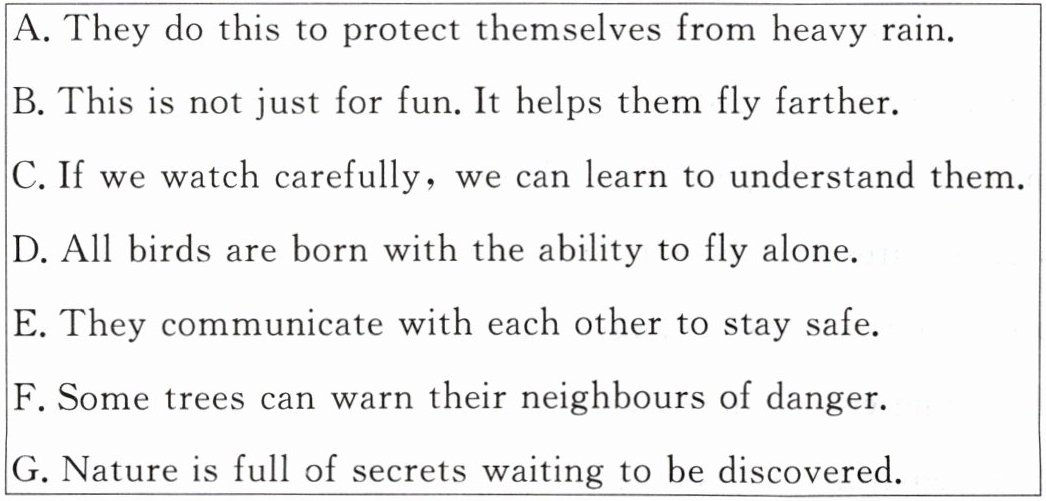
A. They do this to protect themselves from heavy rain.
B. This is not just for fun. It helps them fly farther.
C. If we watch carefully, we can learn to understand them.
D. All birds are born with the ability to fly alone.
E. They communicate with each other to stay safe.
F. Some trees can warn their neighbours of danger.
G. Nature is full of secrets waiting to be discovered.
The Secret Language of Nature
Have you ever noticed that nature has its own way of “talking”? Animals and plants cannot speak like us, but they send messages in other ways. 1. For example, have you seen birds flying together in a V-shape? 2. By flying this way, they can save energy. The birds in front work the hardest, while those behind enjoy less wind resistance. When the leader gets tired, it falls back, and another bird takes its place.
Plants also have their own “language”. 3. When insects start eating a tree’s leaves, the tree sends out a special chemical. This chemical “tells” other trees nearby to produce something that tastes bad to insects. In this way, they help each other survive.
Even the weather follows nature's signs. Before a storm arrives, you might notice ants moving quickly to higher ground. 4. For centuries, people have looked at the sky, watched animals, and read these signs to predict what's coming.
5. The next time you go for a walk, try to “listen” to what nature is saying. You might be surprised by how much you can understand!
A. They do this to protect themselves from heavy rain.
B. This is not just for fun. It helps them fly farther.
C. If we watch carefully, we can learn to understand them.
D. All birds are born with the ability to fly alone.
E. They communicate with each other to stay safe.
F. Some trees can warn their neighbours of danger.
G. Nature is full of secrets waiting to be discovered.
答案
1. C 2. B 3. F 4. A 5. G
解析
我们逐空结合上下文逻辑分析:
1. 空前点明动植物无法像人类一样说话,却能用其他方式传递信息,空后开始列举鸟类行为的相关例子,C选项“如果我们仔细观察,就能学着理解它们”可以承上启下,符合语境。
2. 空前提到鸟类会排成V形飞行,空后解释这种飞行模式可以节省能量,B选项“这不只是为了好玩,它能帮助它们飞得更远”衔接前后内容,对应后文节省能量的作用。
3. 空前说明植物也有自己的“语言”,空后介绍树木被昆虫啃食时,会释放特殊化学物质通知周边树木的生存机制,F选项“一些树可以警告它们的邻居有危险”精准对应后文内容,符合语境。
4. 空前提到暴风雨来临前蚂蚁会快速移动到高处,A选项“它们这么做是为了保护自己不被大雨伤害”解释了蚂蚁该行为的原因,衔接自然。
5. 空后呼吁大家散步时试着“倾听”自然传递的信息,G选项“自然充满了等待被发现的秘密”引出后文的倡议,契合全文收尾的逻辑。
1. 空前点明动植物无法像人类一样说话,却能用其他方式传递信息,空后开始列举鸟类行为的相关例子,C选项“如果我们仔细观察,就能学着理解它们”可以承上启下,符合语境。
2. 空前提到鸟类会排成V形飞行,空后解释这种飞行模式可以节省能量,B选项“这不只是为了好玩,它能帮助它们飞得更远”衔接前后内容,对应后文节省能量的作用。
3. 空前说明植物也有自己的“语言”,空后介绍树木被昆虫啃食时,会释放特殊化学物质通知周边树木的生存机制,F选项“一些树可以警告它们的邻居有危险”精准对应后文内容,符合语境。
4. 空前提到暴风雨来临前蚂蚁会快速移动到高处,A选项“它们这么做是为了保护自己不被大雨伤害”解释了蚂蚁该行为的原因,衔接自然。
5. 空后呼吁大家散步时试着“倾听”自然传递的信息,G选项“自然充满了等待被发现的秘密”引出后文的倡议,契合全文收尾的逻辑。
